
Sunday, November 14, 2010
Royal Rhododendrons
I just discovered that there are beautiful Belgian azalea hybrids named after King Albert I and Queen Elisabeth and King Leopold III and Queen Astrid. Charming!


Saturday, November 13, 2010
A Talk with General von Falkenhausen

In 1960, Jo Gérard, author of a number of popular works on the Belgian monarchy and the Royal Question, interviewed General Alexander von Falkenhausen, military governor of Belgium during the Nazi occupation, at his chalet in Nassau. As governor, Falkenhausen had attempted to moderate the Germans' treatment of the Belgians. Towards the end of the war, he was even dismissed from his post and imprisoned by the Nazis for conspiring against Hitler. Nevertheless, after Germany's defeat, the General was put on trial by the Allies and sentenced to 12 years' imprisonment for atrocities committed during the Nazi occupation of Belgium. A few weeks into his sentence, however, he was released, after overwhelming evidence came to light that he had tried to save as many Belgian and Jewish lives as possible. As he left Belgium, where he had been imprisoned, and crossed the border into Germany, he told a group of journalists: "Ungrateful Belgium, you shall not have my bones." Nine years later, Jo Gérard would visit this veteran Prussian aristocrat and warrior, wittily remarking: "Instead of your bones, I come to ask for your memories." The interview covered many topics, spanning across the General's entire life. I was especially interested by Falkenhausen's thoughts on the Belgian royal family. During his imprisonment by the Allies, the General related, he was pressured to testify falsely against Leopold III:
-Does General von Falkenhausen have a testimony to add to the dossier, already so voluminous, of the Royal Question?
- In the prison camp where I had been interned, I received, on September 10, 1945, a visit from two delegates of the Belgian judicial authorities, or, at least, these policemen introduced themselves as such. They said to me: "You were at Laeken Castle, on the night of June 6-7, which preceded the day of the deportation of King Leopold? "Yes," I answered. The two men then asked: "Is it true that the Sovereign, to manifest the joy this decision caused him, drank, in your company, a bottle of champagne, since he was so happy to become a 'martyr of patriotism' in the eyes of his people and the Allies?" I answered, without hiding my astonishment: "Champagne? Certainly not! We drank nothing, the King and I." They told me: "But a palace lackey is definite, you drank champagne, that night; this man remembers it all the better, since he served it to you himself!" I retorted to the two policemen: "Confront me with this 'lackey'". They were silent; then, one of them murmured: "He's dead..."
Thursday, November 11, 2010
Remembrance Day

(Photo credit)
Tuesday, November 9, 2010
New Pages
Some may have noticed that I have removed from the sidebar the lists of links to posts on the different Belgian kings and queens. I have moved these lists of links to separate, stand-alone pages which can still be accessed from the sidebar, just under "A Note on Reviews." I hope this will make the right column of the blog a little less long and complicated.
Sunday, November 7, 2010
The Marriage of King Leopold III and Queen Astrid
On November 4, 1926, Prince Leopold of Belgium (1901-1983), eldest son and heir of King Albert I and Queen Elisabeth, married Princess Astrid of Sweden (1905-1935), niece of King Gustav V, in a civil ceremony in Stockholm. On November 10, the religious wedding would follow in Brussels. Both handsome, shy, sensitive, thoughtful, and noble people, Leopold and Astrid had fallen passionately in love. Since Astrid was still a Lutheran, however, a papal dispensation was required for the marriage. (Interestingly, it was the mirror image of the union of King Leopold I and Queen Louise-Marie, where the groom was Protestant and the bride Catholic). The princess also had to promise to raise her children in the Catholic Faith. Both her sons, Baudouin (1930-1993) and Albert (1934-), would become Kings of the Belgians, while her daughter, Josephine-Charlotte (1927-2005), became Grand Duchess of Luxembourg.
Here is a beautiful video on the marriage of Leopold and Astrid, incorporating archival footage of the happy young couple:
Here are some related posts:
~ Photographs of the young couple
~Description of their civil wedding in Stockholm
~ A first-hand account of their idyll, by a friend of the royal family
~ Leopold's accession to the throne
~ Astrid's charity work
~Astrid's conversion to Catholicism, in 1930
~Astrid's death
~The legend of the tragically lost Queen
Friday, November 5, 2010
Catherine of Aragon: Henry's Spanish Queen

Wednesday, November 3, 2010
November 3, 1901: The Birth of Leopold III

~Queen Elisabeth
On this day in 1901, the future Leopold III, King of the Belgians, was born in Brussels. Named Léopold Philippe Charles Albert Meinrad Hubert Marie Miguel, he was the first child of Prince Albert of Belgium and his bride, Duchess Elisabeth in Bavaria. In looks and personality, Leopold would prove to be a perfect blend of both parents, mingling his father's kindness and intellect with his mother's grace and charm. His notorious great-uncle, King Leopold II, usually a cold, distant man, was overjoyed at his arrival, as no male heirs had been born in the royal family for many years. On June 7, 1902, the little prince was baptized at the Church of St. Jacques-sur-Coudenberg, where his funeral would be held in 1983. The King was his godfather.

Tuesday, November 2, 2010
Feast of All Souls

The Day of the Dead (1859) by William Bougereau
Out of the depths I have cried to thee, O Lord: Lord, hear my voice. Let thy ears be attentive to the voice of my supplication. If thou, O Lord, wilt mark iniquities: Lord, who shall stand it. For with thee there is merciful forgiveness: and by reason of thy law, I have waited for thee, O Lord. My soul hath relied on his word: My soul hath hoped in the Lord.
From the morning watch even until night, let Israel hope in the Lord. Because with the Lord there is mercy: and with him plentiful redemption. And he shall redeem Israel from all his iniquities (Psalm 129, Douay-Rheims Version)
Eternal Father, I offer Thee the Most Precious Blood of Thy Divine Son, Jesus, in union with the Masses said throughout the world today, for all the Holy Souls in Purgatory, for sinners everywhere, for sinners in the universal Church, those in my own home and within my family.
Monday, November 1, 2010
Prince Albert of Saxe-Coburg and Gotha
A magnificent if melancholy tribute to the consort of Queen Victoria. In looks, personality and sad destiny, he reminds me of his Belgian cousin, King Albert I. (The Belgian Albert was blond, though).
The Family of Leopold I
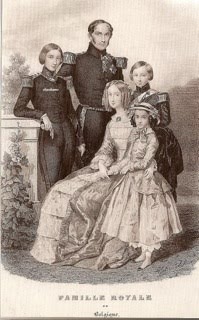
Leopold I, King of the Belgians (1790-1865) had several families. By Charlotte Augusta of Wales (1796-1817), he had two babies, lost to miscarriage, and a son who died at birth, followed shortly thereafter by his mother. By Louise-Marie of Orléans (1812-1850), Leopold had four children: Prince Louis-Philippe, Crown Prince of Belgium (1833-1834), Leopold II, King of the Belgians (1835-1909), Prince Philippe, Count of Flanders (1837-1905) and Princess Charlotte, Empress of Mexico (1840-1927). In his later years, by his young, brash and unpopular favorite, Arcadie Claret Meyer, the King has been alleged to have had two sons, George and Arthur, who were both created Barons von Eppinghoven.
The Exiled Belgian Royalist gives interesting summaries of the lives of Leopold's children by Queen Louise. Their three surviving offspring, Leopold II, Prince Philippe and Empress Carlota were all very different personalities. Leopold II had the intelligence and satirical eye of both parents. He possessed his father's political shrewdness, financial sense and ambition, albeit, unfortunately, without his tact and charm. A tireless colonial imperialist and builder of monuments, Leopold II may have inherited his insistence on grandeur partly from his mother, although he sadly lacked her counterbalancing humility and sweetness. Queen Louise complained of the Belgians' petty ways; her son, however much one may dislike many of his methods, undeniably strove, as he saw it, to make Belgium great.
By contrast, Leopold's brother Philippe had Louise's retiring manner, her love of home and family, her propriety and piety. Despite his admirable traits, however, I have to admit that I find him less interesting than his more dynamic brother and sister. It is Carlota whom I probably find to be the most appealing of the siblings. She seems to have united so many of the best qualities of the first King of the Belgians and his Queen; beauty, brilliance, grand aspirations, energy, determination and charisma, but also kindness, gentleness and charity. What a pity her promising life was so tragically marred.
Subscribe to:
Posts (Atom)


