

Showing posts with label louise-marie. Show all posts
Showing posts with label louise-marie. Show all posts
Sunday, January 19, 2014
Roses and the Queen


A Gentle Queen

From History and Other Thoughts comes this charming description of the first Queen of the Belgians, Louise d'Orléans, by her husband, Leopold I. The King was writing to his niece, Queen Victoria, who became close friends with Louise.
She is extremely gentle and amiable, her actions are always guided by principles. She is at all times ready and disposed to sacrifice her comfort and inclinations to see others happy. She values goodness, merit, and virtue much more than beauty, riches, and amusements. With all this she is highly informed and very clever; she speaks and writes English, German and Italian; she speaks English very well indeed. In short, my dear Love, you see that I may well recommend her as an example for all young ladies, being Princesses or not.
Now to her appearance. She is about Feodore's [Victoria's half-sister's] height, her hair very fair, light blue eyes, of a very gentle, intelligent and kind expression. A Bourbon nose and small mouth. The figure is much like Feodore's but rather less stout. She rides very well, which she proved to my great alarm the other day, by keeping her seat though a horse of mine ran away with her full speed for at least half a mile. What she does particularly well is dancing. Music unfortunately she is not very fond of, though she plays on the harp; I believe there is some idleness in the case. There exists already great confidence and affection between us; she is desirous of doing everything that can contribute to my happiness, and I study whatever can make her happy and contented.(Read entire post)
Friday, September 13, 2013
Praying to St. Anne

This is not a picture of any of the Belgian royals, but rather of two of the greatest princesses whom they count among their relatives. This large stained glass window was given to the Basilica of Sainte-Anne d’Auray by Henri, Comte de Chambord, the last heir to the elder line of the Bourbons. The window depicts Henri's mother, Caroline of Naples, Duchesse de Berry, and his aunt, Marie-Thérèse-Charlotte, Duchesse d'Angoulême, the daughter of Louis XVI and Marie-Antoinette. The two women are shown praying to St. Anne, the patron saint of Brittany. Marie-Thérèse and Caroline were the cousin and niece, respectively, of Marie-Amélie of Naples, Duchesse d'Orléans, later known as Queen of the French, as the wife of Louis-Philippe. Marie-Amélie was the mother of Louise-Marie, the first Queen of the Belgians, and the foremother of all the Belgian kings after Leopold I.
Sunday, February 24, 2013
The Private Theatre of Marie-Antoinette


Saturday, December 29, 2012
Memory Lane
Since we are approaching the end of the year, and the fourth anniversary of The Cross of Laeken, I thought it might be fun to revisit some of my favorite posts from the past. (I was inspired to do so by Gio's recent post along the same lines). Here are a few, in no particular order:
Lilian Baels and Jacqueline Kennedy: I include this one because it is a VERY popular article, apparently my second most popular article of all time. I suspect this is more because of Jackie's fame than Lilian's, but in any case, I do not mind the extra hits!
Princess Lilian: Loved and Loving: A post examining the stereotypes of Lilian Baels as cold and hard and attempting to demonstrate that she was much warmer, kinder and more loving than many realize.
The Conversion of Queen Astrid: An article about Astrid's spiritual journey from the Lutheranism of her childhood and family to the Catholicism of her husband and adopted country.
Queen of Children: A contemporary testimonial of Queen Elisabeth's touching dedication to the youngest Belgian victims of World War I.
A Queen to be Remembered: A profile of the first Queen of the Belgians, Louise-Marie of Orléans, who is often overshadowed by her later, more famous counterparts, such as Elisabeth and Astrid.
Marie d'Orléans: The favorite sister of Queen Louise-Marie, a spirited and artistic soul who sadly passed away from tuberculosis at age 25.
Albert I and the Sacred Heart: A remarkable account of Albert's meeting with Father Mateo Crawley-Boevey, a famous preacher of devotion and reparation to the Sacred Heart of Jesus, during the priest's visit to Belgium in 1922.
The Perfume of Violets: Princess Marie-José's mysterious encounter with Padre Pio, the saintly Italian mystic.
Umberto and Maria José: Some thoughts on the lights and shadows of their marriage.
A Talk with a King: American war reporter Mary Roberts Rinehart's account of her audience with Albert I during the German occupation of Belgium. Albert expressed his anguish over the violation of Belgian neutrality and the cruel treatment of his people.
A Talk with a Queen: Mary Roberts Rinehart's meeting with Queen Elisabeth.
Thursday, October 11, 2012

Wednesday, August 22, 2012
The Life of Queen Louise-Marie

Monday, June 18, 2012
Belgium and Leo XIII

His mission nearly came to a tragic end before it had properly begun. On his way to Brussels, he went by way of Mechlin to visit Cardinal Sterckx, the archbishop. While crossing a canal bridge near Vilvorde the horses took fright and were about to plunge into the water when a priest of the neighborhood courageously seized them by the reins. Pecci refused to ride any further, but left the coach and walked all the way to the capital, where the king joked pleasantly with him about his accident and his coming into Brussels on foot.
The division among the religious and political parties of Belgium with their perpetual intrigues, rendered the post of nuncio to Belgium extremely delicate and difficult...Parties of all sorts, some anti-Catholic, came into being. The country became a hotbed of secret societies conspiring against the monarchical institutions of Europe.
The task was almost insurmountably difficult for any nuncio coming to Brussels, as can be gathered from a long letter Lambruschini wrote as a private instruction for Pecci in which he refers to the complete separation of Church and State. The Pope had already condemned the novelties and systems of Lamennais. Archbishop Pecci was to see that teachers were no longer under the influence of this man, whose errors had caused the bishops of Belgium to create the University of Louvain. At the time of the new nuncio's appointment, the bishops had a bill before the government asking for recognition of the university as a legally incorporated body. Pecci was instructed to see that the bill was withdrawn as the time was not propitious for it. There were constant conflicts between various parties, Church and state, prelates and laity. The parties were struggling for power, and this caused heated opinions and policies, even in other countries of Europe...
How the nuncio felt the weight of his responsibility in these circumstances is described in a letter he wrote to his brother Charles: "You will pardon me, dear brother, for devoting myself entirely to Belgium where the Lord's will has called me to fill an exalted office. Its duties and concerns are extremely delicate and difficult, as you may easily understand without my mentioning them. I ask you always to remember me in your prayers, so that the Lord may assist me with His holy grace. May the appeal of your heart ascend to God from the slopes of Mount Capreo, to win happiness for me and for Belgium." He prayed as if he expected everything from God; he acted as if success depended entirely on his own efforts.
Friday, June 15, 2012


Monday, April 2, 2012
A Family Letter

Laeken, 5th October 1844.
My Dearly Beloved Victoria,
I have not much to say about my father's lodging habits and likings. My father is one of the beings most easy to please, satisfy, and to accommodate. His eventful life has used him to everything, and makes any kind of arrangements acceptable to him; there is only one thing which he cannot easily do, it is to be ready very early. He means notwithstanding to try to come to your breakfast, but you must insist upon his not doing it. It would disturb him in all his habits, and be bad for him, as he would certainly eat, a thing he is not used to do in the morning. He generally takes hardly what may be called a breakfast, and eats only twice in the day.
It would be also much better for him if he only appeared to luncheon and dinner, and if you kindly dispensed him altogether of the breakfast. You must not tell him that I wrote you this, but you must manage it with Montpensier, and kindly order for him a bowl of chicken broth. It is the only thing he takes generally in the morning, and between his meals. I have also no observation to make, but I have told Montpensier to speak openly to Albert whenever he thought something ought to be done for my father, or might hurt and inconvenience him, and you may consult him when you are in doubt. He is entrusted with all the recommendations of my mother, for my father is naturally so imprudent and so little accustomed to caution and care, that he must in some measure be watched to prevent his catching cold or doing what may be injurious to him.
About his rooms, a hard bed and a large table for his papers are the only things he requires. He generally sleeps on a horse-hair mattress with a plank of wood under it: but any kind of bed will do, if it is not too soft. His liking will be to be entirely at your commands and to do all you like. You know he can take a great deal of exercise, and everything will interest and delight him, to see, as to do: this is not a compliment, but a mere fact. His only wish is, that you should not go out of your way for him, and change your habits on his account. Lord Aberdeen will be, of course, at Windsor, and I suppose you will ask, as you told me, the Royal Family. My father hopes to see also Sir Robert Peel, Lord Stanley, and your other Ministers. You will probably ask most of them during his stay. He wishes very much to see again those he already knows, and to make the acquaintance of those he does not know yet.
In writing all this I think I dream, I cannot believe yet that in a few days my dear father will have, God willing, the unspeakable happiness to see you again and at Windsor, a thing he had so much wished for and which for a long time seemed so improbable. You have no notion of the satisfaction it gives him, and how delighted he will be to see you again, and to be once more in England. God grant he may have a good passage, and arrive to you safely and well. Unberufen, as you will soon, I trust, be able to see, he is, notwithstanding the usual talk of the papers, perfectly well.... Yours most devotedly,
Louise
Monday, March 26, 2012
Louis-Philippe of Belgium

"The certainty of the happiness of my poor child has robbed my tears of all bitterness. He is now a little angel who watches over us from heaven on high, and I could not pity him for having avoided all the pains and worries inseparable from this life, sad even for the happiest".
Sunday, March 4, 2012
Louise-Marie and Marie-Henriette


Sunday, December 18, 2011

Thursday, September 29, 2011
The Faith of the Duc de Nemours

The Duc de Nemours was the one who responded most of all to his mother's religious teaching. After his death his biographer, the academician, René Bazin, said, speaking of his noble life: "To what did he owe his unflinching pursuit of the ideal, his firmness and dignity in all vicissitudes? To his birth a little, but chiefly to his faith. His royal blood gave him the natural instinct to serve his country; the Catholic religion prevented his being deceived as to the best means of serving her, or from shrinking from the severity and duration of the service demanded. The Duc de Nemours was a believer, and acted up to his belief. He loved the ancient liturgy, the tradition and ritual of his church. He spoke little of his profoundest feelings, but he lived them, and they consoled him in the hour of death." (C. C. Dyson, The Life of Marie-Amélie last queen of the French, 1782-1866, 1910, p. 167)
Sunday, September 25, 2011
Miniature of Queen Louise-Marie

Commissioned by Queen Victoria in 1840, this miniature watercolor on ivory is the work of Magdalena Dalton, née Ross. After Louise-Marie's death in 1850, King Leopold I wrote to his niece in an effort to locate the Ross miniature of his wife "with red ribbands in her hair". Victoria responded that the original was with Louise-Marie's mother, the former Queen of the French, Marie-Amélie. Listing several other copies, Victoria offered to help Leopold obtain one if he so desired.
Victoria had worn a miniature of "Aunt Louise" in a bracelet even before meeting her for the first time in 1835. As I have mentioned before, the two queens were close. In her journal, Victoria described Louise-Marie as follows : "so kind & good; the more one sees her, the more one must love her; she is so thoroughly unselfish," adding that the Belgian queen was "the dearest friend, after my beloved Albert, I have." High praise, surely!
Saturday, September 17, 2011
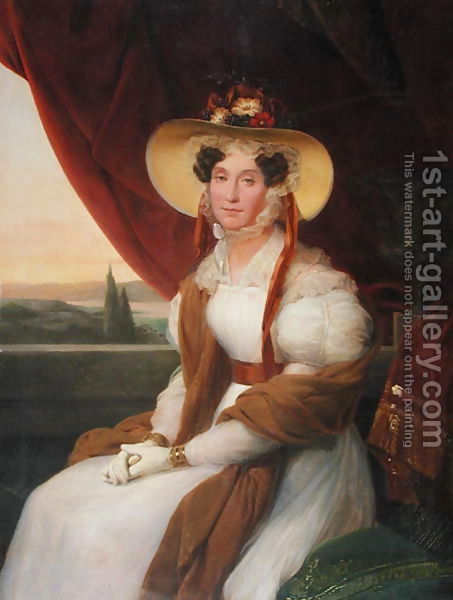
Madame Adélaïde, aunt of Queen Louise-Marie

Educated in liberal ideas by Mme. de Genlis, Adélaïde d'Orléans had made them her own. Long years of exile in a convent in Bremgarten, and afterwards with her aunt Mme. de Conti in Bavaria and Hungary, had separated her from family life. She knew little of her mother, and was subsequently altogether estranged from her, on account of the latter's subjugation by her chancellor, M. de Folmont. After their return to France, she concentrated all her affection on her brother and his family.
Her niece, the Queen of the Belgians, in a letter to Queen Victoria, says: "My good, excellent, beloved aunt lived only for her brother. Her devotion was absolute, and utterly unselfish. A heart so true, so noble, so loving is seldom found. She was a second mother to us, indeed few mothers do for their children all she did for us or love them better, and we in return loved and looked up to her".
Mme. de Boigne says: "In Madame Adélaïde I always admired her extreme goodness of heart and great intellectual powers. Her good qualities were her own, her defects due to circumstances in which she was placed in youth".
She was frank and sincere, and with her the inside was worth more than the outside.
Exclusive in her affections, she was a firm friend but a bitter enemy.
Her charities, however, left out no one.
She gave away one-sixth of her income in pensions to poor artists and men of letters, to the widows and orphans of combatants in the July Revolution, and in subscriptions to schools and hospitals, for the families of shipwrecked mariners, or artisans out of work, to cholera patients; pensions also to faithful servants of the House of Orléans, and rendered assistance even to poor Jews.
Her wealth and liberality gave her much influence, and she lived only for the aggrandisement of her brother and his family.
Her father, Philippe Egalité had been kindness itself to her. She was too young to judge the facts and would not acknowledge that his path had been one of crime. In her days of exile and among the émigrés who formed her aunt, Mme. de Conti's court, she found herself everywhere looked upon coldly on account of the name she bore, so she was driven in upon herself and raised a rampart of reserve in self-defence. Her mother's household being unendurable, she left it and joined her brother, and having no one else upon whom to lavish her capacity for affection, she gave her heart wholly to him.
He returned her affection, fell much under her influence, consulted her on all points, and having great respect for her powers of mind, deferred to her opinions.
Their father's life and death were a bond of intimacy between them.
Though both were generally the easiest of companions, upon this point they were irritable, even to rancour. After the Restoration neither of them was ever at ease with Louis XVIII, and least of all with the Duchesse d'Angoulême, daughter of Louis XVI, for whose death their father had voted.
Madame Adélaïde indeed frankly detested the royal family. She may have remembered that in her youth she had been taught to look on the Duc d'Angoulême as her future husband, but the match fell through upon the determined opposition of Marie Antoinette. Again in later life there had been an idea of marrying her to the Duc de Berry, which also collapsed.
Besides all this she was thoroughly at variance with the policy and opinions of the elder branch of the Bourbons; she despised their narrowness and bigotry, "they had learned nothing, and forgotten nothing". She herself was genuinely liberal and modern in her ideas, and she thought a constitutional Monarchy and representative Government was really what was needed for the welfare of France, and she loved her country only less than her brother. For him she was always ambitious. If he was not of the Orléanist faction, Mdme. Adélaïde certainly was; in and out of season she never lost sight of the ruling desire of her life, i.e. to see her brother on the throne of France. Her wealth gave her great influence. She spent it generously, patronised artists and literary men, and employed much labour on her estates, especially at Randan, which was her favourite residence; a whole countryside benefited by her benevolence and adored her, calling her "the good Mademoiselle"... (C. C. Dyson, The life of Marie-Amélie last queen of the French, 1782-1866, 1910, pp. 183-186)

Thursday, August 25, 2011
Portraits of Marie-Amélie


A Loving Daughter

Today is the feast of St. Louis of France; tomorrow will be the anniversary of the death of Louis-Philippe, King of the French. I find this quite a poignant image of an aged and ailing Louis-Philippe in exile, embracing his daughter, Queen Louise-Marie of the Belgians, during her last visit to her father on June 18, 1850, prior to his death on August 26. Louise-Marie took her family's misfortunes deeply to heart and succumbed to tuberculosis on October 11, only six weeks after her father's passing.
Wednesday, August 10, 2011
A Royal Bride

Wednesday, August 3, 2011
A Queen Mourns a Queen

How beautiful it must be to see that your whole country weeps and mourns with you. For the country and for your children you must try to bear up and feel that in doing so, you are doing all SHE wished. If only we could be of use to you! If I could do anything for poor, little Charlotte. whom our blessed Louise talked of so often to me.(Read full letter)
Subscribe to:
Posts (Atom)

