Showing posts with label princesses. Show all posts

Friday, December 21, 2018

Princess Lilian's Christmas Gifts

Despite her reputation as a stubborn, selfish and difficult woman, the Princesse de Réthy was known in her intimate circle as a generous benefactress and a gracious hostess. Every year, during the Christmas festivities, she lavished delicate attentions on her entourage, with her characteristic refinement, elegance and perfectionism. In Le mythe d'Argenteuil, Michel Verwilghen, himself a frequent guest at the royal estate in its heyday, shares a few charming details of these busy winter days. By the end of November, Lilian's household was astir with preparations for the Christmas celebrations. Aided by her secretary and her faithful housekeeper, Madame Jeannine, the princess prepared over a hundred presents, all substantial and personalized, for her close associates. Anxious to please everyone individually, she even initiated, at times, discreet, indirect inquiries into their desires. 

On December 25 came the ritual of the gift-giving itself; in the tradition of the Belgian royal family, Lilian personally distributed the presents, accompanied with kind words, to her intimates. For her most elite guests, distinguished soldiers and statesmen, she reserved some special treasures: the pocket watches, commemorating the Battle of the Yser (1914-1918), which her late father-in-law, the beloved Albert I, had ordered at the Maison Doucet in Paris. The cases bore the monograms of the Roi Chevalier and his consort, A and E, interlaced and surmounted with a crown, in gilded metal. The metal came from the fragments of exploded shells from the trenches of the Yser. Among the favored few who received one of these tragic but glorious mementos was Charles de Gaulle.

Friday, November 30, 2018

Anna Maria de Visscher, mother of Princess Lilian

I think she has a lovely face. Anna Maria de Visscher was the scion of respectable bourgeoisie, the daughter of a mayor and the granddaughter of a minister. Her ancestors included illustrious figures, such as the Comte Félix de Muelenaere, a member of the National Congress that founded the Kingdom of Belgium, and three times Foreign Minister between 1831 and 1841. In 1905, Anna Maria married Henri Baels, a rising young Ostende shipowner, lawyer and politician, to whom she bore eight children, six daughters and two sons. 

During the Nazi invasion of Belgium, while her husband, the Governor of West Flanders, circulated constantly to alleviate the plight of his province, Madame Baels worked for the Red Cross. The young Lilian assisted her mother in her task, transporting wounded French and Belgian soldiers by car to the St. John Hospital in Bruges, simultaneously flooded by refugees. She also helped to evacuate the elderly from the hospice of Alost, which was within the combat zone, exposed to enemy fire. 

As the military situation headed towards disaster, however, Madame Baels decided to leave for France to bring two of her daughters, then ailing, to safety. Lilian drove the family car. At a restaurant in Bernay, near Lisieux, the news of the Belgian capitulation reached the four women. At Paul Reynaud's infamous broadcast, branding the Belgian king a traitor and felon, French and Belgian officers began vilifying Léopold III, tearing apart his photograph on the front cover of a magazine. Horrified, Lilian indignantly rebuked the officers. One spitefully retaliated by seizing the Baels' car key and throwing it into a ditch. After obtaining a replacement, the ladies proceeded to the south of France, renting a villa in Anglet, near Biarritz. 

Madame Baels would have many sorrows in the years to come. Her husband and her son were unfairly accused of cowardice and treason, while her daughter Lilian was battered by gossip and slander. According to Lilian's account, as recorded in Un couple dans la tempête (2004), the news of her secret marriage with King Léopold upset and worried her mother, who foresaw that it would provoke a political storm. "My little one, you don't know what's in store for you. It will be appalling, they will all attack you, you will have a terribly hard life," she is quoted as saying (pp. 36-37). Anna Maria Baels, née de Visscher, died of heart failure in 1950, while the question of the King's return from exile was still being decided. On the grounds that her arrival, at such an emotional moment, might sway the people in Léopold's favor, Lilian was prevented from returning to Belgium to bid farewell to her dying mother. 

Thursday, July 10, 2014

Wedding of Prince Amedeo


I am happy to announce the news of the wedding of Prince Amedeo of Belgium and Elisabetta Maria Rosboch von Wolkenstein.  The bride is the daughter of Italian nobility.  The couple were married in Rome on July 5.  Here is a video of the couple, announcing their engagement.  Here are photographs of the marriage ceremony. 

Sunday, October 27, 2013

Tender Moments

Two pictures taken by the royal photographer Robert Marchand capture some moments of family tenderness.  Above, we see Queen Astrid with one of her children.  Below, Astrid's daughter, Josephine-Charlotte, and her half-brother Alexandre, play with their baby sister Marie-Christine. 

Tuesday, July 16, 2013

The New Queen

Here is an article about Princess Mathilde, who will become Belgium's seventh queen consort on July 21, and her eldest daughter, Princess Elisabeth. Mathilde will be the first Queen of the Belgians to have been born in Belgium. Elisabeth, in turn, is set to become the country's first queen regnant.

Monday, July 15, 2013

Villa Parkudden

Here are some old pictures of the childhood summer residence of Queen Astrid's family, in Stockholm. The little princess' parents, Carl and Ingeborg of Sweden, lived here from 1899-1908.  The last picture shown is an invitation to a garden party on the grounds of the villa.


Thursday, July 4, 2013

The Kindness of Princess Lilian

Royalement has a touching testimony from Princess Maria Gabriella of Savoy, who was close to her Belgian uncle and aunt, King Leopold III and his second wife, Lilian Baels. Princess Lilian is so often described as cold, calculating and selfish, yet many personal accounts suggest the opposite. Here is an English translation of Maria Gabriella's account, published by Christophe Vachaudez in L'Eventail in September, 2002, two months after Lilian's death.
It is hard for me to speak of my aunt Lilian, so soon after her passing, without feeling the tears springing to my eyes. I very much miss her presence, as well as our frequent telephone conversations. I met her for the first time in Portugal, at the beginning of the 1950s. My uncle and my aunt Lilian were passing through Estoril, and were traveling to America. I saw them again in Brussels, for the eightieth birthday of my grandmother, Queen Elisabeth. It was a very joyous birthday. Aunt Lilian was resplendent, she was expecting Esmeralda.  
In 1958, I was again in Belgium, invited to a court ball. It was my first ball, I was delighted, and at the same time, very intimidated. I was staying at Laeken, and the evening of my arrival, Aunt Lilian came into my room. She wanted to see my evening dress. Very quickly understanding that I suffered from painful shyness, an inheritance from the Coburgs, she reassured me by admiring my gown and saying a thousand kind things to me.  
From that time on, my affectionate friendship for my "Belgian uncle and aunt" never weakened. I went to see them at Argenteuil, Ciergnon, Hinteriss, or in Biot, in the south of France. With my aunt, we talked about everything. The conversation was always interesting, and often amusing. Aunt Lilian was one of the most beautiful women I have known. She was also very intelligent and enthusiastic about life, with a strong, decided character. She was sometimes misunderstood. However, she had a big heart and always showed herself ready to help her neighbor. My affection and admiration for my aunt continued unclouded, without interruption, for 42 years, and I will miss her forever.

Sunday, June 23, 2013

Portraits of Princess Marie-José

Here are two contrasting portraits of the daughter of Albert and Elisabeth of Belgium who became Italy's last queen. The second picture, from 1935, is very sombre and perhaps reflects the suffering the princess endured in that period. The years leading up to the Second World War were marked by the loss of her father and her sister-in-law, Astrid of Belgium, as well as by marital unhappiness and growing concern at the political situation in Italy and Europe as a whole. Marie-José's face almost appears tear-streaked. In the first picture, on the other hand, she somehow seems more cheerful and outgoing.

Monday, March 11, 2013

Death of Princess Lilian of Sweden

Since yesterday, this blog has been absolutely inundated with hits searching for information about Princess Lilian of Sweden, who passed away on Sunday at the venerable age of 97.  Like Princess Lilian of Belgium, she was a commoner who became a royal bride as a result of a wartime romance. Unlike Lilian of Belgium, who was encouraged to marry King Leopold III by Queen Mother Elisabeth, however, Lilian of Sweden was prevented by dynastic considerations from marrying her lover, Prince Bertil, for decades. On the positive side, though, it seems that the Swedish Lilian was much more kindly regarded by the Swedes than the Belgian Lilian was by the Belgians. May they both rest in peace.

Sunday, January 6, 2013

Charlotte of Belgium

CARLOTA DE SAXE-COBURGO GOTHA PRINCESA DE BÉLGICA ARCHIDUQUESA DE AUSTRIA EMPERATRIZ DE MEXICO
Gorgeous!

The Struggles of a Shy Child

One of the most touching parts of Countess Anna Sparre's portrayal of her childhood friend, Astrid, Queen of the Belgians, is her description of the young Swedish princess' development from a timid, vulnerable child to a woman of confidence and poise. In Astrid mon amie, Anna speaks of the contrasting characters of herself and her friend. According to Anna, Astrid was fearful of everyone and everything, painfully reserved and extremely sensitive, while Anna was bold, outspoken, and thick-skinned. Anna used to become annoyed with Astrid, while simultaneously pitying her, because of her excessive anxiety. Apparently, Anna was not the only one to become impatient with Astrid's fears. Her father, Prince Carl, in his memoirs, relates a similar incident during Astrid's childhood on a visit to the beach. Her mother, Princess Ingeborg, scolded her for being afraid of the waves, and the little girl replied, sobbing: "Mummy forgets that I am so small and the sea is so big."

Despite their opposite temperaments, or perhaps because of them, Astrid clung to Anna, humbly willing to accept even her sharpest criticisms. In the summer of 1922, after Prince Carl and Princess Ingeborg and their children had been visiting Anna's family, and were preparing to leave, sixteen-year-old Astrid begged to remain a little while longer. It was the first time she had stayed away from home without her family. She was visibly pained every time she had to greet someone she had never met before, every time Anna's father spoke to her at table, every time there was a storm, every time something happened unexpectedly. At the same time, however, she deepened the friendship with Anna that would bring her so much joy and comfort throughout her life. The two teenagers often lay awake at night, exchanging confidences. Anna's influence seemed to help Astrid to become braver.

Anna believed that much of Astrid's self-doubt stemmed from her position in her family as a middle child. Despite the warm, loving atmosphere of the household of Prince Carl and Princess Ingeborg, Anna felt that Astrid suffered some emotional neglect during her youth. Apparently, Ingeborg was rather overly given to praising Astrid's charming, outgoing, self-assured older sister, Märtha, the future Crown Princess of Norway, constantly holding her up as the model young lady. Meanwhile, Ingeborg doted on Astrid's younger brother, Carl, the adored baby of the family, a delightfully entertaining child, apt to be spoiled. The naturally more self-effacing, more melancholic Astrid received less attention, understanding and encouragement. She found refuge and comfort with her father, and, above all, with her motherly eldest sister, Margaretha.

At thirteen, however, Astrid was devastated by her separation from Margaretha, upon the latter's marriage to Prince Axel of Denmark. A sad little figure amidst the joyous ceremonies, Astrid wept desperately as she strewed flowers in the path of the bride and groom. Little did she know that her new brother-in-law would become a trusted, supportive friend. Even less did she imagine that her own marriage, seven years later, would enable her to blossom into one of the most charismatic and beloved figures of the twentieth century.

Monday, December 24, 2012

Graceful

An elegant picture of the daughter of Leopold and Astrid. She was certainly a beauty, although perhaps too often overshadowed by the elegance of her mother and step-mother.

Saturday, November 17, 2012

Jewellery of the House of Savoy

An English edition of Princess Maria Gabriella's fine book. On the cover is one of my favorite photographs of her stunning mother, Marie-José of Belgium. I love the way Maria Gabriella keeps her mother's memory alive, much as her cousin, Princess Esmeralda, does for her father, King Leopold III of the Belgians. 

Tuesday, November 13, 2012

Tiara of the Nine Provinces

This tiara was a wedding gift from the people of Belgium to Princess Astrid of Sweden, who married the future King Leopold III in 1926. Created by Belgian jeweler Van Bever, the original version of the diadem is a flexible diamond bandeau in a stylized Greek key motif topped with 11 large diamonds on spikes. These large stones, totaling around 100 carats on their own, symbolize the nine provinces of Belgium and the (now former) Belgian colony of the Congo. I've heard a few different explanations for what the 11th diamond stands for, including Belgium as a whole and the Belgian royal family. Obviously, this is where we get our name: I’m calling it the Nine Provinces Tiara, though in English you could also go with the slightly more imposing Diadem of the Nine Provinces or even the Belgian Empire Tiara. (Read entire post)

Monday, November 12, 2012

Queen Astrid's Wedding Gifts

November is the anniversary month of the joyful marriage of King Leopold III and Queen Astrid. Unofficial Royalty has a delightful series of articles on the wedding celebrations, including a description of some of the gifts the bride received.
Wedding gifts began arriving in Stockholm a few weeks before the civil ceremony. The Swedish navy presented Astrid and Leopold with various pieces of silver, while the residents of the city of Stockholm gave the couple a silver and enamel tea set. A diamond and pearl tiara made by the court jeweler Andersson was also given to Astrid. This tiara, now known as the Stockholm Wedding Tiara, has not been seen in several decades. However, Leopold’s second wife, the Princess de Rethy, later wore parts of this tiara as a brooch.

Several items were displayed in Ingeborg’s drawing room before the Swedish ceremony. These gifts included an emerald and diamond necklace from Carl and Ingeborg, a diamond necklace from the Swedish king and queen, a silver and enamel coffee set from the Norwegian royals, and a portrait of the bride’s father.

Shortly before the wedding, a call for donations was made to the Belgian public to fund a national gift to the couple. Collections were also made from various expatriate groups living in Belgium. Within a day, the amount collected reach over 183,000 Belgian francs. While Leopold had requested that the money collected by applied directly to the national debt, the prince was overruled in favor of the purchase of gifts. The items selected from the funds collected included a tapestry in honor of Astrid’s love of Swedish needlework. This tapestry was made over a thirteen-year period by Mademoiselle Dubois, a renowned Belgian weaver.

The first gift presented to Astrid upon her arrival in Belgium was lace given to her by a Belgian girls’ group. Astrid happily accepted the lace, expressing her thanks in the Flemish language.

Also selected from the Belgian collection included a diadem that could be separated into bracelets, rings, a choker, and brooches. The bandeau tiara was made by Belgian jeweler Van Bever and included eleven Congo diamonds. It is now known as the Nine Provinces or Belgian Empire Tiara and has been worn by every Belgian queen since Astrid.

Friday, November 9, 2012

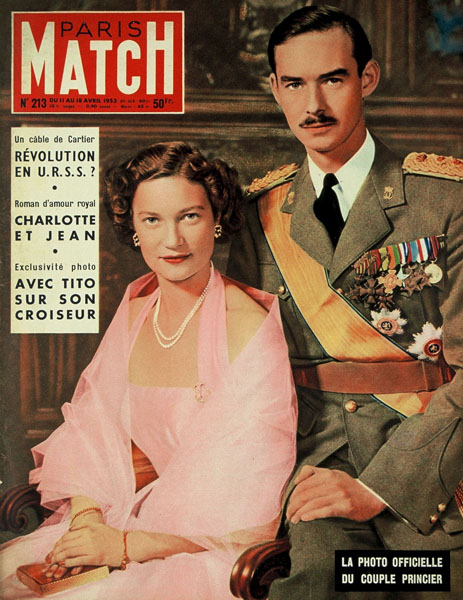
Belgian Royals in Paris Match


A few magazine covers from long ago. The first celebrates the marriage of Joséphine-Charlotte, eldest daughter of King Leopold III, to Jean of Luxembourg. The second features a beaming Princess Esmeralda, Leopold's youngest daughter, on the occasion of her eighteenth birthday.

Sunday, November 4, 2012

Mary-Lilian and Marie-Antoinette

November, the month dedicated to the Holy Souls in Purgatory, is a time full of anniversaries for King Leopold III, Queen Astrid and Princess Lilian. All three began their momentous and often tragic lives in this dark, tempestuous month; Leopold on November 3, Astrid on November 17, and Lilian on November 28. Leopold and Astrid were also married in November! By rather a remarkable coincidence, Leopold was born the day after the birthday of his legendary forebear, Marie-Antoinette of Austria, who actually arrived on All Souls' Day itself, with all the churches of Vienna ominously draped in liturgical mourning. In fact, Leopold would sometimes have celebrated his birthday on All Souls' Day, too, since the feast is commemorated on November 3, if November 2 falls on a Sunday. 

The King was a descendant of Marie-Antoinette's favorite sister, Queen Maria Carolina of Naples. As it happened, Leopold and especially Lilian shared many qualities and experiences with the unfortunate Queen of France. Marie-Antoinette was a Habsburg archduchess, a daughter of the great Empress Maria Theresa, and Mary Lilian Baels was a Fleming, the product of a culture influenced by the Habsburgs, who ruled the Low Countries for centuries. Both Lilian and Marie-Antoinette were among the youngest children in large families, with forceful and capable mothers. Both girls were named after Our Lady, like many other Catholic princesses. Lilian and Marie-Antoinette also shared great beauty, charm, glamor and passion. Both were queens of fashion, with exquisite taste. Both were gracious hostesses, admired for creating magical environments, Marie-Antoinette at Trianon and Lilian at Argenteuil. Both were staunch, loyal and courageous women. Each was kind and charitable to the less fortunate, and known for her goodness within her inner circle. Both were loving wives and mothers. Both were sincere Catholics, fun-loving girls who seemed to grow in spiritual grandeur with time and suffering. 

Like Louis XVI and Marie-Antoinette, Leopold III and Lilian had their faults, but were cruelly maligned beyond all reality. Both Lilian and Marie-Antoinette faced hateful accusations of immorality and even incest. Like the Queen of France, the Queen of the Belgians in all but name bravely shared her husband's miseries. Lilian and Marie-Antoinette bore insult, imprisonment, deprivation, illness and danger of death with patience and dignity. Each strove to protect and comfort her king and his children in terrible circumstances. At the end of her life, each left touching last wishes expressing a gentle spirit of piety, humility and care for her family and faithful friends. While sparing Lilian a bloody martyrdom, and granting her many years and a peaceful passing in old age, Providence called both women to sacrifice. 

Wednesday, October 24, 2012

Portrait of a Princess

Christina Croft shares a description by King Leopold I of the Belgians of his late first wife, Princess Charlotte Augusta of Wales.
 ...My gift is Charlotte’s portrait. The face is extremely like, and the likest that exists; the hair is a little too fair, it had become darker. I take this opportunity to repeat that Charlotte was a noble-minded and highly gifted creature. She was nervous as all the family have been: she could be violent but but then she was full of repentance for it, and her disposition highly-generous and susceptible of great devotion..."

Wednesday, October 17, 2012

Beauty of Flanders

As we have been discussing the divide between Flanders and Wallonia, it might be interesting to consider the case of the Flemish beauty who became the second wife of Leopold III. She was the very type of the Catholic, royalist Flemish who played such an important role in deciding the popular consultation in Leopold's favor after World War II. (Sadly, with the current trend towards separatism, more and more Flemings now seem to be turning rather venomously against the monarchy as a icon of Belgian unity). Princess Lilian was also the very type of the upper-class Flemish who adopted French culture.

This position made life even more difficult for a woman already castigated by the aristocracy as a vulgar adventuress marrying far above her station, and by other elements of popular opinion and the press as a unworthy successor to an impossibly saintly Queen Astrid, as an unscrupulous temptress, devoured by ambition, luring the King into preferring private pleasure to public duty. Lilian was doubly resented for her Flemish heritage by many Walloons. She was also blamed by more nationalistic Flemings, such as her denigrating biographer, Evrard Raskin, for supposedly betraying this same heritage through her Francophile affinities.

As Jean Cleeremans describes in Léopold III, sa famille, et son peuple sous l'occupation, there were also kinder voices among the Flemish who expressed pride at their Sovereign's marriage to one of their own, to a daughter of the talented and energetic class that had brought such prosperity to the Belgian cities through the centuries. As always in Lilian's life, however, spiteful portrayals gained much greater publicity than any appreciative ones. Hating the Princess de Réthy became a veritable industry.

Yet, through it all, Lilian remained steadfastly loyal to her principles as a woman devoted to Belgium and its monarchy. Michel Verwilghen, in Le mythe d'Argenteuil, describes her concern at the rise of separatism during the last years of her life. She even worried that her step-son, King Baudouin, might not be doing enough to oppose the efforts to shatter the country. I wonder what she would say of Belgium's most recent political crises.