
Wednesday, October 28, 2009
Prince Charles in the Congo
I never realized before that Prince Charles (younger brother of King Leopold III) made a visit to the Congo, in 1947, while serving as Regent of Belgium. Here are some interesting videos (courtesy of British Pathe) of this trip:


Sunday, October 25, 2009
Birthday of Princess Elisabeth

Saturday, October 24, 2009
Engagement of Umberto & Marie-José
 On October 24, 1929 (ominously enough, the infamous "Black Thursday," the first day of the Wall Street Crash) the engagement of Princess Marie-José of Belgium and Prince Umberto of Savoy was officially announced. During the celebrations in Brussels, as Umberto was laying a wreath at the tomb of the Unknown Soldier, Ferdinando de Rosa, a young Italian, attempted to assassinate the Prince (it was supposed to be a symbolic act to protest the Italian monarchy's compliance with Mussolini). Fortunately, he failed and was arrested. It was all over so quickly that Umberto and Marie-José did not even notice what had happened. Later, when people praised the Prince for his calm and courage, the Princess misunderstood and was deeply hurt: "Do you really need calm and courage to marry me?"
Friday, October 23, 2009
The King's Appeal
 On September 30, 1945, at St. Wolfgang, Austria, shortly after his liberation from German captivity, King Leopold III prepared a moving address to the Belgian nation. He expressed his gratitude and admiration for the Belgians' heroism during World War II, and protested his innocence of the charges of treason delaying his return to Belgium. On October 16, 1945, Baron Nothomb read the speech to the Belgian Senate. Here is a translation:
Belgians,
At the moment of leaving the soil where, after 11 months of captivity, I was liberated by the victorious American armies, and before reaching Switzerland, where I will await in silence the nation's pronouncement, I want to address myself to you in all sincerity, and from the depths of my heart.
Since my youth, I have lived among you. When I was 15 years old, I came to know the deep qualities of those magnificent soldiers whose simple, tenacious heroism saved our country and covered it with glory.
Later, when life put me in contact with the miners, workers and peasants of our provinces, I found again those same qualities of conscience, of heart, of will, of love of work and freedom which make the strength of our people, which have permitted it to overcome all the crises history has imposed on it, and which, I am convinced, will, this time, too, restore to it the place it has been able to earn among the most civilized nations of the world.
In 1940, when, for the second time, the German army invaded the sacred soil of our country, I took- as did my father- command of our troops. The fortune of arms was unfavorable to us. But our honor was saved.
The Belgian army and its commander have been covered with disgrace. But I know what was the conduct of our 600,000 soldiers, I who saw them under fire, without protection against the incessant attacks of the German air-force, I who saw them break themselves, for two whole days, against the front-lines of the Lys, the most fearsome armored units, I know what was their heroism.
Soldiers, when you return to your homes- some of you after five years of captivity- you will have the right to the gratitude of the country, for you have served it well. History will render you justice. Know that your commander does not forget you. Those of you who have fallen have not died in vain. For it is not only victory that makes a people great and forms a nation, it is the will to defend itself, to remain itself, to stay firm in the ordeal.
You have deserved well of your country. I am honored to have commanded you and you can be all the more proud of yourselves, as your courage and your sacrifice contributed to the final victory of the United Nations over the most ruthless of enemies. If you had not held the line so fiercely on the Lys, without any other hope than that of delaying the German onslaught, the English divisions who would form the core of the great and victorious British army, would probably not have been able to embark at Dunkirk. It is a glorious voice- that of Admiral Keyes, the hero of Zeebrugge- which, at the moment when, all over the world, you were unjustly held responsible for the defeat, made itself heard, with an admirable honesty, to render you this homage.
When, on May 28th, I understood that all further resistance was futile, I decided to lay down our arms. I considered that my conscience and my responsibility as the head of the army did not permit me to sacrifice in vain thousands of soldiers and refugees. Only those who are insensible to human misery and do not know how many sorrows the death of a loved one provokes will condemn me.
Conquered, I did not wish to leave you- I could not have done so- at the moment when a long agony was beginning for you. A number of Belgians then, who did not know the real situation, reproached me for it. Some even believed I was betraying them, and the echo of their voices, which has begun to resound anew, obliges me to relive the painful hours I knew after our defeat in 1940.
But I know that the great majority among you have conserved your faith in me. I thank you from the depths of my heart and I want to tell you- with all that this implies for me in terms of responsibility before history- that I am conscious of having served you as a man and a King.
Only those who did not live through the ordeals of enemy occupation can maintain that the sacrifice I made by becoming a prisoner to remain among you was not useful to the country.
I have the right to affirm- and the proof, one day, will be furnished to you- that the passive resistance I firmly maintained prevented Belgium from negotiating with Germany, momentarily victorious, and supported her in her refusal to let herself be seduced or enslaved by the enemy, aided by a handful of traitors and bad citizens whom we will refuse to consider Belgians any longer.
By remaining among you as your imprisoned sovereign, by not accepting to reign under the occupation, by refusing, despite the pressing offers of which I was the object, to treat with the enemy, I not only saved the country's honor, I maintained its right to independence and will to remain, despite the odious violence done to it, a sovereign nation.
Throughout the whole occupation, as I saw, with proud admiration, the Belgian nation rallying, organizing resistance and forming, in Belgium and in England, the new army to liberate the country, I held myself to the line of conduct I had fixed since the capitulation: to refuse all negotiation with the enemy, to do nothing...which could harm the military, political or economic interests of the noble nations whose armies had responded to our appeal...
People have told you, provoking German testimonies, that I was at Berchtesgaden to save the dynasty by selling my country. Those who have told you this have slandered me. They know- or they could have known, since I offered to show them my dossiers- that, if I agreed to visit Hitler who, a perjurer to his word, had invaded Belgium, it was only to try to stop that odious attempt to divide the nation, consisting in sending home only the Flemish prisoners, and also so that your children could have more bread.
People have told you that I arranged my own deportation, and that of my family, to avoid being among you at the moment of liberation. And they have not hesitated to accuse me of trying to deceive you by publicly protesting against the violence that was done to me.
The conscience of the nation will be able to judge the attitude of those who have taken upon themselves the responsibility for such defamation.
I did not have the happiness, which you knew, to be present at the liberation. And, alone today among the Belgians who endured the suffering of captivity and exile, I have been refused the joy of returning to my homeland.
I accept, for Belgium, this new sacrifice, with the ardent hope that I will see, from afar, concord and union re-established among the Belgians.
Respectful of the institutions and liberties of our parliamentary regime, upon which are based the independence and the prosperity of our country, I have recourse to the sovereignty of the people.
The Belgian monarchy is founded on the common will of the citizens. Whatever this will may be. Whatever the legal means by which it may be expressed, I accept, in advance, its verdict.
Since the start of my reign, serving my country was my only ambition. Tomorrow, like yesterday and today, despite everything, to this I will remain faithful.
(s) Leopold.
(Translated from the French version on the website of Le Vétéran. The document is also included in the annexes of the King's memoirs).
Wednesday, October 21, 2009
Monday, October 19, 2009
King Albert & Queen Elisabeth in the Congo
 The last decade of King Albert's reign was filled with a rapid succession of royal trips to the Congo...We have seen how Prince Leopold journeyed through Belgium's African possessions in 1925 and 1933. His parents did likewise in 1928 and 1932. Colonial issues were always close to the King's heart. In 1920, amidst the aftermath of World War I, while Belgian politicians were still focusing on the nation's recovery, Albert took the initiative of launching a Colonial Congress, the first in Belgian history. He emphasized the role the Congo could play in Belgium's economic development, while also inveighing against abuse of the native population. Plans for a royal visit were soon underway, and the first opportune moment came in 1928.
Accompanied by his wife, Queen Elisabeth, Albert arrived in Africa for the second time in his life. He had last seen the Congo as a young prince in 1909, and he would now retrace his steps. He wore a handsome white and gold uniform specially designed for the trip. Ordinarily, Albert was known for his royal indifference to externals ("Look for the worst dressed fellow of the bunch," he once told an official who asked how to recognize him when he was traveling incognito). Yet, the Congolese attached great importance to the outward trappings of rank and authority, so the King had to dress more grandly on his African visits.
According to a contemporary account of the trip:
The itinerary the King and Queen followed enabled them to visit the most interesting regions of our African colony. From Boma to Banana, the Sovereigns made the complete circuit of the Congo. Thanks to (modern transport), they were able, from Léopoldville, to reach Katanga directly, without having to make the long journey by river. From Elisabethville, where they arrived after a rapid journey by air and rail, the King and his entourage were able to retrace the route taken 20 years earlier by Prince Albert. It was a long...journey along the river, from Bukama to Banana, with many varied stops, with short trips by rail whenever the river ceased to be navigable, and a quick flight by air from Colquilhatville to Léopoldville and Boma (Boula Matari ou le Congo Belge, Jacques Crokaert, 1929).
Warmly welcomed throughout the trip, the King and Queen made detours to visit the agricultural enterprises of Mayumba, the diamond mines of Kasai, the rich lands of Rwanda, Urundi, Kivu and Uele. They met with colonial dignitaries, Christian missionaries and native chieftains alike. Crokaert describes the journey in rather complacent and triumphalist terms, eulogizing the genius of Leopold II in acquiring the colony, citing the vast technological progresses in the Congo since Albert's last visit, and stressing the natives' debt of gratitude for the benefits of European civilization. The King, however, told a different story. In a letter, he noted, with his customary caustic irony:
We have already seen many things, and, above all, many people. Very busy program, pathological insistence of public servants, private individuals, and even servants of God on being endlessly complimented on what they do or even do not do...Boma has not changed in 19 years. The governor-general's house is a dirty box. Matadi: frightful. An insult to the majestic river. Léo-Kin cuts a good figure, could become a magnificent city....To say the voyage is a pleasure would be a lie...The mentality of the big officials for the most part bad. The little ones are often worth more. Great greed everywhere, malice without bounds, few agreeable people. Some great potential in private enterprises (Léopold III, by Vincent Dujardin, Mark van den Wingaert, et. al. 2001.)
Quite critical, like his son! Yet, happier memories of Albert's Congo trips have also come down to us. Le Roi Albert et les Missions (1935) by Joseph Masson, S. J., for instance, provides a wealth of information on the royal couple's close and touching relationship with the Catholic missionaries in Africa. Despite the King's critical comments in his letter, he clearly admired their heroism, as many stories testify (see HERE). Once, for instance, he visited a convent school for young girls, future mothers of Christian homes. He was deeply moved by the experience and quietly told one of the nuns: "Continue, Sister, to devote yourself to this work, for the greater glory of God and for our country." To other missionaries, he confided: "I desire that, at my death, not a single pagan be left in the Congo." His concern for the spiritual welfare of his African subjects was matched by concern for their material prosperity too. He insisted on personally visiting the homes of ordinary people to see, with his own eyes, their living conditions. According to Masson, the indigenous people were very impressed by the kindness and piety of Albert and Elisabeth. Apparently, in religious controversies between Protestant and Catholic Congolese, the latter would even use the King's devout Catholic faith as a clinching argument: "You see the King belongs to our Church, so it must be the true one."
To the end of his life, King Albert was keenly preoccupied with Belgium's distant colony. In 1932, he would return for his third visit, traveling by air through the cotton farms of Uele and the national park bearing his name. As a final touching detail, his last day of work (according to Masson) was devoted to the Congo.
Saturday, October 17, 2009
Adélaïde de Bourbon-Penthièvre, Duchesse d'Orléans
 Queen Louise-Marie's grandmother. A fascinating and dramatic story!
Thursday, October 15, 2009
Prince Leopold & Princess Astrid in the Congo
 Some may remember my post on Prince Albert's visit to the Belgian Congo in 1909. His son, Prince Leopold (future King Leopold III), followed in his father's footsteps in 1925 and 1933. His first trip took place before his marriage, but his second was graced by the presence of his lovely Swedish bride, Princess Astrid.
Visiting the Congo was an important step in the training of the heir to the Belgian throne. In Leopold's case, it was also the start of a lifelong passion for tropical exploration. After his abdication, he would undertake many expeditions through Africa, Asia and South America, recording his experiences in his Carnets de Voyages and taking a vast collection of magnificent photographs (see Léopold III, mon père and Léopold III photographe by Esmeralda de Réthy).


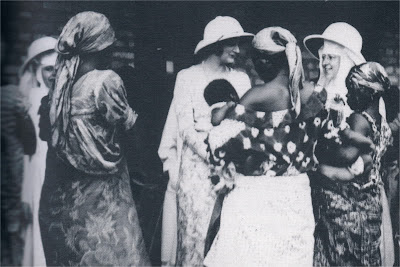
In 1929, the Revue de Zoologie et de Botanique africaine published an article on the Prince's first voyage to the Congo. Here is an excerpt:
In 1925, HRH Prince Leopold of Belgium, Duke of Brabant, undertook a study trip, lasting many months, to central Africa, and, more particularly, to the Belgian Congo. The route he took led him from the Atlantic Ocean to the Indian Ocean. The Prince had an opportunity to traverse very diverse regions, with very different physical characteristics, flora and fauna. These regions...encompass widely varying types of forests and wildernesses, and sometimes reach very high elevations, notably north of Lake Kivu.Despite his many occupations, the Prince, a fervent friend of Nature, was able, in the course of the trip, to find the time to gather specimens of the insect life of some of the regions he visited...Among a total of around 3300 specimens, there were found 1100 species and varieties: among these, many little known types, and over 40 new ones...The relatively high number of species reported and the number of new discoveries and rare forms, clearly shows the importance of the collection assembled by the Prince.
A hardy outdoorsman, Leopold trekked through the wilds on foot. He thoroughly investigated Congolese conditions, visiting mines, railways, hospitals, prisons and missions, interviewing local officials and questioning the humblest of his father's African subjects. He came away with a highly critical view of the colonial régime. He was very worried by the ill-health of the indigenous people, noting in his diary:
The population is weak and does not seem to increase much, its nutrition...is very insufficient, many terrible tropical illnesses are decimating it...an excessive and badly understood employment of labor aggravates the problems mentioned...bad recruitment, lack of care (lodging, clothing, return of sick workers to their villages, poor nutrition, etc.) bad hygiene in the camp clusters, low birth rate in the camps and urban agglomerations...
He noted the devastation caused, in particular, by the irresponsible policies of the palm oil industry:
These companies had obtained huge concessions of millions of hectares and were trying to expand them even further, by resorting to enclosures made to the detriment of the natives. Furthermore, to gather the palm nuts, the companies did not establish plantations, but limited themselves to harvesting the nuts produced by the palm trees in the forest. This forced upon the natives the hazardous task of climbing the tree trunks (which may reach) 20 or 30 meters in height. What is more, this harvesting policy obliged the natives to live with their families in insalubrious forests, where sleeping sickness often reigns. The result is a considerable mortality rate among the workers, and, above all, among their wives and children (L'education d'un Prince by Gilbert Kirschen.)
Despite his admiration for the heroism of the Christian missionaries, Leopold had some critical words for them, too:
The Catholic and Protestant missionaries have played so important a role in the Congo that it is impossible to pass an unmixed judgment on them... The idealism, the devotion, the self-sacrifice of the missionaries, men and women, must never be lost from view and deserve to be rendered homage. I am more hesitant when it comes to the concrete realizations of the missions. I was won over by the Brothers of the Christian Schools who determined...to promote the formation of carpenters, plumbers, mechanics, all knowing, of course, how to read and write and how to integrate themselves in industrial society, without having to break brutally with their milieu. Other missions....created....uprooted people, by forcing the natives to abandon their traditional values...this error never appeared so clearly to me as during that voyage in 1925 (L'éducation d'un Prince, by Gilbert Kirschen).
In 1933, the Prince would return to the Congo, further developing his grasp of the colonial situation. His wife proved an intrepid traveling companion and entered wholeheartedly into his concerns. In her memoirs, Astrid mon amie, her friend Anna Sparre explains:
(In her letters) she described not only the majestic landscapes...she also revealed her emotion, as she was faced with suffering, poverty and infant mortality. Upon her return, she moved heaven and earth to bring aid...Her sense of responsibility had been awakened and she did not stop at good intentions. Her husband entirely shared her sentiments. After their return, he delivered remarkable speeches: the Belgian interventions in the colonies, in his view, ought to benefit, first of all, the natives and their country...The princess, of course, did not deliver official speeches, but obtained results thanks to her disarming smile and her active commitment.
Leopold's bold and uncompromising moral stand on colonial issues did nothing to win him favor in certain industrial circles. Already, he was beginning to make powerful enemies, with ominous consequences in the decades to come.
(*the passages quoted were originally in French, the translations are mine)


Wednesday, October 14, 2009
Playing Carlota
 The Mad Monarchist reviews the 1939 film Juarez, starring Bette Davis as the tragic Belgian-born Empress Carlota of Mexico. More HERE. It always strikes me that Belgian royals have faced many tragedies over the decades, and Carlota's sad fate is yet another example.
Tuesday, October 13, 2009
Parents of Queen Louise-Marie
The father and mother of the first Belgian queen, Louise-Marie of Orléans. This little princess of the cadet branch of the House of Bourbon was born in exile in Palermo in 1812. A few years later, her family were allowed to return to France. In 1830, during the July Revolution, Louise-Marie's father ascended the throne, upon displacing the elder line of the French royal house. In 1832, Louise-Marie was married off (not all that happily) to Prince Leopold of Saxe-Coburg-Gotha, the first monarch of the new Kingdom of Belgium.
 The "Citizen King" of the French, Louis-Philippe of Orléans (1773-1850). (His father, of course, was the infamous revolutionary, "Philippe Egalité," who cast the deciding vote sending his cousin, Louis XVI, to the guillotine). Apparently, Louise-Marie, despite her famed kindness and generosity, had a keen eye for the faults and failings of those around her (I've even seen her described as a "merciless observer"). Upon arriving in Belgium, she was rather too outspoken in her criticisms of her new subjects, and her father had to warn her to be more tactful and diplomatic.... Oddly enough, the Queen passed away only a few months after her (now deposed) father's death in exile.
 Louis-Philippe's wife, Marie-Amélie of Naples. Her somewhat skeptical expression reminds me of portraits of her daughter. I think Louise-Marie strongly resembled her mother, too, in her piety and charity.
I once had a conservative, religious person look at me in horror when I mentioned that the first Queen Consort of the Belgians (and, therefore, the subsequent generations of the Belgian royal family) were descended from the Orléans. Some seem to act as though the entire Orléans line were painted with the brush of indelible guilt and infamy. Yet, the radical background of the family, the regicide of Philippe Egalité and Louis-Philippe's questionable taking of the throne simply cannot be blamed on later people like poor Louise-Marie! She was, by all accounts, a devout, upright woman, a loyal wife and mother, and a generous Queen. She was an innocent person! Also, I find her very interesting, as she seems to have combined a critical, realistic mind with a charitable heart (rare!)
Subscribe to:
Posts (Atom)

