
Showing posts with label congo. Show all posts
Showing posts with label congo. Show all posts
Monday, November 26, 2012
Belgian Royals in the Congo
Well, I seem to be posting alot of documentaries these days. Here is one on the royal visits to the Congo, both before and after the colony gained independence. There is some fascinating footage of Queen Elisabeth visiting Congolese hospitals in her old age.
Friday, May 27, 2011
King Leopold's Soliloquy
Here is the full text of Mark Twain's scathing satire of the founder of the Congo Free State. As always, Twain is a brilliant writer; for a more balanced account of Leopold II, however, see here.
Friday, February 11, 2011
King Leopold III and Princess Lilian in the Congo

Sunday, January 9, 2011
Leopold II and the Congo
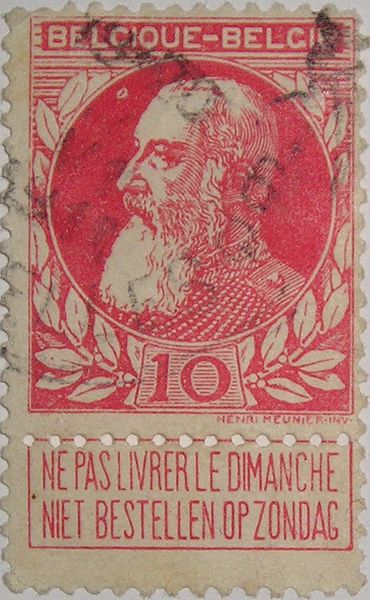
All the principles of Congo policy were decided by the king. But in the implementation of these policies, the administration of the state often played its own game. This was particularly true of the domanial régime. Leopold's will was that the state should extract the maximum profit from its domain. But he was not very much concerned with the way this aim was reached. The system of outright exploitation of the native population which gave, as the figures of production show, such extraordinary results, was mainly devised by the administration, both in Brussels and in Africa. Leopold limited himself to noting that the yield was satisfactory. However when the first accusers rose up to denounce abuses in the treatment of the Africans, the king was deeply moved. From 1896 to 1900, as his private letters reveal, he passed through several periods of agony. 'We are condemned by civilized opinion', he wrote in September 1896. 'If there are abuses in the Congo, we must make them stop.' 'It is necessary to put down the horrible abuses', he repeated in January 1899. 'These horrors must end or I will retire from the Congo. I will not allow myself to be spattered with blood and mud.'
On the occasion of each of these crises of anger and disgust, the king reiterated strict orders: cruelty to the natives should be severely punished. The Congo administration just waited for the storm to pass. It had elaborated a system and stuck to it. Altering the system might weaken it. The lessening of pressure on the Africans would naturally bring about a reduction of revenue; and the administration was well aware that, if this occurred, it would have more than royal anger to face. In other words, the administration distinguished between the king's permanent and fundamental desire--to increase the output of the domain--and his occasional crises of conscience. It modelled its action on what was permanent and fundamental. All those linked with the régime, therefore, and desirous of exculpating themselves, tried to convince Leopold II that the accusations against the Congo were unjust or exaggerated and were made in great measure out of ill will. The attitude of Leopold who, unconsciously no doubt, was ready to be convinced, thus came to undergo profound modification; instead of being affected by the attacks, he began soon to react more and more violently against them. Whereas the king almost always dominated his entourage, it may be said that in this case he allowed himself to be dominated by it (pp. 320-321).
Tuesday, August 17, 2010
A Congolese Martyr

Blessed Isidore was born in 1887 at northeast Republic of the Congo, and at a young age was hired as a domestic boy. Many of the Belgian plantation owners and their agents were avowed atheists, who hated the missionaries because of the latter's defense of the natives' rights and their denouncing of injustices perpetrated against them. "Mon pere" was a pejorative name given to priests and to all that had to do with religion. Isidore soon experienced the hatred of the agents for Catholicism. He asked for leave to return home; permission was refused. He was told to stop teaching his fellow workers how to pray: "You'll have the whole village praying and no one will want to work", one agent shouted at him. Isidore was told to discard his scapular. When he did not, he was twice flogged.
The second time, the agent flew into one of his rages. He jumped at Isidore, tore the scapular from around his neck and threw him to the ground. He had two servant boys hold Isidore by his hands and feet and a third domestic flogged him. The whip was made of elephant hide with nails protruding at the end. The writhing Isidore asked for mercy. "My God, I'm dying", he muttered. But the colonizer kept kicking Isidore in the neck and head, and ordered his domestic to scourge him harder still. After 100, those assisting lost count of the number of blows. Isidore's back was one open wound; some of his bones were exposed. After scourging he was thrown, legs chained, into a hut for processing rubber. He could not even move to relieve himself.
Since an inspector was due, Isidore was banished to another village. But because he could not walk, he fell by the wayside and hid in the forest. He dragged himself before the inspector, who was horrified at the sight of this modern Job. The inspector himself left a written account of his impression: "I saw a man come from the forest with his back torn apart by deep, festering, malodorous wounds, covered with filth, assaulted by flies. He leaned on two sticks in order to get near me -he wasn't walking; he was dragging himself". The agent appeared on the scene and tried to kill "that animal of mon pere", but the inspector even physically prevented him. He took Isidore to his own settlement, hoping to help him heal. But Isidore felt death in his bones. He told someone who had pity on him: "if you see my mother, or if you go to the judge, or if you meet the priest, tell them that I am dying because I am a Christian".
Two missionaries spent several days with him. He devoutly received the last sacraments. He told them the reason for his beating: "The white man did not like Christians.... He did not want me to wear the scapular.... He yelled at me when I said my prayers". The missionaries urged Isidore to forgive the agent; he assured them that he had already done so and that he nursed no hatred for him. This "animal of mon pere", this convert of two-and-a-half years proved that he knew what it meant to follow Jesus - even to the point of being flogged like him, even to the point of carrying the cross, even to the point of dying. The missionaries urged Isidore to pray for the agent. "Certainly I shall pray for him. When I am in heaven, I shall pray for him very much". His agony - more painful than the actual flogging - lasted six months. He died on either 8 or 15 August 1909, rosary in hand and the scapular of Our Lady of Mt Carmel around his neck - EWTN
Wednesday, June 30, 2010
Sunday, June 27, 2010
Monday, May 10, 2010

Saturday, February 13, 2010
Letters from the Congo

My grandmother, Dorothy Chambers, and her husband, Bruno Max Schlotter, went to the Belgian Congo in 1920 to practice missionary work for the Presbyterian church. From 1920 to 1928, they wrote a series of letters back to family members in Texas. These are the transcribed letters that describe their experience.I encourage my readers to have a look.
Friday, October 30, 2009
King Baudouin in the Congo
 We now come to the most controversial era in the history of royal visits to the Belgian Congo- the first decade of King Baudouin's reign. The young monarch visited Belgium's prized colony three times in this period, amidst mounting political tensions and demands for independence- a goal finally achieved in 1960. Above, we see a sombre Baudouin, arriving for the celebrations to mark this occasion in Kinshasa.
The last years of Belgian colonial rule were a deeply troubled, violent time. Nonetheless, the King's first visit- in the summer of 1955- left happy memories. The King was enthusiastically welcomed and nicknamed Bwana Kitoko ("Handsome Young Man") by the Congolese. Queen Fabiola, in her open letter on the 10th anniversary of her husband's death, recalled the warm atmosphere of this tour, while evoking the tragedies to come:
His first visit to the Congo left the memory of a young king, relaxed and cheerful among the Africans, amidst mutual sympathy and attachment. For this reason, he suffered greatly from the murderous clashes later endured in the Congo by Belgians and Congolese.
The moment was already fast approaching when Belgium and the Congo would part ways. From 1955 on, the movement for self-determination, led by nationalists such as Joseph Kasavubu and Patrice Lumumba, became increasingly vocal. In 1958, Lumumba founded the National Congolese Movement (MNC) and was soon leading strikes and demonstrations against the Belgian régime. The climate became increasingly bitter; many Belgians, not surprisingly, were reluctant to relinquish their lucrative empire. 1959 (the year of Baudouin's second colonial tour) began tragically with riots in Léopoldville. What was Baudouin's view of the developments? According to David Wilsford's Political Leaders of Contemporary Europe: a biographical dictionary:
In 1959, King Baudouin addressed the Belgian nation and for the first time recognized that independence of the Congo was imminent. Black leaders continued to organize and criticize the colonial power; they envisioned a presidential, autonomous system of government for the Congo. Baudouin, however, still viewed the colony as an "inheritance" and favored a "Belgian-Congolese" community where he would be maintained as king both of Belgium and the Congo. Nonetheless, in the midst of great political turmoil (and haste, making it impossible for the country to prepare adequately for self-government), the colony was granted independence on June 1, 1960 (p. 30)
Are we to understand that Congolese leaders wanted a complete break with the colonial past, and a republican constitution, whereas Baudouin hoped for an arrangement analogous to the British Commonwealth?
The independence celebrations, according to one fervent nationalist author, began in an exalted atmosphere combining "the pain of separation and the intoxication of liberty." The Guardian, by contrast, reported that the crowd in Kinshasa was "as small, and as unenthusiastic as an independence crowd could very well be. There were only about four thousand there, due, perhaps, to the confusion caused by hasty arrangements." In any case, it was the occasion for a royal visit which, unfortunately, rapidly degenerated into a diplomatic disaster.
Ceremonial gunfire marked the solemn occasion. The King, after praising the Belgians' contributions to the Congo over the past 80 years (even declaring that independence was the "crowning of the work" initiated by the "genius" of his forebear, Leopold II, the founder of the colony, and continued by the Belgian pioneers who helped to build the country) and insisting that the Congolese owed Belgium a debt of gratitude, warned his audience of the heavy responsibilities of their newfound sovereignty:
...Your rulers will know the difficult task of governing. They will have to make the general interests of the country their first priority. They will have to teach the Congolese people that independence is not realized by the immediate satisfaction of facile enjoyment, but by work, respect of the freedom of others and the rights of minorities, by tolerance and the order without which no democratic regime can subsist...
Baudouin's speech has aroused sharp criticism to this day. His tribute to the colonial régime is portrayed as shameless whitewashing of decades of brutal exploitation; his words of warning, as arrogant paternalism. The praise of the Belgians' work in the Congo certainly contrasts with the critical portrayals of colonialism by Albert I and Leopold III.
Lumumba (by then, the Congo's first Prime Minister) responded with an impromptu, violent denunciation of the evils of colonial rule.
Our wounds are too fresh and too smarting (for us to ever forget the colonial régime of the past 80 years)...(We) have known ironies, insults, and blows which we had to undergo morning, noon and night because we were Negroes. We have seen our lands spoiled in the name of laws which only recognised the right of the strongest. We have known laws which differed according to whether it dealt with a black man or a white.
We have known the atrocious sufferings of those who were imprisoned for their political opinions or religious beliefs and of those exiled in their own country. Their fate was worse than death itself. Who will forget the rifle-fire from which so many of our brothers perished, or the gaols in to which were brutally thrown those who did not want to submit to a regime of injustice, oppression and exploitation which were the means the colonialists employed to dominate us?
Tempers ran high (which was especially unfortunate, as the mood of the festivities had, hitherto, been fairly amicable), and the King, mortally offended, decided to cut short his visit and return to Belgium immediately. He was persuaded to stay, but reportedly long retained bitter memories of the episode...
So, our series on royal visits to the Congo sadly ends on a troubled note.


Wednesday, October 28, 2009
Prince Charles in the Congo
I never realized before that Prince Charles (younger brother of King Leopold III) made a visit to the Congo, in 1947, while serving as Regent of Belgium. Here are some interesting videos (courtesy of British Pathe) of this trip:
Monday, October 19, 2009
King Albert & Queen Elisabeth in the Congo
 The last decade of King Albert's reign was filled with a rapid succession of royal trips to the Congo...We have seen how Prince Leopold journeyed through Belgium's African possessions in 1925 and 1933. His parents did likewise in 1928 and 1932. Colonial issues were always close to the King's heart. In 1920, amidst the aftermath of World War I, while Belgian politicians were still focusing on the nation's recovery, Albert took the initiative of launching a Colonial Congress, the first in Belgian history. He emphasized the role the Congo could play in Belgium's economic development, while also inveighing against abuse of the native population. Plans for a royal visit were soon underway, and the first opportune moment came in 1928.
Accompanied by his wife, Queen Elisabeth, Albert arrived in Africa for the second time in his life. He had last seen the Congo as a young prince in 1909, and he would now retrace his steps. He wore a handsome white and gold uniform specially designed for the trip. Ordinarily, Albert was known for his royal indifference to externals ("Look for the worst dressed fellow of the bunch," he once told an official who asked how to recognize him when he was traveling incognito). Yet, the Congolese attached great importance to the outward trappings of rank and authority, so the King had to dress more grandly on his African visits.
According to a contemporary account of the trip:
The itinerary the King and Queen followed enabled them to visit the most interesting regions of our African colony. From Boma to Banana, the Sovereigns made the complete circuit of the Congo. Thanks to (modern transport), they were able, from Léopoldville, to reach Katanga directly, without having to make the long journey by river. From Elisabethville, where they arrived after a rapid journey by air and rail, the King and his entourage were able to retrace the route taken 20 years earlier by Prince Albert. It was a long...journey along the river, from Bukama to Banana, with many varied stops, with short trips by rail whenever the river ceased to be navigable, and a quick flight by air from Colquilhatville to Léopoldville and Boma (Boula Matari ou le Congo Belge, Jacques Crokaert, 1929).
Warmly welcomed throughout the trip, the King and Queen made detours to visit the agricultural enterprises of Mayumba, the diamond mines of Kasai, the rich lands of Rwanda, Urundi, Kivu and Uele. They met with colonial dignitaries, Christian missionaries and native chieftains alike. Crokaert describes the journey in rather complacent and triumphalist terms, eulogizing the genius of Leopold II in acquiring the colony, citing the vast technological progresses in the Congo since Albert's last visit, and stressing the natives' debt of gratitude for the benefits of European civilization. The King, however, told a different story. In a letter, he noted, with his customary caustic irony:
We have already seen many things, and, above all, many people. Very busy program, pathological insistence of public servants, private individuals, and even servants of God on being endlessly complimented on what they do or even do not do...Boma has not changed in 19 years. The governor-general's house is a dirty box. Matadi: frightful. An insult to the majestic river. Léo-Kin cuts a good figure, could become a magnificent city....To say the voyage is a pleasure would be a lie...The mentality of the big officials for the most part bad. The little ones are often worth more. Great greed everywhere, malice without bounds, few agreeable people. Some great potential in private enterprises (Léopold III, by Vincent Dujardin, Mark van den Wingaert, et. al. 2001.)
Quite critical, like his son! Yet, happier memories of Albert's Congo trips have also come down to us. Le Roi Albert et les Missions (1935) by Joseph Masson, S. J., for instance, provides a wealth of information on the royal couple's close and touching relationship with the Catholic missionaries in Africa. Despite the King's critical comments in his letter, he clearly admired their heroism, as many stories testify (see HERE). Once, for instance, he visited a convent school for young girls, future mothers of Christian homes. He was deeply moved by the experience and quietly told one of the nuns: "Continue, Sister, to devote yourself to this work, for the greater glory of God and for our country." To other missionaries, he confided: "I desire that, at my death, not a single pagan be left in the Congo." His concern for the spiritual welfare of his African subjects was matched by concern for their material prosperity too. He insisted on personally visiting the homes of ordinary people to see, with his own eyes, their living conditions. According to Masson, the indigenous people were very impressed by the kindness and piety of Albert and Elisabeth. Apparently, in religious controversies between Protestant and Catholic Congolese, the latter would even use the King's devout Catholic faith as a clinching argument: "You see the King belongs to our Church, so it must be the true one."
To the end of his life, King Albert was keenly preoccupied with Belgium's distant colony. In 1932, he would return for his third visit, traveling by air through the cotton farms of Uele and the national park bearing his name. As a final touching detail, his last day of work (according to Masson) was devoted to the Congo.
Thursday, October 15, 2009
Prince Leopold & Princess Astrid in the Congo
 Some may remember my post on Prince Albert's visit to the Belgian Congo in 1909. His son, Prince Leopold (future King Leopold III), followed in his father's footsteps in 1925 and 1933. His first trip took place before his marriage, but his second was graced by the presence of his lovely Swedish bride, Princess Astrid.
Visiting the Congo was an important step in the training of the heir to the Belgian throne. In Leopold's case, it was also the start of a lifelong passion for tropical exploration. After his abdication, he would undertake many expeditions through Africa, Asia and South America, recording his experiences in his Carnets de Voyages and taking a vast collection of magnificent photographs (see Léopold III, mon père and Léopold III photographe by Esmeralda de Réthy).


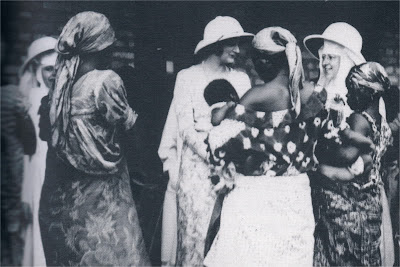
In 1929, the Revue de Zoologie et de Botanique africaine published an article on the Prince's first voyage to the Congo. Here is an excerpt:
In 1925, HRH Prince Leopold of Belgium, Duke of Brabant, undertook a study trip, lasting many months, to central Africa, and, more particularly, to the Belgian Congo. The route he took led him from the Atlantic Ocean to the Indian Ocean. The Prince had an opportunity to traverse very diverse regions, with very different physical characteristics, flora and fauna. These regions...encompass widely varying types of forests and wildernesses, and sometimes reach very high elevations, notably north of Lake Kivu.Despite his many occupations, the Prince, a fervent friend of Nature, was able, in the course of the trip, to find the time to gather specimens of the insect life of some of the regions he visited...Among a total of around 3300 specimens, there were found 1100 species and varieties: among these, many little known types, and over 40 new ones...The relatively high number of species reported and the number of new discoveries and rare forms, clearly shows the importance of the collection assembled by the Prince.
A hardy outdoorsman, Leopold trekked through the wilds on foot. He thoroughly investigated Congolese conditions, visiting mines, railways, hospitals, prisons and missions, interviewing local officials and questioning the humblest of his father's African subjects. He came away with a highly critical view of the colonial régime. He was very worried by the ill-health of the indigenous people, noting in his diary:
The population is weak and does not seem to increase much, its nutrition...is very insufficient, many terrible tropical illnesses are decimating it...an excessive and badly understood employment of labor aggravates the problems mentioned...bad recruitment, lack of care (lodging, clothing, return of sick workers to their villages, poor nutrition, etc.) bad hygiene in the camp clusters, low birth rate in the camps and urban agglomerations...
He noted the devastation caused, in particular, by the irresponsible policies of the palm oil industry:
These companies had obtained huge concessions of millions of hectares and were trying to expand them even further, by resorting to enclosures made to the detriment of the natives. Furthermore, to gather the palm nuts, the companies did not establish plantations, but limited themselves to harvesting the nuts produced by the palm trees in the forest. This forced upon the natives the hazardous task of climbing the tree trunks (which may reach) 20 or 30 meters in height. What is more, this harvesting policy obliged the natives to live with their families in insalubrious forests, where sleeping sickness often reigns. The result is a considerable mortality rate among the workers, and, above all, among their wives and children (L'education d'un Prince by Gilbert Kirschen.)
Despite his admiration for the heroism of the Christian missionaries, Leopold had some critical words for them, too:
The Catholic and Protestant missionaries have played so important a role in the Congo that it is impossible to pass an unmixed judgment on them... The idealism, the devotion, the self-sacrifice of the missionaries, men and women, must never be lost from view and deserve to be rendered homage. I am more hesitant when it comes to the concrete realizations of the missions. I was won over by the Brothers of the Christian Schools who determined...to promote the formation of carpenters, plumbers, mechanics, all knowing, of course, how to read and write and how to integrate themselves in industrial society, without having to break brutally with their milieu. Other missions....created....uprooted people, by forcing the natives to abandon their traditional values...this error never appeared so clearly to me as during that voyage in 1925 (L'éducation d'un Prince, by Gilbert Kirschen).
In 1933, the Prince would return to the Congo, further developing his grasp of the colonial situation. His wife proved an intrepid traveling companion and entered wholeheartedly into his concerns. In her memoirs, Astrid mon amie, her friend Anna Sparre explains:
(In her letters) she described not only the majestic landscapes...she also revealed her emotion, as she was faced with suffering, poverty and infant mortality. Upon her return, she moved heaven and earth to bring aid...Her sense of responsibility had been awakened and she did not stop at good intentions. Her husband entirely shared her sentiments. After their return, he delivered remarkable speeches: the Belgian interventions in the colonies, in his view, ought to benefit, first of all, the natives and their country...The princess, of course, did not deliver official speeches, but obtained results thanks to her disarming smile and her active commitment.
Leopold's bold and uncompromising moral stand on colonial issues did nothing to win him favor in certain industrial circles. Already, he was beginning to make powerful enemies, with ominous consequences in the decades to come.
(*the passages quoted were originally in French, the translations are mine)


Tuesday, September 29, 2009
Finds
It is actually quite difficult to find information on the Belgian royals' visits to the Congo. Most accounts mention these occasions only briefly. I did, however, unearth these titles:
- Albert, King of the Belgians and Buren, Raymond. Journal de route du Prince Albert en 1909 au Congo. 2008.
- Le Congo belge en images. 1927. (Discusses Prince Leopold's visit in 1926)
- Crokaert, Jacques. Boula Matari: au Congo belge avec le Roi Albert. 1929.
There are also the Carnets de Voyages (1919-1983) of Leopold III which, presumably, include his notes on his African trips in 1926 and 1933. I hope in the future to be able to take a look at these (via interlibrary loans and such) but it will probably take a while!
Sunday, September 27, 2009
Royal Visits to the Congo: A Timeline
 I am gathering information for a series of posts on the royal visits to the Belgian Congo (1908-1960). Meanwhile, here is a timeline of these occasions. Ironically, King Leopold II, who cunningly acquired the colony and shocked world opinion by exploiting it ruthlessly, never set foot in his distant possession.
- 1909- Prince Albert (later King Albert I), King Leopold's nephew and heir, tours the Congo, shortly after its annexation by Belgium (previously, it had been under Leopold's personal control.) He is intensely concerned with reform.
- 1925- Prince Leopold, King Albert's son and heir, follows in his father's footsteps by undertaking an extensive journey through the Congo, as part of his preparation for rulership. Like Albert, he returns with sharp criticisms of the colonial régime and suggestions for improvement.
- 1928- King Albert returns to the Congo, with Queen Elisabeth. This is the first time a reigning Belgian Sovereign has visited the colony.
- 1932- King Albert's third visit to the Congo.
- 1933- Prince Leopold's second Congo trip. He is accompanied by his wife, Princess Astrid, who enters wholeheartedly into his hopes and plans for reform.
- 1955- King Baudouin I makes his first state visit to the Congo. The young monarch takes a keen interest in colonial affairs, and, previously shy and reserved, appears to "blossom" on the tour. He is greeted by cheering crowds.
- 1959- King Baudouin's second visit. As Congolese demands for independence mount, the atmosphere is much more tense, even explosive.
- 1960- Belgium agrees to grant the Congo independence. King Baudouin attends the handover of power in the capital, Kinshasa/Léopoldville.
Saturday, July 18, 2009
Prince Albert Visits the Congo, 1909
In Albert, King of the Belgians (1929), Evelyn Graham provides an account of the expedition to the Belgian Congo undertaken by Prince Albert (future King Albert I) in 1909. A year earlier, the area, formerly the "Congo Free State," a private possession of King Leopold II, had been annexed by Belgium. The reports of atrocities and abuses suffered by the indigenous people under the Congo Free State had deeply distressed Prince Albert, and he was determined to embark upon a program of reform.
Probably the most notable event in the years following Prince Albert's becoming Heir- Apparent was his journey to the Congo in 1909. There is no doubt that the ceaseless agitations, and the unsparing criticisms of the administration of Congo affairs, had troubled Prince Albert considerably more than they had disturbed King Leopold. There was an entire contrast between their outlook on life, for whereas Prince Albert always recognized that his first duty was to his country, King Leopold seemed, in certain actions at all events, to consider his duty to himself paramount.For several years previous to Belgium's annexation of the Congo, Prince Albert had studied with the closest attention all questions relating to the State. He was a frequent visitor to the Colonial Museum, reading everything of importance published on the subject of the Congo and its development. He lost no opportunity of meeting and conversing with all persons whose experience had put them in a position to enlighten him on any matter regarding affairs in the "Dark Continent," as it was called.Being highly conscientious in his treatment of all men, the allegations regarding the treatment of Congo natives grieved and distressed him. He knew, of course, that many of the reports of wrong-doing were exaggerated, but he felt that any doubt at all as to the matter was a slur on the fair fame of Belgium, and something in the nature of a challenge to himself as its future ruler.He had many conversations with King Leopold on the subject — one or two of them being of a very piquant nature. In these interviews the Prince spoke his mind with a freedom and courage that his uncle by no means relished. King Leopold was always impatient of criticism in any form, and, to the day of his death, he never admitted that there had been any defects in his administration of the wonderful colony which he had gained for his people.Prince Albert welcomed the appointment of M. Renkin as Colonial Minister, for the reason that he had always shown himself zealous in all manner of reforms on the Congo. M. Renkin and the Heir to the Throne held lengthy discussions as to the best means of putting these reforms into practice. M. Renkin's first Budget surprised the country, for, with great boldness and a supreme faith in the future of the Congo, he sanctioned an outlay far in excess of any sum hitherto assigned to the administration of the colony. In this Budget there was allowed for administration in Africa over 7,000,000 francs ; for health, nearly 900,000 francs ; and for justice nearly 2,000,000 francs. It may be added that M. Renkin had his reward in seeing the price of rubber rise by over fifty per cent, by which rise Belgium was saved the necessity of raising another Colonial loan. His foresight and courage were therefore rewarded financially as well as in improving the condition of the Congo.During M. Renkin's tenure of office, Prince Albert achieved what had been for several years his great ambition — he toured the Congo. Over and over again he had expressed his wish to make this visit in order that he might see for himself what truth there was in the constant charges against King Leopold's administration, and that he might consider what could be done to put matters on a more satisfactory basis. In Court circles, it was well understood that the only thing that had prevented the Prince hitherto from carrying out his desire was the attitudeof King Leopold himself.Although Prince Albert was his direct heir, the King's grasp on the reins of government was tenacious to the very hour of his death. He knew and acknowledged — not only in public speeches made for the world's ears, but in private conversations not meant to pass beyond the walls of the room in which they were held — that his nephew had in him the makings of a successful ruler. He realized that the Prince was highly popular with his future subjects, and that he had qualities which would enable him to fill the throne with dignity, firmness, and courage. At the same time King Leopold seemed determined that Prince Albert should have no added opportunities of demonstrating his fitness for the position he was destined to fill.In the end, however, the Prince had his way ; defeating his uncle's stubborn anger and mocking cynicism with unwearying persistence, he held to a firm resolve to further the ends of justice, and do what he considered his duty to his future African subjects.In the spring of 1909 he set out for the Congo.It was arranged that M. Jules Renkin should accompany him, but, in order that the survey might be thorough, it was decided that the Prince should traverse the country from east to west, while the Colonial Minister should start from the west. The Prince, accompanied by Baron de Moor, left Southampton on April 3rd, 1909, and spent the following four months travelling throughout the length and breadth of the Congo. He covered nearly 3,000 miles — partly by land, partly by river, and, in a lesser degree, by rail. Only the members of his suite can really appreciate the thoroughness of his investigations. He was not content with seeing things and asking questions. He had his staff supplied with notebooks, and saw that they used them, while he himself filled book after book with his own personal comments. These copious notes helped him greatly in the reforms which he inaugurated subsequently.On foot, in a steamer, in a train, he passed day after day, seeing all that was to be seen. He inspected the hospital ; he attended service in the churches ; he visited the schools, and made friends with the scholars at once ; and called at several of the mission posts.Prince Albert talked with everyone with whom he came contact. Often these conversations were of the most informs character. It was useless for officials to wait upon him with written reports, expecting him to accept them without further investigation. It was more than useless to attempt to put him off with ready-made information. Prince Albert had come to make his own discoveries in his own way, and he accomplished his task.The European residents and officials were delighted with his visit for, tired though he might be, yet not so tired as certain members of his staff, he responded with characteristic courtesy to all their efforts to entertain him. Officials and their wives, many of them now retired and scattered in different parts of the country, still speak with pleasure of the tour when Prince Albert was among them, and made so gallant and gracious a figure at the receptions at which they were presented to him.But it was to the natives that Prince Albert paid the greatest attention. When it was learned — and the news spread in the amazing way peculiar to native communities — that King Leopold's heir was coming among them, the chiefs of every tribe clamoured for an audience. They besieged him with the story of wrongs which demanded to be redressed. With untiring patience, the Prince listened, questioned, investigated the truth...and promised to see that just grievances should be put right and each man have his due. These promises he redeemed with scrupulous care on his return.His fine stature and kingly bearing impressed greatly the Congolese. They conferred upon him a native title meaning "Tall Man, Breaker of Stones," There is no doubt that Prince Albert's tour of the Congo State did much to reconcile the natives to the new regime and to give them confidence in the future.The Prince who, as has been mentioned, had been greatly troubled by the reports of Congo atrocities, was determined that he would take not merely European statements on these, but would get the natives to talk freely. To the consternation of his staff, he would often disappear, and be found later in the native quarters, surrounded by a group of Congolese, all intent upon pouring their life histories into his attentive ears.On one occasion he was discovered squatting upon the ground before the hut of a native chief, vis-a-vis with his host, who, in somewhat peculiar English, was recounting his version of the history of the past decade. The Prince, with the unfailing notebook open on his knee, was endeavouring to translate the story into the kind of language that could be written down.It was this eagerness to obtain first-hand information that deepened the respect which the natives had been prepared from the first to accord to one of Royal rank. They realized that he had a brotherly nature and was anxious to help them to the best of his ability.The tour, interesting though it was, offered many discomforts and even hardships, not to mention the difficulties peculiar to tropical climates. M. Renkin's health suffered greatly from the trials of the tour, but Prince Albert faced it all unperturbed. His robust frame and excellent constitution enabled him to withstand the heat, to ward off the tropical fevers to which the white visitor succumbs so often, and to finish his tour in as good health as when he set out. Again and again he had to "rough it"...The Belgian people and the Press had welcomed the prospect of Prince Albert's travels with enthusiasm. They had had no part in whatever malpractices had occurred in the Congo, but the world's criticism had been directed against Belgium, and they felt that Prince Albert's visit would do much to remove any grounds for the campaign of bitter criticism which was being conducted not only against their Sovereign but against his people.When the date of the Prince's return was announced, Antwerp prepared a wonderful welcome for the Prince, on the occasion of his joyeuse entrée, as one Antwerp paper called it. The Congo steamer, the Bruxellesville, was due on Monday, August 16th, 1909, and from the earliest hour Antwerp was packed with sightseers from the surrounding district, anxious to greet their Prince. They desired to express their gratitude publicly for the labours he had undertaken...
Saturday, March 21, 2009
"Moi aussi, je servirais avec plaisir"
Another story from Le Roi Albert et les Missions illustrates King Albert's admiration for the Catholic missionaries in the Belgian Congo, and sheds light on his own spirituality.
...(N)on contente de s'exprimer en des circonstances solennelles, cette admiration reconnaissante se traduisit également, combien de fois! en des audience privées...
Ne citons qu'une conversation avec le Père Prieur d'Orval... On parlait du dévouement.
'L'année passée,' rappela le Roi, 'j'étais au Congo. Le Frère Gillet, de la Compagnie de Jésus, nous avait fait les honneurs de son magnifique jardin botanique. Et, à midi, étant coadjuteur, il servait à table.
Le Gouverneur Général se penche à mon oreille: "Cela doit bien humilier le Frère Gillet de remplir cet office?"
Je lui réponds: "Mais pourquoi? Moi aussi, je servirais bien... Vous verrez. Après le dîner nous le lui démanderons."
Nous allons donc le trouver. "Est-ce que cela vous à gêné de nous servir?"
Il réplique: "Mais non, je n'y ai même pas pensé... - "Vous voyez," dis-je au gouverneur....
Moi aussi, je servirais avec plaisir. Quand le monde s'éloigne de l'Evangile, il fait fausse route, retournant aux erreurs de la civilisation romaine où tout était basé sur l'orgueil et la force, tandis que la doctrine de Christ repose sur l'humilité et la charité.'
...Not content with expressing this grateful admiration on official occasions, he also did so - how many times! in private audiences...
Let us take one example - his conversation with the Prior of Orval (a Benedictine monastery in Belgium)... They were discussing abnegation.
'Last year,' the King recalled, 'I was in the Congo. Brother Gillet, of the Society of Jesus, had done us the honors of his splendid botanical garden. And, at noon, being coadjutor, he served at table.
The Governor-General bent over my ear: "It must be humiliating for Brother Gillet to perform this service?"
I replied: "But why? I, too, would gladly serve... You will see. After lunch, we will ask him."
So we went to find him. "Did it irritate you to serve us?"
He answered: "No, I did not even think about it..." - "There, you see," I said to the governor.
I, too, would serve with pleasure. When the world distances itself from the Gospel, it takes the wrong path, returning to the errors of Roman civilization, where everything was based on pride and force, whereas the doctrine of Christ rests upon humility and charity.'
"He who would be greatest among you must be the servant of all." King Albert seems to have made this injunction the rule of his life.
Subscribe to:
Posts (Atom)

