Showing posts with label leopold ii. Show all posts

Thursday, April 11, 2013

Mourning a Prince

Again, I have to apologize for a long absence. This was not due to lack of interest in the Belgian royal family, but I have been very busy with studies and pro-life work. I will still be maintaining this blog, but it seems that I will have to post here less often than in previous years.

I find many of the old prayer cards commemorating deceased members of the Belgian royal family to be quite touching and sobering, as well as helpful in shedding light on traditional Belgian religious practices. Here are memorial cards to Prince Baudouin (1869-1891), the handsome, pious and gifted elder brother of King Albert I.

Netley Lucas, in Albert the Brave: King of the Belgians, captures the mood of the Belgians during the tragic family illness that so suddenly took the life of the heir to the throne. The shattering effect of the loss of his nephew upon the ostensibly cold, formidable and impervious King Leopold II is especially striking.
Towards the end of 1890, Prince Albert caught a bad cold, which developed quickly into a species of influenza. From the Prince the illness spread to his sister Princess Josephine, and from her to Princess Henriette, whose condition grew gradually worse until it was considered necessary to publish bulletins. The life of the Princess was for some days in danger. The anxiety of the Count and Countess was lightened by the manifestations of popular sympathy with which they were overwhelmed. The Palace of the Rue de la Regence was besieged with streams of callers of all ranks and classes, who begged for the latest news or brought gifts that, in the case of the poorer donors, were indicative of the very deep sympathy felt by everyone. 
The malady ran its course, but happily the constitution of the Princess, strengthened by the simple, wholesome life she had led, withstood the strain. Towards the middle of January, 1891, Princess Josephine was pronounced out of danger. But no sooner were her parents relieved of one anxiety than another arose. On January 17th, only a day after the hopeful report of the Princess had been published, Prince Baudouin was taken ill. He took the disease in a lighter form, and though his condition gave rise to anxiety, he was not at first so ill as had been his sister, and no bulletins were issued. He was indeed well enough to take a walk. Unhappily, the illness increased suddenly, and despite every precaution, Prince Baudouin developed pleuropneumonia. He grew steadily worse, after less than a week's illness, he passed away on January 23rd, 1891.  
Prince Baudouin was in his twenty-second year. It was stated that he would probably have married his cousin Princess Clementine. By a sad coincidence his death took place on the fiftieth anniversary of the death of King Leopold's only son. Queen Victoria and all the crowned heads of Europe hastened to express their condolence with the bereaved parents and King Leopold. Court mourning in Belgium was ordered for three months.  
The funeral took place on January 29th, amidst universal signs of sorrow. The service in St. Gudule was deeply pathetic. The coffin was followed by King Leopold who, said the representative of The Times, "was quite overcome by emotion and walked with halting steps, supported on his left by the Count of Flanders, who was himself weeping bitterly...The young Prince Albert, the sole surviving son of the Count of Flanders, who walked by his father, also betrayed profound grief."(pp. 29-30)
Above is a highly symbolic scene, featuring the Cross, flowers, dynastic heraldry, mourning ribbons and a drooping Belgian flag, with the words:

"The entire Nation weeps for the beloved prince whom cruel death has snatched from our hopes."

Here, Belgian Catholics are entreated to pray for the repose of the soul of their prince, while being reassured that he died with the benefit of the Sacraments of the Church. Pious thoughts are also offered:

"My kingdom is not of this world."
"It is the Lord who heals their broken hearts and binds their wounds."
"God will clothe him in a mantle of justice and place on his head a crown of glory."
"Merciful Jesus, give him eternal rest."

Friday, March 8, 2013

Four Generations of the Belgian Royal Family

A dynastic portrait showing young, intense Princess Elisabeth of Belgium, the future Nurse-Queen of the Great War, with her sons, Prince Leopold, future Leopold III, and Prince Charles, the future Regent. Behind Elisabeth, from left to right, are her in-laws and patriarchs of the Belgian royal family, Leopold I, Leopold II, and her own husband, Prince Albert, future Albert I. The portrait commemorates the 75th anniversary of Belgian independence in 1905, and suggests that the new kingdom is entering the new century with confidence, pride and high hopes for the future. 

Of course, not all the figures appearing in the picture actually met in real life. Leopold I, the founder of the Belgian branch of the Saxe-Coburgs, died in 1865, ten years before Albert's birth and eleven years before Elisabeth's. Leopold II only overlapped briefly with his great-nephews, Leopold and Charles. In L'éducation d'un prince (1984), a collection of interviews with Leopold III, he describes only a few childhood memories of meeting the very controversial Leopold II, on holiday at the seaside in Ostende. The sensitive, rather fragile-looking little boy had a recollection of his stern, bearded great-uncle pinching him on the cheeks and telling him to eat heartily and get strong! Leopold III also remembered that his parents never spoke of the scandals in their uncle's personal life that gave rise to so much gossip in Belgium and beyond. 

Friday, May 11, 2012

Nationality and the Belgian Monarchy

Michael Palo thoughtfully reviews Belgium and the Monarchy: from National Independence to National Disintegration, an adapted English translation of Herman van Goethem's book  De monarchie en ‘het einde van België’: Een communautaire geschiedenis van Leopold I tot Albert II. I must admit, however, that I did not like the reviewer's vaguely ominous comments about the intentions of Leopold III. While discussing his Political Testament, Palo claims that the King "had done nothing less than outline an authoritarian future for his country." This suggests that the Political Testament was a call to change the Belgian Constitution radically along authoritarian lines, which it was not. In fact, in the same document, Leopold noted that his role, as a constitutional monarch, did not allow him to take sides with one political doctrine or program or another. Rather, he said, it was for the Belgian people, freely consulted, to decide upon any possible changes to the political structure of the kingdom.

Friday, May 27, 2011

King Leopold's Soliloquy

Here is the full text of Mark Twain's scathing satire of the founder of the Congo Free State. As always, Twain is a brilliant writer; for a more balanced account of Leopold II, however, see here.

Tuesday, March 15, 2011

Defending the Saxe-Coburgs: Part III

(Continued from Part I and Part II)
Ever since Paul Reynaud's tragic, unjust indictment of the King, on May 28, 1940, an endless series of personal attacks have been launched at Leopold III. In the aftermath of Reynaud's venomous broadcast, accusing the King of betraying the Allies, the man who had been hailed by the world as a hero only a few weeks earlier began to be vilified as a coward, a traitor and a libertine. There were rumors, for instance, that he had a Nazi mistress planted on him by the Gestapo. During the Nazi occupation, lewd pamphlets circulated through Belgium, sometimes with the connivance of the German authorities. Other, more clever troublemakers produced damaging forgeries in the name of intimates of the King, such as his secretary, Count Robert Capelle. After the liberation of the country, during the controversy over the King's wartime conduct, the tradition of personal attacks continued. According to authors such as Roger Keyes and Jean Cleeremans, a special agency was even set up in London to spread scandalous stories about Leopold. Every effort was made to portray the King and his second wife, Princess Lilian, as a decadent, self-indulgent and morally enervated pair, as the Belgian equivalents of the Duke and Duchess of Windsor, if not worse.

The royal couple, for example, were accused of "honeymooning" in Austria at the home of a "notorious Nazi". The legend has persisted to this day, appearing in many publications and flaring up all over online forums. In an interview, transcribed in Le Soir, on September 3, 1998, upon the publication of his biography of Princess Lilian, Evrard Raskin insidiously asked why Lord Keyes, in his defense of the King, had "willfully ignored" this episode. The question seems highly disingenuous, since far from "willfully ignoring" the charge, Keyes actually answers it at great length. In Échec au Roi (1986), he demonstrates, in detail, that the King had to travel to Vienna to see a specialist for a delicate jaw operation. His new bride accompanied him on the trip, but it was no fun to travel with the Gestapo on their trail. In addition, Lilian had to care for a husband unable to eat normally for some time following the procedure. It does not seem to have been a very idyllic "honeymoon". Keyes also disputes the claim that the King's host was a "notorious Nazi"; on the contrary, he says, the man in question actually had Allied connections. The journey through hostile territory, moreover, gave Leopold something of an opportunity to reconnoitre. Are these conflicting versions of events merely a case of Keyes' word versus Raskin's? I think not. It's significant that Raskin resorted to pretending that Keyes had ignored the alleged pleasure trip, rather than offering counter-evidence to try to refute Keyes' account. To me, this suggests that Raskin lacked counter-evidence to provide. Besides, is it likely that the same King who took such pains to maintain his passive resistance to the occupying power, evading all efforts to lure him into collaboration, would compromise himself so carelessly by blithely vacationing in Hitler's homeland, by fraternizing with a pillar of Hitler's régime?

By far the most infamous and implausible accusation, though, is the claim that King Leopold, during his visit to Berchtesgaden in November, 1940, to press for the release of Belgian prisoners of war, and for better treatment of the Belgian civilian population, consorted with call-girls, obligingly placed at his disposal by the Gestapo! This allegation, supposedly emanating from an interrogation of a Gestapo official, has been repeated by authors such as Evrard Raskin and Paul Beliën. I would rather not mention such a vile claim, let alone dignify it with a response, but it is important to see how low Leopold's enemies have been willing to stoop. Keyes describes how Leopold's opponents, presumably using the hope of more lenient treatment as leverage, tried to provoke damning "testimonies" against the King from captive Germans, who were themselves compromised by collaboration with the Nazi régime. General Alexander von Falkenhausen, the military governor of Belgium during the occupation, for his part, related that he had been pressured, in prison, to bear false witness against Leopold III. The version of events which, he claimed, some supposed Belgian officials had attempted to cajole him into confirming, like the story of the escorts at Berchtesgaden, cast Leopold in a ridiculously hedonistic light: the King was supposed to have celebrated his own imminent deportation to Germany, in June, 1944, by drinking a bottle of champagne in the General's company. If the Gestapo official in question did, indeed, tell such a disgusting tale, I suspect that similar pressure was behind it. In any case, in his memoirs, written long after the fact, in perfect liberty, Herr Schmidt, Hitler's interpreter, noted the Belgian monarch's stiff, reserved, dignified manner, his adroit skill in avoiding compromising himself, during his visit to the German chancellor. He also indicated that the King specifically, and rather disdainfully, refused the Führer's offer of personal favors...

Unfortunately, the attacks did not come to an end with Leopold's abdication in 1951. As I have mentioned before, in the decades to come, many rumors of conjugal discord and infidelity would swirl around Leopold and Lilian. In 1962, despite the laws protecting the personal lives of private citizens, including the former King of the Belgians at this point in his career, a particularly vulgar and virulent press campaign, combined with the tacit acquiescence of the public authorities, would oblige Leopold to submit a stern protest to the Belga news agency.  Like many other couples, Leopold and Lilian may well have had moments of marital friction. Yet, Michel Verwilghen notes, the lurid tales tended to emanate from the political class. This milieu had much to justify: the rejection of a monarch who had previously been cleared of all charges of treason by a commission of inquiry consisting of eminent jurists, and who had been restored to his royal prerogatives by the majority vote of his people. To compensate for the absence of solid, irrefutable accusations of political misconduct, would charges of personal misconduct not be very helpful? Furthermore, from the beginning of his career, Leopold had been known as an idealist. Even before ascending the throne, for instance, he had irritated colonial interest groups by insisting on responsible rule of the Congo. During the early years of his reign, he had alienated many party politicians by condemning their selfishness; these tensions would later be complicated by his wartime differences with his ministers and allies. "Le monde politique ne pardonna pas au Roi son souci du bien commun et sa grande moralité politique"*. To discredit, as a moral leader, a man who was a reproach to many, would smears not be highly useful? In Leopold's regard, too, the political world and the press did not have much of a record of truthfulness. For example, Prime Ministers Gaston and Mark Eyskens, aided by journalists, promoted the extravagant, absurd, false, but incredibly persistent rumors that Leopold and Lilian had "pillaged" Laeken during their move to Argenteuil. In such a treacherous environment, are we to believe rumors of extramarital affairs?

What of the supposed love children attributed to the King? In A Throne in Brussels (2005) Paul Beliën claims that Count Michel Didisheim, a distinguished Belgian civil servant, is an illegitimate son of Leopold III, fathered during his marriage to the beautiful and beloved Queen Astrid, no less. The claim is based only on the fact that Didisheim "resembles" the late King. In a weaselly footnote, Beliën admits that Didisheim's supposed royal paternity has never been proven. Nevertheless, he says, he has it on the authority of "sources in Brussels" which he considers reliable. The rumor also figures in De Kroon Ontbloot (2008), a sensationalist book by Noël Vaessen, a disgraced former aide to Prince Laurent, the youngest son of King Albert II and Queen Paola. On October 16, 2008, after the appearance of both books, Michel Didisheim issued a press release, published in La Libre Belgique, denying that he was the son of Leopold III. Nevertheless, the claim has recently been reiterated by Leo van Audenhaege.

For several reasons, I find the story highly implausible. First, Leopold adored Astrid. In Vännen min (1985), the Queen's closest companion, Anna Sparre, emphasizes that the King was a completely devoted husband. (And Anna was not one to over-romanticize the past. In fact, she can be quite critical, at times, in her recollections of her friendship with Astrid. For instance, she portrays Astrid's mother-in-law, Queen Elisabeth, rather derisively, something I found to be out of place). Second, Michel Didisheim's mother, Claire Maigret de Priches, seems to have been a lady of high character. An Allied agent during the Second World War, she was deported to Ravensbrück concentration camp, to be starved and tormented by Nazi doctors, who injected typhus into her blood to develop serum. According to a fellow inmate, she bore these terrible experiences with great courage and kindness. I doubt that such a heroine would have been a woman of easy virtue. Third, Michel seems to have been the eldest legal child of Baron René Didisheim and Claire Maigret de Priches, born barely more than nine months after their marriage. Are we to believe that Claire had a tryst with the then Duke of Brabant, around the same time as her wedding night? It's a bit grotesque...And the fact that Michel Didisheim, a littérateur with a keen interest in European royalty, wrote a novel about Valerie Schwalb, an illegitimate great-grand-daughter of Queen Victoria, proves precisely nothing...

Leo van Audenhaege also made headlines last month with a totally weird new allegation, regarding a supposed wartime affair with an "ice princess", the married Austrian skating champion Liselotte Landbeck. According to Van Audenhaege, the young and pretty Liselotte was invited to Laeken to teach the royal children to ice-skate, during the winter of 1939-1940, and Leopold and Liselotte "fell in love at first sight", possibly consummating their relationship on the very first night after they met, at the palace. The result, the author continues, was the birth of an illegitimate daughter in Antwerp a year later. Supposedly, Liselotte's hospital room was "filled with flowers from Laeken" and a signed photograph of the "biological father" of her baby was also prominently on display. Incredibly implausibly, despite all this indiscretion, the story was allegedly kept a dark secret for over 70 years; so dark, in fact, that even Leopold's daughter-in-law, Princess Léa, who has doubtless heard many rumors in her time, was extremely surprised at this "revelation".

It all sounds very suspicious to me. Why would Liselotte Landbeck even be needed to teach the royal children how to ice-skate? I would actually be very surprised if Joséphine-Charlotte, Baudouin and Albert did not already possess this skill. The Belgian royal family were famously athletic, and, surely, this was not the first time the ponds at Laeken had iced over! Even if the children did not know how to skate, surely someone in the royal entourage could have given them lessons? Skating is hardly an arcane art. Could the children's much-loved Dutch governess, for instance, not have served the purpose? The Dutch are famous for their feats on the ice. Furthermore, is it likely that the King, who was quite slow, prior to the war, in his advances towards a much more beautiful, single woman, Lilian Baels, whom he could legitimately court, would fall head over heels in love with Liselotte Landbeck, already married to another, at their first meeting? Is it probable that Leopold and Liselotte would tryst at Laeken, of all places, under the eyes of all the palace staff? (Even Leopold I and Leopold II, who genuinely had affairs, met their mistresses elsewhere). Is it credible that the King, while his reputation was in an extremely fragile position, amidst the flurry of scandalous stories circulating in the wake of Reynaud's indictment, would advertise that he had fathered an illegitimate child, by sending his mistress loads of flowers and a signed photograph, to be seen by doctors, nurses, patients and passers-by?

The semi-satirical Belgian paper, Humo, claims to have interviewed the supposed daughter, Ingeborg Verdun, who allegedly lives in the United States under an assumed name, but Leo van Audenhaege has apparently refused to reveal Ingeborg's current identity, or the location of her mother, merely claiming that Liselotte, now very elderly and frail, lives in southern climes. Supposedly, this discretion is motivated by a concern to protect these ladies from press attention, but it is also all very convenient, since it makes it much harder for a third party to verify Van Audenhaege's story. Frankly, too, if Ingeborg Verdun is willing to expose the entire royal family of Belgium, including a deceased and already much-maligned man, to such lurid press attention, she ought to have the decency and integrity to face the same sort of publicity herself, especially when unheard-of allegations are being made. Furthermore, even if Ingeborg Verdun has, indeed, claimed to the the daughter of Leopold III, it's not necessarily true...Consider, for instance, the elaborate imposture of the Affair of the Diamond Necklace.

In fact, the story of Ingeborg Verdun seems incredibly implausible, even aside from everything else, for this simple reason: if it is true, then WHY was it not eagerly unearthed and widely publicized long ago, particularly during the torrential mudslinging of the Royal Question? It would have been very useful to Leopold's enemies to be able to charge him with frittering away his time with a mistress- an Austrian mistress, too, one of Hitler's fellow country-women- while his people were embroiled in war and occupation. Instead, they resorted to trumping up nonsense of Nazi mistresses, honeymoons in Vienna and call-girls at Berchtesgaden. It all sounds quite desperate...

To the allegations concerning Michel Didisheim and Ingeborg Verdun, Leo van Audenhaege has added yet another rumor. He claims that Leopold had a third illegitimate child, a son, conveniently left unnamed, by a young Frenchwoman, during the 1950's. In the press, Van Audenhaege blustered: "What I say is 100% certain. Nobody will be able to refute this". How can anyone be 100% certain about such matters in the first place? Was Mr. van Audenhaege present at the conception of the child? Has he performed a DNA test? Apparently, Prime Minister Achille van Acker (above) reported the birth of the supposed son, among other lurid rumors regarding the royal couple, in his private papers. Achille van Acker, however, was a highly devious individual, a bitter opponent of Leopold III, and a man with a vile mind. During the Royal Question, he tried to frame his Sovereign, accusing him of conniving at his own deportation to Germany, based upon the false testimony of a treacherous friend of the King, Victor van Straelen. (Fortunately, the commission of inquiry investigating Leopold's conduct was able to refute these claims, by demonstrating that the testimonies of all the other witnesses, including Cardinal van Roey, and the rest of the evidence relating to the deportation contradicted Van Straelen's account). It was Achille van Acker, too, who tried to suborn Princess Lilian, offering her ample sums and luxurious advantages, if only she would abandon her husband in exile and return to Belgium with Prince Baudouin. It was Achille van Acker, moreover, who fomented the despicable allegations of an incestuous relationship between Baudouin and Lilian. This is how the Prime Minister, hardly the chivalrous gentleman, referred to the Princess: "Une intrigante qui a la moitié de son derrière sur le trône, et qui se tortille pour y installer l'autre"**. There you have the man. Achille van Acker is not a reliable source concerning Leopold III.

Finally, the 1950's opened with messages of passionate tenderness, overflowing with love for his wife and family, from Leopold to Lilian, and closed with the King's noble tribute to the Princess, on the eve of the wedding of Baudouin and Fabiola. Leopold reminded his son of all he owed Lilian, who had shared her husband's ordeals with the greatest courage, while giving her step-son the affectionate and vigilant care that his own mother, so mourned by all, had not been able to provide herself. It seems rather a surprising admonition on such an occasion. In marriage, a man leaves his father and mother to cleave to his wife, and yet, Leopold saw fit to emphasize the family's debt to Lilian even at this moment. Afterwards, amidst the cruel press campaign against Leopold and Lilian, the former King of the Belgians reiterated the same sentiments of respectful gratitude towards his second wife. Many beautiful photographs from the 1950's also bear witness to the harmony and joy of the royal family in this period. It is during these years that Achille van Acker supposedly claimed that Leopold was having extramarital affairs, spending millions of francs on mistresses, fathering illegitimate children, and even contemplating divorcing Lilian. I think not. In my opinion, Princess Esmeralda described her parents' marriage much better: "Leur seul tort fut de s'aimer"!***


*"The political world did not forgive the King his concern for the common good, or his great political morality".
**"A schemer who has half of her rear on the throne, and is wriggling to set the other half there".
***"Their only fault was to love each other!"

(to be continued)

Thursday, March 10, 2011

Defending the Saxe-Coburgs: Part II

We must not trust every word of others or feeling within ourselves, but cautiously and patiently try the matter, whether it be of God. Unhappily we are so weak that we find it easier to believe and speak evil of others, rather than good. But they that are perfect, do not give ready heed to every news-bearer, for they know man's weakness that it is prone to evil and unstable in words. ~Thomas à Kempis

With all the discussion of unhappy and unfaithful royal marriages, it is forgotten that there have also been many devoted ones. Notable examples are St. Louis IX of France and Marguerite of Provence, Charles I  and Henrietta Maria of England, Louis XVI and Marie-Antoinette, Louis-Philippe and Marie-Amélie, Tsar Alexander III and Empress Maria Feodorovna of Russia, Queen Victoria and Prince Albert, Tsar Nicholas II and Empress Alexandra, Emperor Charles I and Empress Zita of Austria-Hungary. Sadly, however, stories of virtue tend to be neglected, while stories of vice are frequently featured in popular accounts of the lives of past monarchs. As a result, many credit lurid rumors about royalty hastily and uncritically, assuming that all kings, more or less, are libertines. In Belgium, these prejudices are feeding the current campaign to portray the reigning Saxe-Coburg dynasty as lascivious and promiscuous. In my opinion, the campaign is often unfair; in a previous post, I gave my thoughts on the attacks on the first three Kings of the Belgians: Leopold I, Leopold II and Albert I. Over the next few weeks, I hope to discuss some of the gossip surrounding their successors: Leopold III, Baudouin I and Albert II.

Leopold III has the general reputation of an inveterate libertine. This image has been reinforced by authors such as Evrard Raskin, Paul Beliën, and, most recently, Leo van Audenhaege. Granted, no man is immune to temptation. Yet, I tend to disbelieve the accusations of promiscuity. Authors such as Roger Keyes, Jean Cleeremans, Georges-Henri Dumont, Jo Gérard and Michel Verwilghen all contradict these charges. However deeply entrenched in the public mind, by endless repetition, the scandalous allegations have often emanated from suspicious sources, at suspicious times. Before the Second World War, Leopold III did not have a reputation for libertinism; quite the opposite. A neutral witness, the American ambassador to Brussels from 1938-1940, Joseph E. Davies, described the young, handsome, athletic King of the Belgians as a noble man of great moral intensity, completely devoted to his duty and to his family, chaste, irreproachable, above even the suspicion of scandal. In The Prisoner at Laeken: King Leopold, legend and fact (1941), written to defend the King from charges of treason during the Nazi occupation, Emile Cammaerts noted his sterling record, prior to the war. In the glare of modern publicity, he argued, Leopold had led a spotless life; how could such a man turn, overnight, into a scoundrel? What sense would such an argument make, if the King had already been known for corrupt habits? In Amours royales et princières: mariages, liaisons, passions et trahisons de la cour de Belgique (2006), Patrick Weber also indicates that the lurid rumors about the King surfaced later in his career. In fact, the legend of Leopold's libertinism evolved amidst a flood of other venomous accusations, amidst the many calumnies promoted by his political opponents, a fact which ought to put us on our guard in the first place. Nor does debauchery accord with the King's lofty, uncompromising idealism, his profound piety, or his spiritual serenity.


There is evidence that Leopold III cared deeply about chastity: his alarm, for instance, during the Nazi occupation, at the prospect of the deportation of young Belgian women to Germany. Appalled by the perils facing these girls, and, in particular, by the threat to their virtue, the King intervened strenuously, and, in large measure, successfully, to ward off the danger of deportation, much to Hitler's fury. In L'éducation d'un prince: entretiens avec le roi Léopold III (1984),  the King, on a similar note, reflected sadly upon prostitution in the developing world. In Échec au Roi: Léopold III, 1940-1951 (1986), Roger Keyes notes that Leopold, like his parents, was worried by the irregular private life of his troubled younger brother, Charles. According to Keyes, Leopold's chastity was one of the reasons why his father preferred him to Charles. In Le mythe d'Argenteuil: demeure d'un couple royal (2006), Michel Verwilghen mentions Leopold's distress at his daughter Marie-Christine's scandals. Most famously, the King insisted on marrying his wartime sweetheart, Lilian Baels. Although the young lady was beneath his station, and the occupation was a constitutionally difficult time for the Sovereign to take a wife, he did so. (Incredibly, he is criticized for this decision; while portraying Lilian as a trollop, many simultaneously blame the King for not treating her as such. The logic of these arguments escapes me). Not only Keyes, Dumont and Gérard, who are sympathetic to the King, but also Jan Velaers and Herman van Goethem, who can be quite critical of him, indicate that the couple's religious and moral principles made marriage imperative.

Some authors, such as Evrard Raskin, have insinuated that Leopold married Lilian merely under "pressure" from the Primate of Belgium, Cardinal van Roey, and from Queen Mother Elisabeth, who did not want a Catholic monarch to "live in sin". (Raskin, however, admitted to lacking precise details as to this supposed episode. Apparently, he had not been authorized access to the Cardinal's archives at Malines, and the Queen's notes were not yet available for study). The King did consult with the Cardinal before the wedding, but what "pressure" could the prelate, realistically, have brought to bear, other than reiterating the laws of the Church, which Leopold and Lilian already knew? Throughout history, monarchs have kept mistresses, and no amount of clerical intervention has been able to prevent it. Van Roey would have been powerless, if the interested parties themselves had not respected Catholic morality. Nor ought we to view Lilian's insistence on marriage as driven merely by ambition, as Raskin also suggested. (As a side note, it's important to realize that Raskin, a former Volksunie deputy, disliked Lilian in any case, on ethnolinguistic grounds, for "betraying" her Flemish roots by opting for French culture. His venom, therefore, is not surprising. I can recommend reading Verwilghen's critique of Raskin's biography of Lilian, in Le mythe d'Argenteuil). The dire political circumstances of Lilian's marriage do not suggest that she accepted the King's proposal out of ambition; quite the opposite. As for Leopold, although few might think it today, he had, in his parents' union, a very pure, very noble ideal of love, which he fervently admired. From his earliest years, he venerated his father; by his own testimony, he desired to emulate him in all matters, public and private. In consequence, as I believe that King Albert I was a virtuous man, I think it's most likely that King Leopold III strove to be so, too.

In fact, perhaps he strove only too hard. Based upon the confidences of one of the King's intimates, in 1937, Victor Serge noted in his diary that Leopold had refused to remarry, following the death of his first wife, Queen Astrid. His scrupulous conscience overwhelmed with guilt at having caused her death, albeit involuntarily, the King had resolved to inflict solitude upon himself forever, as a penance. Of course, he was being overly strict with himself, and he did eventually decide to remarry, but his readiness, for principled reasons, to deny himself even the legitimate consolations of wedlock, gravely undermines the notions of his supposedly irresistible attraction to women, his supposedly voracious, amoral sexual appetites. Serge also described Leopold's life as very pious, dutiful and austere. Later, there were tales of pleasure parties in Paris during this period; I think not. From his youth, as his companion Alfred Willemart noted, Leopold had tremendous self-control. At the age of nine, for example, after dislocating his elbow in a car accident, he bravely underwent a painful operation to reset the bones, his teeth clenched, without a murmur. As a teenager, during the First World War, he gladly shared the dangers and hardships of the Belgian army, as a private in the trenches. It's hard to believe that such a disciplined person would indulge in sensual excess.

It is also worth noting that Leopold was intensely shy and modest, facts which are often overlooked. In her memoirs, his sister Marie-José relates his embarrassment, as a youth, at the feminine attention attracted by his stunning beauty. On on occasion, he blushed to the ears, merely upon overhearing a flirtatious group of girls comment on his good looks. Decades later, it seems, he still felt uncomfortable with such compliments. Marie-José also recalled her brother's embarrassment at the risqué remarks of Lady Asquith during her wartime visit to the Belgian sovereigns. The officers present smiled at her teasing manner, but the young prince blushed. During this period, Leopold was actually known for his reserve around women; before meeting Princess Astrid of Sweden, ladies never seemed to arouse his interest. It seems highly unlikely that he would later become a Don Juan.

(to be continued)

Friday, March 4, 2011

Defending the Saxe-Coburgs

And kings in general...

I'd rather not dwell on this silliness, but I find I must be strict for a bit. We're witnessing far too much scurrilous stereotyping of the Saxe-Coburg family. The campaign is spurred along by the eager publication of books, such as Paul Beliën's highly disingenuous, vituperative and sensationalist polemic, A Throne in Brussels: Britain, the Saxe-Coburgs and the Belgianisation of Europe (2005), which all too many seem to take at face value. Of course, using sexual slurs to discredit public figures is nothing new. Consider, for example, all the feverish, torrid, and, in fact, false accusations launched against Anne Boleyn, Marie-Antoinette, Queen Maria Carolina of Naples and Queen Louise of Prussia by their political opponents. The same process is underway today, in Belgium. We need not be conspiracy theorists to conclude that many people, in powerful positions, simply do not want this battered little kingdom to exist. There is no other explanation for the endless, paralyzing political problems, the bitter divisions, growing ever greater and ever deeper, that afflict a nation which has weathered the worst storms in history triumphantly. Therefore, it is not surprising that sordid little tales are sedulously spread, to undermine Belgians' respect for their monarchy. The Saxe-Coburgs are portrayed as lascivious, promiscuous creatures by definition. How accurate is this image? 

Let's take a look at the six Kings of the Belgians, and examine some ghostly, shadowy rumors in the sober light of day. Oh, and by the way... the Belgian Royal Family dropped the name "Saxe-Coburg" after the First World War...The constant labeling of the reigning house, often in a rather contemptuous fashion, as the"Saxe-Coburgs", serves, subliminally, to insinuate into people's minds the idea that this is merely a foreign family, artificially imposed upon an artificial state, cobbled together in 1830 merely for extraneous, geopolitical reasons, another highly popularized myth. 
Under Leopold I and Leopold II, the Belgian court still had something of the flavor of the ancien régime. Both kings married strictly for reasons of state. Not surprisingly, in consequence, both kings indulged in amorous adventures, to their pious queens' distress. However unfortunate, though, such behavior was commonplace throughout the royalty and aristocracy of Europe for centuries. It does not prove that the Saxe-Coburgs, per se, were extraordinarily lustful. True, Leopold II undeniably took his marriage vows even more lightly than most monarchs. Even within his family, though, his domestic life was unusually disastrous; his character, judging, most notably, by his dealings in the Congo, unusually corrupt. We cannot ascribe his failings to his entire dynasty. This clearly emerges, for instance, from the fact that his successors, Albert I and Leopold III, tried strenuously to reform the colonial administration, taking a deep, personal interest in the Congo's welfare, in sharp contrast to their predecessor.

I also find that even Leopold II's notorious liaison, in his last years, with the young Parisian courtesan, Caroline Delacroix, who ultimately made off with much of his ill-gotten colonial gains, is over-sexualized in many popular accounts. It is easy to see the King as a lascivious old man, besotted with a voluptuous young woman, and, sadly, this scenario was doubtless true to a considerable extent. Yet, more thoughtful accounts, such as the masterful character study of the pair by Xavier Paoli, suggest a subtler, more complex, more genuine, and, oddly enough, more staid romance. Paoli also makes clear that the lovers, despite everything, retained the glimmerings of a conscience. After the death of Queen Marie-Henriette, Leopold II and Caroline Delacroix took care to regularize their union, if only in God's eyes, through a secret religious marriage. Most sources report that the ceremony took place during the King's last illness, but Paoli thought it might have happened earlier.
We come now to Albert I. In his letters, in the reminiscences of various intimates, he emerges as a deeply pure, pious and prayerful soul, although this is often forgotten today, in the poisonous cynicism that has taken over much of Belgian historiography. For many reasons, I am convinced that every aspersion cast upon his private life is a violent outrage. Raised in the virtuous atmosphere of the Palace of Flanders, by pious and charitable parents, Prince Philippe of Belgium and Princess Marie of Hohenzollern-Sigmaringen, a quietly devoted couple, Albert had strict, high moral principles instilled in him at an early age, as evinced by many contemporary accounts. 

At 25, he married an enchanting young princess, the sweet, nimble, 24-year-old Elisabeth of Bavaria, daughter of the noted physician and philanthropist, Duke Karl Theodor. The couple shared many humanitarian, social, cultural and intellectual interests. Both highly intelligent and sensitive, husband and wife also had happily contrasting, complementary temperaments. Albert was thoughtful, reflective, reserved, steady, philosophic, realistic, a bit pessimistic; Elisabeth, lively, energetic, spontaneous, imaginative, impulsive, artistic, optimistic. Not surprisingly, then, they fell tenderly, deeply, undeniably in love. This is abundantly proven in their rich correspondence, dating from the time of their engagement and the early years of their marriage. We are far, very far from the floods of tears shed by Louise d'Orléans at her marriage to Leopold I, her terror at the approach of her wedding night; even further from the mutual revulsion of Leopold II and Marie-Henriette of Austria, from the bride's prayer for death to escape her unhappy marriage. 

Upon becoming engaged to Elisabeth, Albert promised her infinite love, and unfailing fidelity. Albert had an intense commitment, not only to his wife, but, even more importantly, to marriage itself. More than mere love letters, his missives to his bride are ethical lessons, expressing an edifying ideal of conjugal affection, respect, loyalty and collaboration. Not only in his private life, but also in his public life, Albert evinced this commitment to marriage, as the foundation of the family, and, therefore, as essential to the health of society. During his tour of the Congo in 1909, he noted in his diary various criticisms of the colonial legal code, regretting, for instance, that it failed to adequately penalize adultery. It's unlikely that the King would fail to live up to his own principles in a matter he regarded as so important. This was a man so conscientious, that he regularly exposed himself to danger and hardship in the trenches, even beyond the call of duty; on one occasion, he collapsed, with sheer exhaustion, at the side of a road. This was a man so rigorous, so stern, that he preferred to lead his entire nation, which he deeply loved, to devastation and death, rather than betray his international obligations, as shown by an early draft of a wartime letter to his Bavarian brother-in-law, Count Toerring. 

Indeed, for many years, nobody cast doubt on Albert's fidelity. On the contrary, Albert and Elisabeth were revered for their domestic virtues. After the King's ghastly, accidental death at Marche-les-Dames, however, evil tongues soon began to whisper...There were torrid tales of trysts in various castles, of illegitimate children, and even of crimes of passion: it was suggested that the King had been killed by a jealous husband, by an abandoned mistress, or even by the Queen herself (!), in increasingly lurid and improbable scenarios. It seems unfathomably tasteless, and bizarrely at odds with the general mood of awe and sorrow, throughout the world, at the King's passing, to spread such scurrilous stories about a man no longer able to defend himself, who had served his country so magnificently, and who had just died so tragically. 

The gossip, moreover, was unsubstantiated. Although the rumors have persisted to this day, Patrick Weber notes, there's no solid evidence that the King had any affairs, at all. (And Weber is certainly not shy about discussing genuine liaisons, which he invariably relates in an open, non-judgmental fashion; he even wrote a whole book on the topic). Even Paul Beliën, who normally relishes salacious details, resorts to a suspicious vagueness in this matter, while nonetheless boldly proclaiming that Albert became unfaithful towards the end of his life. This idea, however, makes no sense. After so long, so strong a commitment to marriage and family, why would Albert suddenly throw his moral principles to the winds, in his last years? Virtue becomes easier, not harder, with practice. How does gold turn into dross?    

The children of Albert and Elisabeth, King Leopold III of the Belgians and Queen Marie-José of Italy, movingly maintained that their parents' love never dissipated; if anything, it only deepened through the years. Other distinguished, thoughtful and sincere contemporaries of Albert and Elisabeth paint a picture of a very simple, sober, orderly and upright couple, quietly devoted to each other throughout their marriage. Furthermore, in his last years, rather than degenerating, Albert apparently improved. As Charles d'Ydewalle indicates, he became more and more physically austere, giving up smoking his Italian cigars, and drinking nothing but water after 1915. As he grew older, his dislike of gluttony was extended to those who indulged in it. In the light of this temperance; this asceticism, even, debauchery seems incredibly implausible. In her memoirs, Albert's daughter also relates that he began to see problems in a more and more elevated manner during his final years. She describes his efforts to conquer faults of character. Irascible from childhood, often frustrated with the iron fetters of his constitutional position, he nevertheless succeeded in overcoming his fits of impatience. How could he take such care to avoid these venial sins, while blithely committing mortal sins, in the same general period? (Yes, mortal sins; I feel that the permissive attitudes of our day make it hard for some people to understand the gravity of unchastity, for a believing, practicing Catholic, especially in those traditional times). This brings us to a final point: during his last years, it seems, Albert became more and more devoted to God. The wise and noble Abbot of Orval, who knew the King well, mentioned his efforts to be prepared, at any moment, for divine judgment, and testified to his great peace of conscience. He also suggested that the King's private life, if anything, was even more beautiful than his public life; perhaps, because only in private did his faith have free rein. 

(to be continued)

Sunday, January 9, 2011

Leopold II and the Congo

Here are some pages from The Cambridge history of Africa: from 1870 to 1905 giving a well-balanced account of an inflammatory subject: the disastrous history of the Congo Free State, the unsavory colonial venture of the second King of the Belgians. Contrary to some versions, Leopold did initially have qualms upon hearing of crimes perpetrated against the Congolese. Tragically, however, he was then all too willing to be persuaded that these charges were calumnies. To quote:
All the principles of Congo policy were decided by the king. But in the implementation of these policies, the administration of the state often played its own game. This was particularly true of the domanial régime. Leopold's will was that the state should extract the maximum profit from its domain. But he was not very much concerned with the way this aim was reached. The system of outright exploitation of the native population which gave, as the figures of production show, such extraordinary results, was mainly devised by the administration, both in Brussels and in Africa. Leopold limited himself to noting that the yield was satisfactory. However when the first accusers rose up to denounce abuses in the treatment of the Africans, the king was deeply moved. From 1896 to 1900, as his private letters reveal, he passed through several periods of agony. 'We are condemned by civilized opinion', he wrote in September 1896. 'If there are abuses in the Congo, we must make them stop.' 'It is necessary to put down the horrible abuses', he repeated in January 1899. 'These horrors must end or I will retire from the Congo. I will not allow myself to be spattered with blood and mud.'
On the occasion of each of these crises of anger and disgust, the king reiterated strict orders: cruelty to the natives should be severely punished. The Congo administration just waited for the storm to pass. It had elaborated a system and stuck to it. Altering the system might weaken it. The lessening of pressure on the Africans would naturally bring about a reduction of revenue; and the administration was well aware that, if this occurred, it would have more than royal anger to face. In other words, the administration distinguished between the king's permanent and fundamental desire--to increase the output of the domain--and his occasional crises of conscience. It modelled its action on what was permanent and fundamental. All those linked with the régime, therefore, and desirous of exculpating themselves, tried to convince Leopold II that the accusations against the Congo were unjust or exaggerated and were made in great measure out of ill will. The attitude of Leopold who, unconsciously no doubt, was ready to be convinced, thus came to undergo profound modification; instead of being affected by the attacks, he began soon to react more and more violently against them. Whereas the king almost always dominated his entourage, it may be said that in this case he allowed himself to be dominated by it (pp. 320-321).

Thursday, December 2, 2010

The Belgian Tiara

A magnificent gift from the court of Leopold II to Pope Pius IX. To quote the Exiled Belgian Royalist:
By tradition Belgium has always been a Catholic country but in those days (1860-1870) religious faith in Belgium was especially strong and the Belgians were, overall, not happy with the Italian liberal-nationalists invading the States of the Church, effectively to depose Pope Pius IX from his position as the local king in Rome. Hundreds of Belgians bravely volunteered for service with the Papal Zouaves, the army of the Pope named after the flamboyant style of their uniforms, grey and red, the style taken from Algerian fashion that was introduced by the French army during their North African service. The first papal military commander and the Belgian Minister of War for the Pope were veterans of service in North Africa and this probably explains why the general dressed his soldiers in Algerian style uniforms. However, as you read in the previous post, the assignment the Pope gave to Bishop Xavier de Merode was really an impossible one (everyone must have known that) and ultimately unsuccessful.
When it was over and the Pope lost his political authority he secluded himself inside the walls of the Vatican in protest. Many Catholic powers tried to show the Pope that they still respected his authority even while political circumstances forced them to come to terms with the new Kingdom of Italy. One of these was the court of King Leopold II of the Belgians. The Ladies of the Royal Court raised funds for the design of a very unique and magnificent papal tiara for Pius IX. This was a way many countries showed support for the authority of the pope, by sending him a new crown. The “Ladies of the Royal Court of the King of the Belgians” (then Leopold II) presented the crown to the Pope on June 18, 1871. The crown, often known as the “Belgian Tiara” was not like any other. It was designed by Jean-Baptiste Bethune of Ghent with a unique shape for the three jewel-encrusted crowns and the tiers decorated with the words, “CHRISTI VICARIO - IN TERRA - REGUM”.

Monday, November 1, 2010

The Family of Leopold I

Leopold I, King of the Belgians (1790-1865) had several families. By Charlotte Augusta of Wales (1796-1817), he had two babies, lost to miscarriage, and a son who died at birth, followed shortly thereafter by his mother. By Louise-Marie of Orléans (1812-1850), Leopold had four children: Prince Louis-Philippe, Crown Prince of Belgium (1833-1834), Leopold II, King of the Belgians (1835-1909), Prince Philippe, Count of Flanders (1837-1905) and Princess Charlotte, Empress of Mexico (1840-1927). In his later years, by his young, brash and unpopular favorite, Arcadie Claret Meyer, the King has been alleged to have had two sons, George and Arthur, who were both created Barons von Eppinghoven. 

The Exiled Belgian Royalist gives interesting summaries of the lives of Leopold's children by Queen Louise. Their three surviving offspring, Leopold II, Prince Philippe and Empress Carlota were all very different personalities. Leopold II had the intelligence and satirical eye of both parents. He possessed his father's political shrewdness, financial sense and ambition, albeit, unfortunately, without his tact and charm. A tireless colonial imperialist and builder of monuments, Leopold II may have inherited his insistence on grandeur partly from his mother, although he sadly lacked her counterbalancing humility and sweetness. Queen Louise complained of the Belgians' petty ways; her son, however much one may dislike many of his methods, undeniably strove, as he saw it, to make Belgium great. 

By contrast, Leopold's brother Philippe had Louise's retiring manner, her love of home and family, her propriety and piety. Despite his admirable traits, however, I have to admit that I find him less interesting than his more dynamic brother and sister. It is Carlota whom I probably find to be the most appealing of the siblings. She seems to have united so many of the best qualities of the first King of the Belgians and his Queen; beauty, brilliance, grand aspirations, energy, determination and charisma, but also kindness, gentleness and charity. What a pity her promising life was so tragically marred. 

Monday, August 23, 2010

The Family of the Count and Countess of Flanders

In Amours royales et princières, Patrick Weber writes that the Belgian royal family has had a tradition of brothers with diametrically opposed characters. This was certainly true for Leopold II and Prince Philippe, Count of Flanders, rivals who seemed to share only a taste for irony and sarcasm. In contrast to Leopold's ambitious overseas ventures and unhappy private life, Philippe and his wife, Princess Marie, a Catholic Hohenzollern, enjoyed a relatively retiring, peaceful and harmonious (if rather monotonous) existence together, in the shadow of the court. Due to Leopold's lack of a surviving male heir, however, they would become the ancestors of all the Belgian kings to come. Here are some of my favorite images of the family of Philippe and Marie. They all look so stoical!
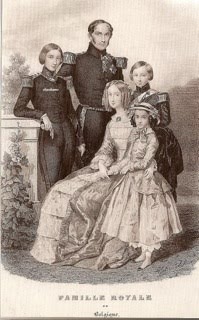
The Countess of Flanders with her four children: Baudouin, Henriette, Josephine and Albert (on his mother's knee). I have posted on Princess Marie before; she was a strong, religious and artistic woman. She was a loving wife and mother, but very strict and proper, although later, as a grandmother, she was much more indulgent. Albert always spoke of her with great regard, but seems to have found her extreme conservatism too restricting, especially in his youth. He was attracted to liberal tutors whose opinions were diametrically opposed to hers, and felt he needed to break free of her "pietistic" outlook. He also commented: "My mother is a saint, but a saint of ice!" 


Baudouin and Henriette, the two eldest siblings in the family. They were very close and Henriette, in her diary, portrayed Baudouin as nothing less than a saint. Their mother was more critical of him, complaining of a certain weakness or lack of energy in his character. Nonetheless, most accounts of Baudouin paint a picture of a gifted, conscientious youth, pious and despising worldly vanities. Henriette and her mother were both deeply upset by Baudouin's early death and the subsequent efforts of gossip-mongers to besmirch his reputation. In response, the saddened Countess of Flanders paid tribute to the "pure memory" of her child.


I love this photograph of a little Henriette. The future Duchesse de Vendôme, staunch and opinionated royalist historian of France, already looks so decided! 
Josephine and Albert, the two youngest siblings in the family, also very close to each other, like their older counterparts. Josephine and Albert were the "modern" element in the family, according to Albert's daughter Marie-José. Josephine, who eventually became a nun, would outlive her parents and all her siblings, dying in 1958. In her old age, she fascinated Princess Lilian, the second wife of her nephew, King Leopold III, with her memories of the distant past. 


A postcard of Philippe and Marie, their daughters Henriette (top right) and Josephine (bottom left) and their son Albert, with their respective spouses, Prince Emmanuel d'Orléans, Duc de Vendôme,  Prince Karl Anton of Hohenzollern and Elisabeth, Duchess in Bavaria. Afflicted by deafness, and, perhaps, harmed by his lack of an active public life, the Count of Flanders became quite a difficult character. It's said that Albert actually had a better relationship with his uncle Leopold than with his own father. Philippe also didn't like Elisabeth, apparently. During the courtship of Albert and Elisabeth, the Count made disparaging remarks about the romance, and about his son's bride, complaining, for instance, that she was too short! This may sound unkind, but, on the whole, I think Philippe and Marie were a good couple; they were not perfect people but they had a solid marriage and home life and raised four very admirable children. 

Sunday, June 27, 2010

Monday, May 10, 2010

Leopold II

Belgium's most controversial monarch. An excellent article everyone should read.

Thursday, December 17, 2009

Accession of Leopold II

On December 17, 1865, a week after his father's death, Leopold II, King of the Belgians, ascended the throne. Leopold II is no favorite of mine. Nonetheless, here is his accession speech:
"Gentlemen: Belgium has, like myself, lost a father. The unanimous homage which the nation renders to his memory worthily responds to the sentiments which he cherished towards it during his life."
I am equally moved and grateful. Europe herself has not remained indifferent to this affliction. Foreign sovereigns and princes have wished to take part in the last honors which we render to him whom they placed so high in their confidence and friendship. I thank them for myself and for Belgium.
" On this day, succeeding to a father so honored during his life and so regretted after his death, my first engagement before the representatives of the nation is to religiously follow the precepts and examples which his wisdom has left me, and never to forget the duties imposed on me by this precious inheritance.  If I do not promise to Belgium either a great reign like that which founded her independence, or a great king like him whom we mourn, I at least promise her a king Belgian in heart and soul, whose whole life belongs to her.
"The first King of the Belgians to which Belgium has given birth, I have from my childhood shared all the patriotic emotions of my country. Like her, I have watched with happiness the national development which has fecundated in her bosom all the sources of strength and prosperity. Like her, I love those grand institutions which guarantee at the same time order and liberty, and are the most solid foundation of the throne.
"In my thoughts the future of Belgium has always been blended with my own, and I have always regarded it with the confidence inspired by the right of a free, honest, and brave nation, which wills its independence, which has won it, proved Itself worthy of it, and will know how to preserve it.
" I have not forgotten, gentlemen, the marks of kind feeling which I received on attaining my majority, when I came to take part in your legislative labors, and, some months later, on the occasion of my marriage with a princess who shares all my sentiments for the country aud instils them into our children.
"I have been gratified to recognize in these spontaneous manifestations the unanimous accord of the populations. On my part, I have never made any distinctions between Belgians ; all are devoted to their country, and I comprise them in one common affection.
" My constitutional mission places me apart from the struggle of opinions. Leaving the country itself to decide them, I ardently desire that their differences may always be tempered by that spirit of national fraternity which unites, at this moment, round the same flag all the children of the Belgian family.
"Gentlemen, within the last thirty-five years Belgium has witnessed the accomplishment of things which, in a country of the size of ours, have rarely been realized in a single generation ; but the edifice of which the congress laid the foundations may rise, and will rise, higher still. My sympathetic co-operation is assured to all who shall devote to this work their intellect and efforts.
"By persisting in this course of activity and wise progress, Belgium will more and more consolidate her institutions at home, and will preserve abroad that esteem which the powers guaranteeing her independence, and other foreign states, have always accorded her, and have again this day so kindly testified. On ascending the throne, my father said to the Belgians: ' My heart knows of no other ambition than that of seeing you happy.' These words, which his whole reign has justified, I do not fear to repeat in my own name.
"Providence has vouchsafed to hear the wish they expressed. May He hear it again this day, render me the worthy successor of my father, and, I pray from my inmost soul, continue to protect our dear Belgium."
Curiously, Leopold would die on the 44th anniversary of his accession, on December 17, 1909. Strange coincidence! May God have mercy on his soul.

Thursday, December 10, 2009

Death of Leopold I


On December 10, 1865, the first King of the Belgians, Leopold of Saxe-Coburg-Gotha, died after a lingering illness. Although he had ruled a predominantly Catholic country for over 30 years, he remained firmly Protestant to the end. Charles d'Ydewalle, biographer of Leopold's grandson, King Albert I, gives a melancholy account of Leopold's passing:
The death-bed of Leopold I was a sad one, with something puritanical and cold about it. In his death agony, he called: "Charlotte...Charlotte..." but no one knew whether he was calling to his daughter, the Empress of Mexico, or to that first Charlotte of Claremont and those enchanted years whose happy memories once more unfolded before his darkening eyes.
"Do you regret the sins you have committed, Sire?" asked his daughter-in-law. He sighed heavily, and answered: "Yes..."
"In the name of the love you bear for the Queen's memory," went on the wife of Leopold II, "will you not be converted to her religion so that you may meet her again in Heaven?"
"Nein..." he whispered.
Thus died the first King of the Belgians.
The same day, the Monitor eulogized the deceased Sovereign, whose political and diplomatic abilities had secured Belgium's place among the independent nations of Europe and had won him the title "Nestor of Kings."
Brussels, December 10, 1865.
An immediate mourning is about to spread over Belgium.
The first of our kings, the founder of our national dynasty, his Majesty Leopold I, died this morning at the Palace of Laeken, at a quarter before twelve o'clock, surrounded by his august family, whose grief we will not attempt to portray.
History will tell what was the sovereign who, in the times of grave uncertainties, did not hesitate to respond to the wish of the nation, by coming to strengthen and fix its destinies ; who, during a reign of nearly thirty-five years, at an epoch so troubled as was ours, knew how to call to himself the love and veneration of the Belgian people, and to win the high esteem and respect of sovereign monarchs and peoples ; who, true to his solemn pledges, was minutely scrupulous in the observance of our constitutional compact, and in reward for this duty, so religiously fulfilled, and the services which he did not cease to render to the country, carries with him the gratitude of a whole nation united to bless his memory; who, finally, leaves to the august heir of the crown, with his great and noble example, a free, happy, and prosperous kingdom, which has acquired its place among the family of European nations.
Belgium will long weep the loss she has sustained ; she will ever preserve the remembrance of a King who was for her a devoted friend, a constant support; but her too just regrets will not cause her to forget her legitimate hopes.
The country does not die, and if on all sides is raised the doleful cry—
The King is dead! —
All Belgians, mastering their affliction, and rallying round the throne, will re-echo the shout
—Long live the King !

Wednesday, July 15, 2009

Vignettes of Leopold II

In Chapter VIII of his memoirs, Their Majesties As I Knew Them (1911), Xavier Paoli provides a fascinating portrayal of the controversial and paradoxical King Leopold II of the Belgians and his last mistress, Baroness Vaughan. A Corsican by birth, Paoli was employed for years in the French political police; his task was to guard foreign Sovereigns visiting France. Here are some excerpts from his account of Leopold II. (Interestingly, although I had always heard the King married Madame Vaughan in his last illness, Paoli suggests the secret wedding might have occurred earlier).
Of all the sovereigns with whom I have been connected in the course of my career, Leopold II is perhaps the one whom I knew best... and whose thoughts and soul I was nevertheless least able to fathom, for the simple reason that his thoughts were impenetrable and his soul remained closed. Was this due to excessive egotism or supreme indifference? To both, perhaps. He was as baffling as a puzzle, carried banter occasionally to the verge of insolence and cynicism to that of cruelty; and, if, at times, he yielded to fits of noisy gaiety, if, from behind the rough exterior, there sometimes shot an impulse of unexpected kindness, these were but passing gleams. He promptly recovered his wonderful self-control; and those about him were too greatly fascinated by his intelligence to seek to understand his habit of mind or heart. And yet, though fascinating, he was as uncommunicative as it is possible to be; he possessed none of the external attractions of the intellect which captivate and charm; but, whenever he deigned to grant you the honour of an interview, however brief, you at once discovered in him a prodigious brain, a luminous perspicacity and critical powers of amazing subtlety and keenness...

His habit of icy chaff made one feel perpetually ill at ease when he happened to be in a conversational vein. One never knew if he was serious or joking. This tall, rough-hewn old man had a trick of stinging repartee under an outward appearance of innocent good-nature and, better than anyone that I have ever met, understood the delicate art of teaching a lesson to those who ventured upon an improper remark or an unseemly familiarity in his presence.

One evening, at a reception which he was giving to the authorities in his chalet at Ostende, the venerable rector of the parish came up to him with an air of concern and drawing him respectfully aside, said:

"Sir, I feel profoundly grieved. There is a rumour, I am sorry to say, that your Majesty's private life is not marked by the austerity suited to the lofty and difficult task which the Lord has laid upon the monarchs of this earth. Remember, Sir, that it behooves kings to set an example to their subjects."

And the worthy rector, taking courage from the fact that he had known Leopold II for thirty years, preached him a long sermon. The penitent, adopting an air of contrition, listened to the homily without moving a muscle. When, at last, the priest had exhausted his eloquence:

"What a funny thing, monsieur le cure!" murmured the King, fixing him with that cold glance of his, from under his wrinkled eye-lids. "Do you know, people have told me exactly the same thing about you! Only I refused to believe it, you know!"

That was a delicious sally, too, in which he indulged at the expense of a certain Brazilian minister, who was paying his first visit to court, and who appeared to be under the impression that the King was hard of hearing. At any rate, he made the most extraordinary efforts to speak loud and to pronounce his words distinctly. The King maintained an impassive countenance, but ended by interrupting him:

"Excuse me, monsieur le ministre," he said, with an exquisite smile. "I'm not deaf, you know: it's my brother!"

Picture the diplomatist's face!

Lastly, let me recall his caustic reply to one of our most uncompromising radical deputies, who was being received in audience and who, falling under the spell of King Leopold's obvious intelligence, said to him, point-blank:

"Sir, I am a republican. I do not hold with monarchies and kings. Nevertheless, I recognise your great superiority and I confess that you would make an admirable president of a republic!"

"Really?" replied the King, with his most ingenuous air. "Really? Do you know, I think I shall pay a compliment in your style to my physician, Dr. Thirier, who is coming to see me presently. I shall say, 'Thirier, you are a great doctor and I think you would make an excellent veterinary surgeon!'"...

The fact is that Leopold II looked at everything from two points of view: that of practical reality and that of his own selfishness. The King had in his veins the blood of the Coburgs mixed with that of the d'Orleans, two highly intelligent families, but utterly devoid of sentiment or sensibility; and he treated life as an equation which it was his business to solve by any methods, no matter which, so long as the result corresponded with that which he had assigned to it beforehand.

He had an extraordinarily observant mind, was marvellously familiar with the character of his people, its weaknesses and its vanities and played upon these with the firm, yet delicate touch of a pianist who feels himself to be a perfect master of his instrument and of its effects. His cleverness as a constitutional sovereign consisted in appearing to follow the movements of public opinion, whereas, in reality, he directed and sometimes even provoked them...

He had idiosyncrasies, like most mortals. For instance, he used to have four buckets of sea-water dashed over his body every morning, by way of a bath; he expected partridges to be served at his meals all the year round; and he had his newspapers ironed like pocket-handkerchiefs before reading them: he could not endure anything like a fold or crease in them. Lastly, when addressing the servants, he always spoke of himself in the third person. Thus he would say to his chauffeur, "Wait for him," instead of, "Wait for me." Those new to his service, who had not been warned, were puzzled to know what mysterious person he referred to.

A strange eccentric, you will say. No doubt, although these oddities are difficult to understand in the case of a man who displayed the most practical mind, the most lucid intelligence and the shrewdest head for business the moment he was brought face to face with the facts of daily life. But, I repeat, to those who knew him best, he appeared in the light of a constant and bewildering puzzle; and this was shown not only in the peculiarity of his manners, but in the incongruity of his sentiments. How are we to explain why this King should feel an infinite love for children, this stern King who was so hard and sometimes so cruel in his treatment of those to whom by rights he ought never to have closed his heart nor refused his indulgence? Yet the tall old man worshipped the little tots. They were almost the only creatures whose greetings he returned; and he would go carefully out of his way, when strolling along a beach, rather than spoil their sand-castles. How are we to explain the deep-seated, intense and jealous delight which he, so insensible to the softer emotions of mankind, felt at the sight of the fragile beauty of a rare flower? How are we to explain why he reserved the kindness and gentleness which he so harshly refused to his wife and daughters for his unfortunate sister, the Empress Charlotte, whose mysterious madness had kept her for forty-two years a lonely prisoner within the high walls of the Chateau de Bouchout? And yet, every morning of those forty-two years he never failed, when at Laeken, to go alone across the park to that silent dwelling and spend two hours in solitary converse with the tragic widow. Each day, with motherly solicitude, he personally supervised the smallest details of that shattered existence.

Lastly, what an astounding contrast was offered in Leopold II, who was considered insensible to the weaknesses of the heart, by the sudden blossoming of a sentimental idyll in the evening of his life....

...(A) single and decisive love, which he preserved until his death was soon to fill his thoughts exclusively and graft upon his... heart a belated bloom of disconcerting youth. When Leopold II made the acquaintance of Mlle. Blanche Caroline Delacroix, whom he afterwards raised to the dignity of Baroness Vaughan, he had just reached his sixty-fifth year....The humbleness of her birth prevented her from raising her eyes to a throne. She was the thirteenth child of a working mechanic and was born at Bucharest, where her father had gone to seek his fortune. She was brought up, therefore, in courts which were very different from royal courts; and I need not say that her education had hardly prepared her for the brilliant destiny which her chequered life held in store for her...

To what did Blanche Caroline Delacroix owe her success with Leopold II: to her vivid conversational powers, to the dazzling youthfulness of the fair-haired divinity that she was, or to her genuine intelligence? I cannot tell; but this much is certain, that, at her first audience, she succeeded in arousing in the old man's heart a love which was manifested at first in a polite flirtation and consecrated later in a union the mystery of which was never fully solved. Both the King and Mme. de Vaughan carefully refrained from making the smallest confidence on the subject of their marriage even to those in whom they confided most readily. Nevertheless, I have always believed that a secret religious ceremony did take place, so as to regularise their situation, if not with regard to Belgian law, at least in respect to the Church and their consciences. This conviction on my part was strengthened by the pastoral letter which Mgr. Mercier, Archbishop of Mechlin addressed to the Belgian Catholics after the King's death and in which the primate declared that the sovereign had died at peace with the Church of Rome. Allowing for the legitimate susceptibilities of the royal family, it was impossible to confirm the existence of a morganatic union in a more diplomatic manner. Some have said that the marriage was celebrated at San Remo, during the time when the King and Mme. de Vaughan were staying at Ville- franche, near Nice. I cannot certify this. When I consult my recollection, I merely remember that, on a certain morning, some years before Leopold II's death, I saw the King and Mme. de Vaughan drive off together in a motor-car—a thing which they had never done before—he looking very nervous and she greatly excited. They forbade anyone to accompany them and did not return until evening, when they made no attempt to tell us where they had been. Marcel, the chauffeur, said that he had taken them to San Remo, on Italian territory; but, apart from this, he also showed a memorable discretion and we got no more out of him.

I noticed, however, that, from that day, the attitude of the couple changed: they showed themselves in public together, went openly to the theatre at Nice and to the carnival masquerade and abstained from taking the very childish and rather ridiculous precautions which the King had prescribed during the period of flirtation and "engagement" on the score of "saving appearances!"

Ridiculous and childish they were, as the reader can judge for himself. For instance, although the Baroness Vaughan shared all the King's journeys and accompanied him wherever he went, she was never to address a word to him in public or appear to know him. They took the same trains, got out at the same stations, put up at the same hotels in adjoining rooms, lunched and dined in the same dining-room, but ignored each other's existence, he with an imperturbable composure, she with a charming awkwardness...

The Baroness Vaughan was not a bad sort of woman on the whole. In the early days, she used to put up with the violent outbursts to which the King occasionally treated her: she would light a great, big cigar and think no more about it. Afterwards, when she grew accustomed to look upon herself as the King's morganatic wife, her ambition increased and she insisted on being treated with deference. She complained to me that the Princess Clementine, whom she had met on the road or in some path in a garden, had not condescended to return her bow; and she added, in a regretful tone:

"To think that, if I had lived in the days of Louis XIV, I should have had a stool at Court !"

In the absence of a stool, she managed to achieve a most luxurious existence. The King, who now never left her, had installed her, when he was in residence in Brussels, in a charming villa which communicated directly with the grounds of the Chateau de Laeken by means of a bridge that spanned the road and led into the Baroness Vaughan's garden. Every day, before paying her his visit, he sent her the choicest flowers from his hot-houses and the finest fruit in his orchard...

He was very thrifty in his personal expenditure and ended by imparting his habits of economy to his fair friend. Baroness Vaughan used to scrutinise the kitchen accounts as closely as any middle- class housewife. True, the housekeeping books sometimes took excessive liberties. I remember, one year at the Chateau de Lormois near Fontainebleau, which the King had hired for the season... there was a violent scene with the cook, who had had the temerity to charge for seventy-five eggs in six days. Mme. de Vaughan was justly annoyed, dismissed him on the spot and refused to pay him the usual wages instead of notice...

Great as was the influence which Mme. de Vaughan had gained over the King's mind, I am bound to confess that it was never exercised in political matters nor in any of Leopold's financial undertakings. The baroness knew nothing about those things and made no attempt to understand them. The King was grateful to her for this discretion, which in reality was only indifference, for he never allowed any outsider to interfere in his affairs, whether public or private. He discussed none of his schemes before they were completed or before he had drawn up his plan of execution down to the minutest details.

"It shall be so," he used to declare; and no one ever dreamt of opposing his will so plainly expressed.

It was in this way that he conducted his enormous Congo enterprise entirely by himself. The different phases of this business are too well known for me to recapitulate them here. One of them, however—the first phase—has been very seldom discussed and deserves to be recalled, for it throws a great light not only upon the king's conceptive genius, but also upon his diplomatic astuteness and his amazing cynicism.

In 1884, Leopold II, who had for years been obsessed by the longing to lay hands upon the Congo territory, promoted an international conference in order to frustrate the West African treaty which had lately been concluded between Great Britain and Portugal and which stood in the way of the realisation of his secret ambitions. The King of the Belgians now conceived the subtle and intelligent idea of inducing the congress to proclaim the Congo into an independent state, with himself as its recognised sovereign.

There was only one person in Europe possessed of sufficient authority to bring about the adoption of this daring plan; and that was Bismarck. Bismarck was the necessary instrument; but how was he to be persuaded? Faced with this difficulty, Leopold II hit upon the idea of sending to Berlin a mere journalist, whom he knew to be a clever and talented man, and instructed him to capture the Iron Chancellor's confidence. Leopold coached this journalist, a gentleman of the name of Gantier, to such good purpose that, as the result of a campaign directed from Brussels by the King himself, M. Gantier managed, within a few months, to insinuate himself into Bismarck's immediate surroundings, to interest him in the Congo question and to prove to him that Germany would derive incomparable benefits from proclaiming the independence of the Congo and entrusting its administration to a neutral sovereign like the King of the Belgians.

The stratagem was successful from start to finish. The Congress of Berlin, on the motion of the chancellor, proclaimed the Congo an independent territory with Leopold II, for its sovereign. We know the result: the Congo is at this day a Belgian colony. Leopold II, in a word, had "dished" Prince Bismarck...