

Showing posts with label carlota. Show all posts
Showing posts with label carlota. Show all posts
Thursday, March 21, 2013


Cascarones

It is said that Belgian-born Empress Carlota introduced what would become a popular Carnival custom to Mexico. In Europe, the eggshells had been filled with perfume rather than confetti and had been used in courtship.
Though brightly colored eggs remain a traditional Easter element in many countries, they do not figure prominently into the celebration of Pascua (Easter), one of Mexico's most important and solemn religious holidays. Curiously, however, eggs--in the guise of cascarones-- are a popular feature of Carnaval (Mardi Gras), which marks the opposite end of the Easter season, as well as a variety of other Mexican festivities.
In their most common form, cascarones are empty egg shells that have been washed out, painted on the exterior, filled with confetti and closed again with a small square of tissue paper pasted over the opening. They may sometimes contain small toy prizes or sweets as well. Early variations, connected with the customarily riotous pre-Lenten celebrations, were filled with either perfumed or rank-smelling colored water and sealed with a plug of wax.
Cascarones figure heavily into local fiestas in towns and cities all over the nation, as fellow revelers enjoy playfully cracking the eggs over one another's heads, unleashing showers of confetti that help heighten the sense of merriment. The practice has long been favored among adolescents who still may be observed engaging in this innocent form of flirtation with members of the opposite sex during Sunday evening paseos around village plazas. (Read full article)
Sunday, January 6, 2013

Friday, May 11, 2012
The May Queen

Here are pictures of Italy's last queen, the only daughter of King Albert I and Queen Elisabeth of the Belgians, as a thoughtful young girl, a glamorous princess and a loving mother. In some respects, she reminds me of her great-aunt Carlota, the doomed empress of Mexico. Both women were beautiful, brilliant Belgian princesses who wholeheartedly embraced the causes of their adopted countries. Each cherished idealistic hopes for the future, aspiring to do good, on a grand scale, for her subjects. Alongside her liberal and romantic husband, Maximilian I, Carlota wished to usher in a new era of enlightened rule in Mexico. Maria José, inspired by her parents' example, hoped to be a close collaborator of her husband, Umberto II, and to promote cultural and humanitarian projects in Italy as her mother had done so magnificently in Belgium. Like Carlota, Maria José was thwarted, betrayed, dethroned and forced into exile. In her last years, by a strange coincidence, she moved for some time to the Mexican city of Cuernavaca, once beloved by Carlota. She was fascinated by the sad life of her forebear. Fortunately, however, Maria José's family survived the disaster in Italy, in contrast to the murder of Maximilian. The Italian queen was also much better able to cope emotionally with her tragedies. Both Carlota and Maria José, however, certainly deserved a kinder fate.
Here are a few more posts on Maria José:
Her First Communion
Her marriage
Her visit to Padre Pio
Her message to the women of Italy


Wednesday, February 22, 2012
Monday, October 24, 2011
Carlota and Zita

Carlota, born Princess Charlotte of Belgium, was nearly insane with ambition. Save for her insistence, poor Maximilian, a Romantic dreamer who wished nothing so much as to be able to dream forever, almost certainly would not have accepted the crown of Mexico when it was proffered. Carlota never had a child, or at least none by her husband. After Maximilian was shot the world saw little of her. Driven truly mad by the loss of the Mexican throne, she lived all the long decades of her remaining life in seclusion at one of her family’s chateaux in Belgium, still believing she was a reigning empress.

Friday, September 23, 2011
Remembering the Saxe-Coburgs
Not to be morbid, but here are a few of my favorite tributes, from Find a Grave.
~Au courage incarné par le grand Roi que fut Albert I.
~A Léopold III, Roi incompris mais courageux. Reposez en paix.
~A Elisabeth, héroïque Reine des Belges pendant la I°Guerre Mondiale. Que Dieu lui accorde le repos éternel tant mérité.
~Au Roi Baudouin I, grand Roi et grand homme, personne généreuse possédant de rares qualités. Que son âme repose en paix pour l'éternité.
~A l'Impératrice Charlotte, Votre vie n'a été que souffrance puissiez Vous trouvez enfin le repos éternel dans la Paix du Christ.
Sunday, May 8, 2011
Cuernavaca


Reinvigorated by the climate and the energy of the place, touched by the warmth of the people, she regained her humor, curiosity, fighting spirit and love of life. (She said that her beloved old dog, Alaska, was also restored by his new environment). She spent four culturally active, sociable years, in a modest, welcoming, single-storey villa, at 1005 Palmira Avenue, becoming increasingly close to Maria Beatrice and her husband, before before returning to Switzerland to live with her son, Victor Emmanuel, and his wife, Marina Doria. According to Luciano Regolo, Maria José's home in Cuernavaca clearly reflected her spirit: her reserved, but constant sentiments, her cult of history and art, her preference for lively colors and her cheerful irony. She was assisted by a small, but loyal and affectionate entourage: a talkative lady-in-waiting, Madame Claudine Estrayer, a French-speaking secretary, Monsieur Dominique Voghel, who kept the Queen in contact with the courts and cultural institutions of Europe, a Spanish teacher, and medical, security and household staff, including the Queen's majordomo, Juan, and her housekeeper, Zenaida Isabel. Many distinguished visitors, ranging from Mexican ministers to European ambassadors, as well as her own nephew and niece, King Albert II and Queen Paola of the Belgians, came to pay their respects to Maria José in Cuernavaca.
 Maria José had vivid childhood memories of her great-aunt Carlota, whom she had visited as a little girl with her parents. Albert and Elisabeth had taken their daughter to pay their respects to the tragic, deranged, exiled empress, living in seclusion in the Flemish castle of Bouchout. According to her later account, recorded by her biographer, Luciano Regolo, Maria José doubted Carlota's insanity. During Maria José's childhood visit, the old lady, after appearing lost and vacant, suddenly changed completely when Albert and Elisabeth, who were talking among themselves, were trying to remember the name of a newly appointed minister of state. Interrupting the conversation, Carlota supplied all the particulars of the person in question. The little princess was stunned; whereupon, Carlota turned and confided to her: "I will tell you a secret: when you want to escape from your past, pretend to be mad. Nobody will ask you any more indiscreet questions". In her last years, following her move to Mexico, Maria José's interest in Carlota's life would deepen.
The Queen also became increasingly intrigued by Mexican history, archaeology and culture in general. She was fascinated by the pre-colonial period, and tended to sympathize with the native populations rather than the Spanish conquistadors. (In this respect, she resembled her brother, King Leopold III of the Belgians, who was also sharply critical of many colonial methods, once again giving the lie to those who portray the entire Belgian royal family as ruthless imperialists). Maria José also developed a great admiration for the Mexican revolutionary, Emiliano Zapata, devouring biographies of her hero, laying flowers at his tomb, and proudly displaying a large portrait of him on her wall. Some suggested to her that it was inappropriate for a queen to honor a revolutionary. The always broad-minded Maria José, however, viewed the matter differently. Zapata, she believed, deserved every respect, since he had been willing to die for his ideals of "land and liberty", ideals which raised him above partisan differences. Maria José also had a more humorous encounter with Mexican history on a visit to Oaxaca. The local authorities were enthusiastically praising President Benito Juarez, who had been responsible for the execution of Emperor Maximilian I. Amused by the irony of her situation, the Queen carefully avoided reminding her hosts that the figure in question had killed her great-uncle...


Tuesday, January 18, 2011
Maximilian and Carlota: Imperial Tragedy
A blog for researchers, by historical novelist C. M. Mayo, author of The Last Prince of the Mexican Empire.
A touching online exhibit, courtesy of the Woodson Research Center, including samples of Carlota's exquisite handwriting. In the first letter displayed, notable for its beautifully decorated margins, little Charlotte, the first Princess of Belgium, sends tender greetings to her grandmother, the last, exiled Queen of the French, Marie-Amélie. The child regrets that she cannot accompany her mother, Queen Louise-Marie of the Belgians, to England to visit Marie-Amélie. Reunited on paper, we have three generations of remarkable royal ladies.
A touching online exhibit, courtesy of the Woodson Research Center, including samples of Carlota's exquisite handwriting. In the first letter displayed, notable for its beautifully decorated margins, little Charlotte, the first Princess of Belgium, sends tender greetings to her grandmother, the last, exiled Queen of the French, Marie-Amélie. The child regrets that she cannot accompany her mother, Queen Louise-Marie of the Belgians, to England to visit Marie-Amélie. Reunited on paper, we have three generations of remarkable royal ladies.
Sunday, January 2, 2011
"King Leopold's First Charlotte": A Guest Post by Cheryl Anderson Brown

Today, I am celebrating the second anniversary of Cross of Laeken with a beautiful guest post by Cheryl Anderson Brown of The Princess Palace. Cheryl is an award-winning writer and editor who has been avidly studying royal history for nearly 30 years. She has a bachelor's degree in international relations and a master's in professional writing. Her master's thesis is a biography of Princess Charlotte of Wales, the beloved, spirited and tragically lost first wife of Leopold I, King of the Belgians. Cheryl has graciously agreed to share with us some of her thoughts on her heroine:-
King Leopold’s First Charlotte
Long before Prince Leopold of Saxe-Coburg was invited to be King of the Belgians, he envisioned a much different destiny for himself: guiding the British Empire through the nineteenth century. Although he influenced Britain from afar as advisor to his niece and nephew, Queen Victoria and Prince Albert, it was Leopold who had been expected to serve as Prince Consort to a far different queen than Victoria: a vivacious young woman named Charlotte.
From the moment of her conception, the hopes of the Hanoverian dynasty and of England were pinned on Princess Charlotte Augusta of Wales. With a vibrant hatred growing daily stronger between her parents, the future King George IV and Caroline of Brunswick, it was pretty clear that she would be the only offspring of the marriage. In fact, the couple separated very soon after Charlotte’s birth in 1796 and the Prince of Wales spent the next 20 years trying to divorce the loud and colorful Caroline. He didn’t even invite her to his coronation in 1820—when she showed up any way, he locked the doors against her!
George himself was no model of decorum, although he certainly felt otherwise. A gambler and ladies’ man who also indulged in extravagant spending, he was kept only moderately in check by Parliament’s and King George III’s willingness to pay his debts, which would always mushroom again. In fact, he had been practically bribed to marry Caroline in order to continue the royal line.
Most of George III’s 14 other children also led scandalous lives. As a result, Charlotte was the only legitimate grandchild and, therefore, the only heir to the throne. Today, a girl like her might be pampered and spoiled, but not Charlotte. Certainly, she had ponies and pets and received a far better education than most girls of the day, but Charlotte’s childhood was marred by emotional instability. Caught in the battle between her parents, her greatest champion—perhaps the person who loved her best—was her grandfather, but his recurrent illnesses and eventual seclusion deprived her of his loving kindness.
Charlotte was given her own homes and households, separate from either of her parents. Her father often banned her from seeing her mother, but he did not offer her much companionship either. She grew up mostly in the company of servants, occasionally visiting her grandmother Queen Charlotte and her spinster aunts.
Any news about young Charlotte excited the population. She was the royal superstar of the day. If she visited a shop or showed a little charity, the kingdom was abuzz with the news. As she grew to adolescence, this interest intensified. Who would she marry?
Like many young girls, Charlotte had a propensity for falling in love. Passionate like her father and excitable like her mother, she gave her heart willingly to an illegitimate first cousin, to a young army officer, to a mysterious Prince F. With her mother’s indulgence, a couple of these relationships came within a hair’s breadth of scandal, but Charlotte was always able to keep her reputation and her popularity in tact. These traits would serve her well, when her father began planning her marriage.
Charlotte was coming of age at a moment of true splendor for her nation. In addition to many dashing English noblemen, the victory over Napoleon brought all of Europe’s greatest royals and military leaders to London for peace talks and glorious celebrations. Charlotte met many eligible young men in the heady atmosphere. She enjoyed the round of entertainments, sometimes against her father’s wishes and sometimes keeping company with people who deemed questionable, like “The Bachelor Duke” of Devonshire and the Czar’s sister.
Prince George’s greatest concern, however, was the amount of attention and adoration Charlotte was receiving—she was clearly more popular than he was!
He devised a plan that would remove Charlotte from the limelight: he betrothed the 18-year-old princess to Prince William of Orange. Ever enthusiastic, Charlotte initially agreed, but William hardly compared to the numerous handsome young men she had met. When she discovered that she would be required to live in The Netherlands, Charlotte objected and she had the support of the Whigs. But, George refused to relent. On the eve of a critical election, Charlotte took drastic measures.
She ran away. To her mother. Fearful of public riots, royal dukes and bishops and even the Lord Chancellor begged her to return to her father. The Whigs also wanted to avoid potential violence in the streets. Charlotte caved in and her father punished her by sending her away from London. Within weeks, her mother abandoned her entirely, opting to take a prolonged tour of the newly peaceful Europe. Charlotte would never see her again.
During her exile, Charlotte determined to take control of her own future and selected for her mate, the most handsome and perhaps poorest of all the princes she had met in London. Prince Leopold was a rising young officer in the Czar’s service who had distinguished himself during the war. Charlotte, for once, kept her plan quiet and her father eventually allowed her to return to London the following year, still insisting on the Orange marriage. William of Orange, however, was tired of waiting for his unwilling bride. When he married another, George had little room to dodge the persuasive princess’s formal request to marry Leopold. George was inundated from all sides—members of the royal family and governor ministers counseled him to concede. Early the next year, 1816, he said yes.
Monday, November 1, 2010
The Family of Leopold I
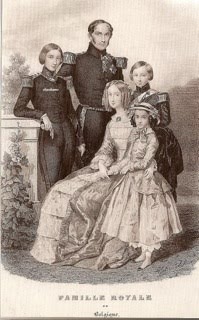
Leopold I, King of the Belgians (1790-1865) had several families. By Charlotte Augusta of Wales (1796-1817), he had two babies, lost to miscarriage, and a son who died at birth, followed shortly thereafter by his mother. By Louise-Marie of Orléans (1812-1850), Leopold had four children: Prince Louis-Philippe, Crown Prince of Belgium (1833-1834), Leopold II, King of the Belgians (1835-1909), Prince Philippe, Count of Flanders (1837-1905) and Princess Charlotte, Empress of Mexico (1840-1927). In his later years, by his young, brash and unpopular favorite, Arcadie Claret Meyer, the King has been alleged to have had two sons, George and Arthur, who were both created Barons von Eppinghoven.
The Exiled Belgian Royalist gives interesting summaries of the lives of Leopold's children by Queen Louise. Their three surviving offspring, Leopold II, Prince Philippe and Empress Carlota were all very different personalities. Leopold II had the intelligence and satirical eye of both parents. He possessed his father's political shrewdness, financial sense and ambition, albeit, unfortunately, without his tact and charm. A tireless colonial imperialist and builder of monuments, Leopold II may have inherited his insistence on grandeur partly from his mother, although he sadly lacked her counterbalancing humility and sweetness. Queen Louise complained of the Belgians' petty ways; her son, however much one may dislike many of his methods, undeniably strove, as he saw it, to make Belgium great.
By contrast, Leopold's brother Philippe had Louise's retiring manner, her love of home and family, her propriety and piety. Despite his admirable traits, however, I have to admit that I find him less interesting than his more dynamic brother and sister. It is Carlota whom I probably find to be the most appealing of the siblings. She seems to have united so many of the best qualities of the first King of the Belgians and his Queen; beauty, brilliance, grand aspirations, energy, determination and charisma, but also kindness, gentleness and charity. What a pity her promising life was so tragically marred.
Friday, October 22, 2010
Carlota's Prayer
In the 1939 film Juarez, Bette Davis, cast as the tragic Belgian empress of Mexico, begs Our Lady for a child.
Monday, October 11, 2010
Worldly Wisdom from Leopold I

Friday, October 1, 2010
Situating Charlotte: Reading Politics in Portraits of Belgian Princess Charlotte, Vicereine of Lombardy-Venetia, Empress of Mexico

By a stroke of luck, I just found this PhD dissertation, by Linda MacNayr of Queen's University, on the artistic portrayals of Empress Carlota. I have only had a chance to glance through it briefly, but it looks fascinating. The illustrations are beautiful. You can download the thesis in PDF format HERE.
Friday, July 9, 2010
The Emperor Maximilian Diamond

At an early age, Maximilian developed a keen interest in the sciences, particularly botany and he was fascinated by the New World. In 1860, he journeyed to the tropical forests of Brazil on a botanical expedition. While there, he acquired two exceptionally large diamonds which have been named after him: The Emperor Maximilian Diamond and The Maximilian Diamond. The Emperor Maximilian was a 41.94 carat antique cushion-cut diamond with a strong blue fluorescence which gives the diamond a soft luminosity in daylight. The second diamond was of a greenish-yellow tint and weighed 33 carats. After his return to Europe, Maximilian presented this smaller diamond to Charlotte, who wore it as a pendant. It is not known where either diamond was cut but it is possible that they were cut in Brazil, which has long possessed a diamond cutting industry, albeit on the smaller scale than in some other countries...
...Legend holds that Maximilian was wearing the Emperor Maximilian Diamond in a small satchel tied around his neck when he faced the firing squad. Following the execution, his remains were sent to Vienna and the Emperor Maximilian Diamond returned to Charlotte. Upon news of his death, Charlotte’s condition worsened and she shut herself off from the outside world. The diamond was subsequently sold to help pay for expenses during Charlotte’s illness and it disappeared until 1919 when it returned to America. Maximilian’s widow lived on for another sixty years, hopelessly insane, dying in January 1927 in Brussels at the age of 86. Even in her final days, some say she still believed herself to be the Empress of Mexico.
In 1919, the Emperor Maximilian Diamond was purchased by a Chicago gem dealer, Ferdinand Holtz and was displayed in the 1934 Chicago World’s Fair as the highlight of the 'Century of Progress' exhibition. Despite several offers to buy it, Mr. Holtz refused to sell the diamond and it remained in his possession until his death in 1946. It was subsequently sold to a private collector in New York.
The name of the new owner has never been revealed and the diamond remained in her possession, mounted in a ring by Cartier, until Christie’s auctioned it in New York in 1982. It was expected that diamond would fetch $330,000 but it eventually sold for $726,000 to Laurence Graff, the London jeweler, who has a vast collection of notable and historic diamonds. In January 1983, Graff sold The Emperor Maximilian, together with two other important diamonds, in a single transaction to the same buyer, Madame Imelda Marcos, wife of the President of the Philippines. Subsequently, it was sold and re-cut in the 1990’s, to its current weight of 39.55 carats, and finally it was acquired by the present owner.
Wednesday, May 26, 2010
Carlota's Youth

Carlota was born at the palace of Laeken, which is about fifteen miles from Brussels, on the 7th of June, 1840; and never passed over six months of her life in France, although she is called French. The French tongue is her vernacular.
Nearly eighteen years ago, the promenaders that sauntered through the public park of Brussels, frequently observed a charming and attractive little girl, the picture of beauty and loveliness, accompanied by her two little brothers, a preceptor, and governess. She was plainly dressed, wearing a broad-brim straw hat, a short dress, and white pantalettes; and under her coiffure, on each side, could be seen her neatly braided hair. That her appearance of beauty and innocence should not be lost to memory, the skill of the artist was brought into requisition, and her portrait, as she was then dressed, was taken; which may now be seen in one of the private apartments of the palace of Brussels. She was usually then seen, when promenading, with a little hoop in her hand, which she never rolled. The little bright-eyed and rosy-cheeked girl wishfully looked upon the various groups of children which she chanced to meet, anxious to join them in their innocent pleasures. But, no, that was not allowed,— the governess said, No. She then doubtless wished that she had no teacher to control her, as she saw no good reason why the freedom of others should not be allowed to her. Her little party never seemed to stop nor run, but gravely walked on with a measured tread.
The former part of the life of those children was not a gay one. At home, in the palace, during the lifetime of their mother, they were taught to pray, and all the principles of religion which their youthful minds were capable of receiving, were instilled into them. The days of reception were not play-days to those youths;—the lessons of Christianity were dispensed with, only to let those of etiquette be given in their stead. As visitors entered, they found the little princess by her mother's side; and as salutations were given and received, the bright-eyed daughter did not fail to act her part. The rank and dignity of the different personages were soon known to her, and the respective salutations due to each.
The young princess never seemed to have a playmate of her own age. She saw no one around her save the ladies of honor, whom her father had chosen for her mother. Their conversation was principally upon religious topics, or matters of importance. And yet with all the apparent severity and strictness of her mother, the princess was the object of that parent's deepest affection, who doted upon and idolized that daughter. It was the Christian virtue, the honest pride of that good mother's heart, that caused her to watch with a jealous care every act and word of that young and tender heart, that was destined to attract the world. But while that young princess was in the bud of life, the genial rays of that mother's affectionate heart ceased to shed their holy influence over her. She saw that mother on the couch of death, and heard her last affectionate farewell, which fell upon her ear like the music of a sad dream, mournfully sounding, long after that Spirit of Love had entered the heavenly portal. After that sad bereavement, the broken-hearted princess lived as it were alone in the midst of the ladies of honor.

It was quite observable, that from the age of eleven to fifteen she was less child-like in her manners and conversation than most children of that age, even including those of royalty. It must be attributed to her continual companionship with those of maturer years. She always possessed a marked gravity and dignity even in the ballroom. At the age of sixteen she was allowed to attend balls; but only four times a year, when they were given by the king in the winter season. None but those of royal blood were honored with her company in the dance; and none were permitted to embrace her in the waltz but her brothers. And while she gazed upon others that whirled in the round dances, it was apparently with indifference; and as they glided briskly in the circle, she promenaded in a dignified manner, yet with a pleasing air.
She was fine-looking—her stature tall, majestic, not haughty, graceful in her carriage; and with her air of majesty there was mingled a gentleness and mildness of disposition that won and attracted all who chanced to meet her. Her face is oval; complexion bright, and readily flushed; her nose is a little aquiline; her mouth is pretty, and beneath her rosy lips is a set of regular pearl-white teeth; her eyes are not large, but very bright, and when she becomes excited, they flash like fire. She has a heavy head of hair, of a beautiful dark auburn shade. Nature formed her for an empress, and her acquirements not less fitted her for the station. As she rose above the horizon of childhood, she appeared in all the splendor of the morning star, bright, beautiful...

She inherited the talents of her father. Her mind was deep, and exceedingly well cultivated. If her native powers were not more than ordinary, it would be remarkable, since her father and mother were both of superior intellect. At an early age she was placed in the presence of the ministers of State, while matters of importance were discussed; and therefore her opportunities for forming her judgment and training her logical powers of thought, were more than those usually allotted to princesses,—of which she gave conclusive proof in after years. She spoke and wrote, with great perfection, the French, Spanish, German, English, and Italian languages. As has been before observed, she was married in the year 1857, being then of the age of seventeen years. She never became a mother (pp. 35-39).
Monday, May 24, 2010
A Tragic Empress

A while back, I linked to a short biography, by the Mad Monarchist, of Empress Carlota of Mexico, only daughter of King Leopold I and Queen Louise-Marie of the Belgians. Recently, I was delighted to see that he has been writing a longer series on this beautiful, brilliant, charitable, idealistic, but tragically doomed royal lady:
Sunday, June 21, 2009
A Letter by Empress Carlota
 In The Life of Maximilian I, Late Emperor of Mexico (1868), Frederic Hall includes a moving portrayal of the tragic Empress Carlota, born Princess Charlotte of Belgium. She seems to have inherited the intelligence of her father, King Leopold I of the Belgians, the "Nestor of Europe," combined with the charity and devotion to duty of her mother, Louise-Marie, the "Holy Queen." Hall includes a touching letter addressed by Carlota to the prefect of Puebla, during her visit to the city on her birthday, June 7, 1864.
Señor Prefect:
It is very pleasing to me to find myself in Puebla, the first anniversary of my birthday which I have passed far from my old country. Such a day is for everybody one of reflection; and these days would be sad for me, if the care, attentions, and proofs of affection, of which I have been the object in this city, did not cause me to recollect that I am in my new country, among my people. Surrounded by friends, and accompanied by my dear husband, I have no time to be sad; and I give thanks to God because he has conducted me here, presenting unto him fervent prayers for the happiness of the country which is mine. United to Mexico long ago by sympathy, I am today united to it by stronger bonds, and at the same time sweeter- those of gratitude. I wish, Señor Prefect, that the poor of this city may participate in the pleasure which I have experienced among you.
I send you seven thousand dollars of my own private funds, which is to be dedicated to the rebuilding of the House of Charity, the ruinous state of which made me feel so sad yesterday: so that the unfortunate ones may return to inhabit it who found themselves deprived of shelter.
Señor Prefect, assure my compatriots of Puebla that they possess, and will always possess, my affections.
CARLOTA.
Subscribe to:
Posts (Atom)

