
Showing posts with label germany. Show all posts
Showing posts with label germany. Show all posts
Wednesday, January 18, 2012
Hirschstein
A magnificent panoramic view. The site of so much suffering on the part of King Leopold III and his family, the castle was later turned into a children's sanatorium.


Monday, June 20, 2011
Josephine of Baden, grandmother of Albert I

Here is a portrait of Princess Josephine Friederike Luise of Baden (1813-1900), the maternal grandmother of Albert I, King of the Belgians. (It seems that yesterday was the anniversary of her death).The daughter of Karl, Grand Duke of Baden and his wife, the famous Stéphanie de Beauharnais, Josephine was the consort of Karl Anton, Prince of Hohenzollern-Sigmaringen, and the mother of six children, including King Carol I of Romania, Queen Stephanie of Portugal and Princess Maria Luise, Countess of Flanders, the mother of Albert I. From the painting, it appears that Josephine was quite the dignified, brunette beauty, a kind of counterpart to Albert's paternal grandmother, Queen Louise-Marie of the Belgians, a lovely blonde.
Calumny
The Exiled Belgian Royalist has some reflections on The Beast of Berlin, a melodramatic American propaganda film produced during World War I, demonizing Kaiser Wilhelm II and portraying his much-admired cousin and opponent, King Albert I, as something of an avenging angel. While many are aware that the Kaiser suffered from undue vilification in the wake of the war, fewer probably realize that King Albert himself endured his share of mudslinging at the same time. Lionized in the Allied press as the incarnation of right versus might, he was shamelessly defamed and derided by German journalists as a coward, traitor and general failure. The Belgian patriot Emile Cammaerts lamented:
In spite of the most authentic documents, of the most glaring material proofs, it might be difficult to realise that the human spirit may fall so low. It seems as if we were diminishing ourselves when we accuse our enemies. We have lived so long in the faith that "such things are impossible" that, now that they happen almost at our door, we should be inclined to doubt our eyes rather than to doubt the innate goodness of man. Never did I feel this more strongly than when I saw, for the first time, a caricature of King Albert reproduced from a German newspaper.
Surely if one man, one leader, has come out of this severe trial unstained, with his virtue untarnished, it is indeed Albert the First, King of the Belgians. His simple and loyal attitude in face of the German ultimatum, the indomitable courage which he showed during the Belgian campaign, his dignity, his reserve, his almost exaggerated modesty, ought to have won for him, besides the deep admiration of the Allies and of the neutral world, the respect and esteem even of his worst enemy. There is a man of few words and noble actions, fulfilling his pledges to the last article, faithful to his word even in the presence of death, a leader sharing the work of his soldiers, a King living the life of a poor man. When in Paris, in London, triumphal receptions were awaiting them, he and his noble and devoted Queen remained at their post, on the last stretch of Belgian territory, in the rough surroundings of army quarters.
The whole world has noted this. People who have no sympathy to spare for the Allies' cause have been obliged to bow before this young hero, more noble in his defeat than all the conquerors of Europe in their victory. But the Germans have not felt it. Not only did they try to ridicule King Albert in their comic papers. Even the son of Governor von Bissing did not hesitate to fling in his face the generous epithet, "Lackland." (1) As soon as the last attempt to conciliate the King had failed the German press in Belgium began a most violent and abusive campaign against him. The Diisseldorfer General-Anseiger published a venomous article, in which he was represented as personally responsible for "the plot of the Allies against Germany and for the crimes of the franc-tireurs." He was stigmatised as "the slave of England," and it was asserted that " If he did not grasp the hand stretched out to him by the Kaiser on August 2nd and the 9th it is only because he did not dare to do so" (October 10th, 1914). He was said to have "betrayed his army at Antwerp. Had he not sworn not to leave the town alive?" And Le Reveil, another paper circulated in Belgium by German propagandists, announced solemnly that, once on the Yser, the King wanted to sign a separate peace with Germany, but England had forbidden him to do so. The Hamburger Nachrichten, the Vossische Zeitung and the Frankfurter Zeitung repeated without scruple this tissue of gross calumnies. The Deutsche Soldatenpost, edited specially for the German soldiers in Belgium, went even a step further and violently reproached the Queen of the Belgians for not having protested against the cruelties inflicted on German civilians in Brussels and Antwerp, at the outbreak of the hostilities! (Through the iron bars: two years of German occupation in Belgium: Volume 4, Issue 6, 1917, pp. 28-30)(1) Suddeutsche Monatshefte, April 1915.
Saturday, November 13, 2010
A Talk with General von Falkenhausen

In 1960, Jo Gérard, author of a number of popular works on the Belgian monarchy and the Royal Question, interviewed General Alexander von Falkenhausen, military governor of Belgium during the Nazi occupation, at his chalet in Nassau. As governor, Falkenhausen had attempted to moderate the Germans' treatment of the Belgians. Towards the end of the war, he was even dismissed from his post and imprisoned by the Nazis for conspiring against Hitler. Nevertheless, after Germany's defeat, the General was put on trial by the Allies and sentenced to 12 years' imprisonment for atrocities committed during the Nazi occupation of Belgium. A few weeks into his sentence, however, he was released, after overwhelming evidence came to light that he had tried to save as many Belgian and Jewish lives as possible. As he left Belgium, where he had been imprisoned, and crossed the border into Germany, he told a group of journalists: "Ungrateful Belgium, you shall not have my bones." Nine years later, Jo Gérard would visit this veteran Prussian aristocrat and warrior, wittily remarking: "Instead of your bones, I come to ask for your memories." The interview covered many topics, spanning across the General's entire life. I was especially interested by Falkenhausen's thoughts on the Belgian royal family. During his imprisonment by the Allies, the General related, he was pressured to testify falsely against Leopold III:
-Does General von Falkenhausen have a testimony to add to the dossier, already so voluminous, of the Royal Question?
- In the prison camp where I had been interned, I received, on September 10, 1945, a visit from two delegates of the Belgian judicial authorities, or, at least, these policemen introduced themselves as such. They said to me: "You were at Laeken Castle, on the night of June 6-7, which preceded the day of the deportation of King Leopold? "Yes," I answered. The two men then asked: "Is it true that the Sovereign, to manifest the joy this decision caused him, drank, in your company, a bottle of champagne, since he was so happy to become a 'martyr of patriotism' in the eyes of his people and the Allies?" I answered, without hiding my astonishment: "Champagne? Certainly not! We drank nothing, the King and I." They told me: "But a palace lackey is definite, you drank champagne, that night; this man remembers it all the better, since he served it to you himself!" I retorted to the two policemen: "Confront me with this 'lackey'". They were silent; then, one of them murmured: "He's dead..."
Friday, May 28, 2010
Marie d'Orléans, Sister of Queen Louise
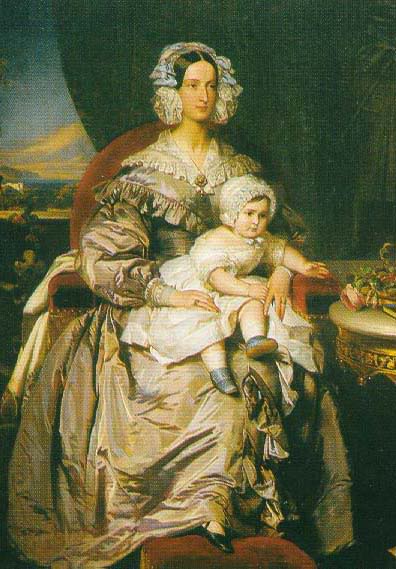
Marie d'Orléans was the beautiful, accomplished and beloved younger sister of Queen Louise of the Belgians. Born at Palermo in 1813, she was the third child of Louis-Philippe, Duc d'Orléans, and his wife, Marie-Amélie of Naples, the future King and Queen of the French.The year after Marie's birth, her family returned to Paris, only to be forced to flee to England during the Hundred Days. In 1817, they finally returned to France, dividing their time between the Palais Royal in Paris and the country estate of Neuilly. Louis-Philippe and Marie-Amélie were known for their solid domestic virtues and Marie and her nine siblings were raised in a very affectionate and close-knit family. Marie was a lively, precocious, spontaneous, independent and mischievous girl.
Marie was very close to her eldest sister, Louise. Yet, they had markedly contrasting looks and temperaments. With her blonde curls, fair skin and blue eyes, Louise was a real "golden lily of France," so to speak, while Marie was a brunette elf. From her earliest years, 'la bonne Louise' was sober, steady, disciplined, docile, gentle, retiring; Marie was vivacious, ardent, charming, witty and outgoing, but also moody, whimsical, turbulent and undisciplined. According to Louise, she had a warm, good heart, but, despite her intelligence, a "bad head," and poor judgment. Nonetheless, throughout many political and personal vicissitudes, the girls found great comfort in each other's companionship. Marie seems to have been very dependent on Louise for her emotional tranquillity, and Louise looked after Marie with almost maternal care. The sisters' relationship always reminds me of that of Elinor and Marianne Dashwood in Jane Austen's novel, Sense and Sensibility.
Along with her siblings, Marie was carefully educated. Together, Louise and Marie took lessons in history, modern languages, literature, drawing, music and horseback riding. In politics, Marie was quite liberal, influenced, in this respect, by her father and her aunt, the formidable Madame Adelaide. In religion, Marie seems to have been initially less devout than Louise, but, with time and suffering, increasingly turned to God for consolation. From a young age, Marie had a special love for art. Her favorite painter was Van Dyck, but she also admired Titian, Veronese, Michelangelo, and, among the modern artists, Gericault. She was less attracted to the Flemish primitives, finding them soulless. Marie herself eventually became a noted Romantic artist, but not before many vicissitudes. Her early attempts at drawing frustrated her teacher, Ary Scheffer, who praised her rich imagination, but criticised the quality of her lines. Rather harshly, he remarked that he was tired of "correcting broken arms and twisted legs every day." Plunged, however, into deep depression by the departure of her sister, Louise, to marry Leopold I, King of the Belgians, Marie sought comfort by throwing herself wholeheartedly into art, particularly sculpture. At seven in the morning, she would begin working in her studio, with all the windows open, dressed austerely in a cotton skirt and blouse. Under Scheffer's supervision, she developed discipline and rigor, executing a number of fine works. She drew inspiration from historical topics, and one of her favorite themes was St. Joan of Arc.
The July Revolution of 1830, which brought Marie's parents to the throne, imposed new obligations upon the young Orléans, who, like their parents, now had to fulfill the public functions of royalty. Marie hated these official duties. The revolution also meant that Marie and her siblings encountered difficulties in finding spouses. Marie's grandfather, the notorious "Philippe Egalité," who had voted for the execution of his cousin, King Louis XVI, during the first French Revolution, had already branded the Orléans with infamy. Louis-Philippe's displacement of the senior Bourbons in 1830 reinforced the family's bad reputation. European royal houses were reluctant to form alliances with people viewed as renegades. Even those who might have been willing to overlook the unfortunate events of the past were put off by the Orléans's own insecure position. After delicate negotiations, and hopes alternately raised and dashed, the 24-year-old Marie finally married Duke Alexander of Wurttemberg, a nephew of King Leopold of Belgium. A year after the wedding, in 1838, Marie gave birth to a healthy baby boy, christened Philippe.
Sadly, however, the birth shattered Marie's own health. Like Louise, Marie had always been fragile, prone to colds, coughs and dizzy spells. Her depression at the deaths of her nephew, Louise's first-born son, Louis-Philippe, in 1834, and her governess, Madame de Malet, in 1835, had further weakened her. As an additional stroke of ill-luck, a disastrous fire, erupting in the middle of the night, had forced Marie, during her pregnancy, to flee outside, scantily clad, into the snow and ice. She fell victim to tuberculosis, and, despite her travels to warmer climes and her family's hopes and prayers, she passed away in January, 1839. By then deeply religious, she bore her agony with courage, contrition, resignation, even cheerfulness. She was only 25 years old. Despite her youth, however, she declared she was dying happily, thanks to her faith. "My friends, see the power of religion," she told her loved ones,"Nemours, see it for yourself, profit by it, and tell Chartres (1)."

(1)Her second eldest brother, the Duc de Nemours, who was present, was religious, but the Duc de Chartres, the eldest, who was absent, did not share his siblings' faith.
References:
Marie-Amélie, Queen, consort of Louis-Philippe, King of the French. Journal de Marie-Amélie, Reine des Français: 1800-1866, presented by Suzanne d'Huart, 1981.
Dyson, C.C. The life of Marie Amélie last queen of the French, 1782-1866. 1910.
Kerckvoorde, Mia. Louise d'Orléans, reine oubliée. 1991. See especially Chapter XVI, "Marie, Mademoiselle de Beaujolais."
Lassère, Madeleine. Louise reine des Belges: 1812-1850. 2006.
Thursday, May 27, 2010
Le Roi Prisonnier

On Tuesday, May 28, 1940, the day of the capitulation of his army, which had taken place that very morning, King Leopold III was at Bruges, in the hotel of the provincial government of West Flanders.
It was 15:15 when General von Reichenau, Commander of the 6th Army, presented himself at the provincial palace, surrounded by a brilliant military staff and followed by numerous reporters of the German press... The General asked to be received by the Sovereign. He was coming, on Hitler's orders, to (salute) the King of the Belgians, with the mission to express to him the Führer's friendly sentiments.
The King was waiting in the great salon on the first floor, where he had been able to observe the entry of the court of honor of General von Reichenau, and his imposing suite. He sent for Major Van den Heuvel, then commander of the royal palaces, and asked him to make known to the German general that he refused all spectacular manifestations.
Major Van den Heuvel asked me to assist him in this delicate task. It was difficult to persuade the victor of the day to bend before the formal wish of the Sovereign, but, in the end, we succeeded.
After he had sent away his staff, with the legion of journalists, General von Reichenau was introduced, alone, into the great salon.
At the back of the room, standing, behind his desk, His Majesty was fixed in the rigidity of a military attitude.
After launching a vibrant "Heil Hitler," the German general approached the King, his hand outstretched. But, impressed by the cold impassivity he encountered, he halted, right in the middle of the room, although he had ten meters or so left to cross.
Then the King spoke. "I only have one question to ask General von Reichenau," he said, "what is happening to my army?"
The General remained embarrassed for a moment, then stammered : "I have no instructions in that regard, Your Majesty. But we must recognize that a conquered army is an army taken prisoner..."
The King held his peace for a long time, before declaring, with great calm: "Under these conditions, let General von Reichenau consider me his first prisoner."
The German turned white. Disconcerted, he found nothing to reply. The King let a whole minute pass, before adding, in a firm voice: "I consider that the meeting between General von Reichenau and myself is over. Gentlemen, lead the general away."
Monday, August 3, 2009
Belgium Rejects the German Ultimatum, 1914
This note has made a deep and painful impression upon the Belgian Government. The intentions attributed to France by Germany (the ultimatum had claimed that Germany was only acting to preempt an impending French invasion of Germany through Belgium) are in contradiction to the formal declarations made to us on August 1, in the name of the French Government.Moreover, if, contrary to our expectation, Belgian neutrality should be violated by France, Belgium intends to fulfil her international obligations and the Belgian army would offer the most vigorous resistance to the invader.The treaties of 1839, confirmed by the treaties of 1870 vouch for the independence and neutrality of Belgium under the guarantee of the Powers, and notably of the Government of His Majesty the King of Prussia.Belgium has always been faithful to her international obligations, she has carried out her duties in a spirit of loyal impartiality, and she has left nothing undone to maintain and enforce respect for her neutrality.The attack upon her independence with which the German Government threaten her constitutes a flagrant violation of international law. No strategic interest justifies such a violation of law.The Belgian Government, if they were to accept the proposals submitted to them, would sacrifice the honour of the nation and betray their duty towards Europe.Conscious of the part which Belgium has played for more than eighty years in the civilisation of the world, they refuse to believe that the independence of Belgium can only be preserved at the price of the violation of her neutrality.If this hope is disappointed the Belgian Government are firmly resolved to repel, by all the means in their power, every attack upon their rights.
Subscribe to:
Posts (Atom)


