
Showing posts with label artists. Show all posts
Showing posts with label artists. Show all posts
Monday, August 10, 2020


Monday, July 5, 2010
Eugène Ysaÿe

HERE is a biography of the renowned Belgian virtuoso and composer. He was a close friend and violin teacher of Queen Elisabeth. "She plays badly divinely," he once remarked. Like many artists and savants, Ysaÿe found a kindred spirit in the poetic, intellectual queen and adored her. After Ysaÿe's death, Elisabeth founded her famous musical competition in his honor. Sadly, long after the fact, there have been those who have tried to distort their friendship into something sordid.

In her memoirs, Russian sculptress Catherine Barjansky, another member of Elisabeth's artistic circle, gives a touching account of Ysaÿe:
Ysaye was as charming a person as one could meet. He was tall and large and stout, with long straight hair, beautiful features, gray-blue eyes, and great intelligence and goodness. At this time he was in his late sixties but he appeared young and he was still handsome. He was wearing a black velvet jacket, striped trousers, pumps on his feet, and he came in exuberantly, greeted my husband with shouts of delight, whirled around to talk to me about Russia, declaring that he loved it, and exclaiming, "Caviar! O ma jeunesse!"
...His hospitality was indescribable. He had always been lavish in his generosity and had never managed to hang on to any money. His house and his purse were at his friends' disposal. Only one key he clung to and that was the key to his cellar. In the midst of his dinner, he took this key from his belt and gave it to a servant with long and careful instructions, explaining the particular wine he wanted to offer us.
I asked if he would pose for me, and he agreed at once. So the next morning I came to him. He was on the second floor, in a big room with three or four windows overlooking a little garden.
"Maître," I said, "I should like to do you with your left hand holding the violin."
"Of course."
"If you want to practice, please forget I am here while I work."
At that time, Ysaye no longer appeared in concerts, but he practiced every morning, and he was in wonderful form. He lifted his violin and began to play as only he could play. It would have been perfect if I could only have found the expression I sought for my sculpture.
Then he began to play the Mendelssohn concerto and at last I found the ecstatic expression only music can give. After that, whenever he posed for me he played the Mendelssohn. And now I cannot listen to it any more. I shall never again hear it as he played it. All the warmth and generosity of his nature was in his music. For he loved all the earthy and sensual things: good food, the sun, children, beautiful women, rain, physical love (Portraits with Backgrounds, 1947, pp. 127-129).Here is a 1912 recording of Ysaÿe playing the Mendelssohn Concerto.
Monday, June 7, 2010
Suzanne Danco
Here is a biography of one of my favorite singers, the great Belgian soprano, Suzanne Danco (1911-2000). She was a protégée of the music loving Queen Elisabeth of the Belgians. (Who says monarchs are a useless burden on their peoples?)
Wednesday, June 2, 2010
Bust of Queen Elisabeth

Elisabeth Gabrielle Valerie Marie, born at Possenhoven, on July 25, 1876, daughter of HRH Charles Theodore, Duke of Bavaria(1) and HRH Marie-Josephe Beatrix, Duchess of Braganza. Married on October 2, 1900 to King Albert (then heir presumptive). We know the queen's charitable role during the war. With a sweet simplicity, she busied herself with the wounded, cared for them, comforted them, presided over the creation of field hospitals (often under very difficult conditions) and supported everyone with her valiance, her smiling kindness, her constant equanimity. Wounded in her deepest affections by the tragic death of the King and of Queen Astrid, she opposes, in a most dignified retirement, a resigned stoicism to the blows of fate.(1) His title was actually Duke in Bavaria.
Friday, May 28, 2010
Marie d'Orléans, Sister of Queen Louise
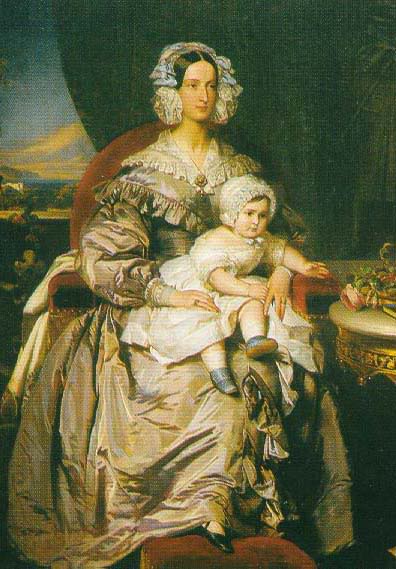
Marie d'Orléans was the beautiful, accomplished and beloved younger sister of Queen Louise of the Belgians. Born at Palermo in 1813, she was the third child of Louis-Philippe, Duc d'Orléans, and his wife, Marie-Amélie of Naples, the future King and Queen of the French.The year after Marie's birth, her family returned to Paris, only to be forced to flee to England during the Hundred Days. In 1817, they finally returned to France, dividing their time between the Palais Royal in Paris and the country estate of Neuilly. Louis-Philippe and Marie-Amélie were known for their solid domestic virtues and Marie and her nine siblings were raised in a very affectionate and close-knit family. Marie was a lively, precocious, spontaneous, independent and mischievous girl.
Marie was very close to her eldest sister, Louise. Yet, they had markedly contrasting looks and temperaments. With her blonde curls, fair skin and blue eyes, Louise was a real "golden lily of France," so to speak, while Marie was a brunette elf. From her earliest years, 'la bonne Louise' was sober, steady, disciplined, docile, gentle, retiring; Marie was vivacious, ardent, charming, witty and outgoing, but also moody, whimsical, turbulent and undisciplined. According to Louise, she had a warm, good heart, but, despite her intelligence, a "bad head," and poor judgment. Nonetheless, throughout many political and personal vicissitudes, the girls found great comfort in each other's companionship. Marie seems to have been very dependent on Louise for her emotional tranquillity, and Louise looked after Marie with almost maternal care. The sisters' relationship always reminds me of that of Elinor and Marianne Dashwood in Jane Austen's novel, Sense and Sensibility.
Along with her siblings, Marie was carefully educated. Together, Louise and Marie took lessons in history, modern languages, literature, drawing, music and horseback riding. In politics, Marie was quite liberal, influenced, in this respect, by her father and her aunt, the formidable Madame Adelaide. In religion, Marie seems to have been initially less devout than Louise, but, with time and suffering, increasingly turned to God for consolation. From a young age, Marie had a special love for art. Her favorite painter was Van Dyck, but she also admired Titian, Veronese, Michelangelo, and, among the modern artists, Gericault. She was less attracted to the Flemish primitives, finding them soulless. Marie herself eventually became a noted Romantic artist, but not before many vicissitudes. Her early attempts at drawing frustrated her teacher, Ary Scheffer, who praised her rich imagination, but criticised the quality of her lines. Rather harshly, he remarked that he was tired of "correcting broken arms and twisted legs every day." Plunged, however, into deep depression by the departure of her sister, Louise, to marry Leopold I, King of the Belgians, Marie sought comfort by throwing herself wholeheartedly into art, particularly sculpture. At seven in the morning, she would begin working in her studio, with all the windows open, dressed austerely in a cotton skirt and blouse. Under Scheffer's supervision, she developed discipline and rigor, executing a number of fine works. She drew inspiration from historical topics, and one of her favorite themes was St. Joan of Arc.
The July Revolution of 1830, which brought Marie's parents to the throne, imposed new obligations upon the young Orléans, who, like their parents, now had to fulfill the public functions of royalty. Marie hated these official duties. The revolution also meant that Marie and her siblings encountered difficulties in finding spouses. Marie's grandfather, the notorious "Philippe Egalité," who had voted for the execution of his cousin, King Louis XVI, during the first French Revolution, had already branded the Orléans with infamy. Louis-Philippe's displacement of the senior Bourbons in 1830 reinforced the family's bad reputation. European royal houses were reluctant to form alliances with people viewed as renegades. Even those who might have been willing to overlook the unfortunate events of the past were put off by the Orléans's own insecure position. After delicate negotiations, and hopes alternately raised and dashed, the 24-year-old Marie finally married Duke Alexander of Wurttemberg, a nephew of King Leopold of Belgium. A year after the wedding, in 1838, Marie gave birth to a healthy baby boy, christened Philippe.
Sadly, however, the birth shattered Marie's own health. Like Louise, Marie had always been fragile, prone to colds, coughs and dizzy spells. Her depression at the deaths of her nephew, Louise's first-born son, Louis-Philippe, in 1834, and her governess, Madame de Malet, in 1835, had further weakened her. As an additional stroke of ill-luck, a disastrous fire, erupting in the middle of the night, had forced Marie, during her pregnancy, to flee outside, scantily clad, into the snow and ice. She fell victim to tuberculosis, and, despite her travels to warmer climes and her family's hopes and prayers, she passed away in January, 1839. By then deeply religious, she bore her agony with courage, contrition, resignation, even cheerfulness. She was only 25 years old. Despite her youth, however, she declared she was dying happily, thanks to her faith. "My friends, see the power of religion," she told her loved ones,"Nemours, see it for yourself, profit by it, and tell Chartres (1)."

(1)Her second eldest brother, the Duc de Nemours, who was present, was religious, but the Duc de Chartres, the eldest, who was absent, did not share his siblings' faith.
References:
Marie-Amélie, Queen, consort of Louis-Philippe, King of the French. Journal de Marie-Amélie, Reine des Français: 1800-1866, presented by Suzanne d'Huart, 1981.
Dyson, C.C. The life of Marie Amélie last queen of the French, 1782-1866. 1910.
Kerckvoorde, Mia. Louise d'Orléans, reine oubliée. 1991. See especially Chapter XVI, "Marie, Mademoiselle de Beaujolais."
Lassère, Madeleine. Louise reine des Belges: 1812-1850. 2006.
Wednesday, May 19, 2010
Delphine Boël, Art and Scandal

Belgian Pearls, the blog of interior decorator Greet Lefèvre, is displaying some of the work of Belgian papier maché artist Delphine Boël. Delphine herself is a very pretty lady, but, despite the many rave reviews, I regret to say that I find her work hideously garish. I am sure that part of the reason for all the attention she receives is not her artistic merits but the sensation surrounding her claim to be the illegitimate daughter of Belgium's reigning king, Albert II.
I find it extremely unfortunate that Delphine not only made these public claims, but poured fuel on the flames of scandal by bitterly denouncing the King, asserting that he simply wanted to wash his hands of her and bury the embarrassing issue. If she really is his daughter, I can understand her desire for recognition, and feelings of rejection, but, at the risk of sounding harsh, there are more important things than hurt feelings. I believe that the dignity and prestige of the monarchy ought to take precedence. Even when royals have acted less than admirably, their position is deserving of respect. Not that they should be immune to criticism, but lurid scandal-mongering and vitriolic public attacks are out of place. This is all the more so in a place like Belgium, where the monarchy is so vital to the country's fragile national unity.
As for Delphine's paternity allegation in itself, I cannot say whether it is true or false. There would be nothing impossible or improbable about Albert II having a child out of wedlock. Although they were thankfully reconciled at the beginning of the 1980's, it is certainly true that the royal couple's marriage has known painful times. The King himself admitted it in his Christmas Speech, in 1999. Whether Delphine is his daughter, however, is another matter altogether, and I would like to note that her claim has never been formally verified. Therefore, the Belgian press' continued references to her as the "King's love child," as if it were a confirmed fact, are out of place. I also find it unnecessary that many chose to make such a cause celebre out of Delphine's case in particular. Leopold I, Leopold II, and Prince Charles of Belgium all had natural children, and it is hardly an extraordinary phenomenon among royalty in general.
(Image: Delphine Boël at a book-signing, by Luc van Braekel. Some rights reserved.)
Tuesday, May 11, 2010
Happier Times

I was working in the bungalow one day with the Queen when I received a telephone call from my husband, who was spending a week at Namur as the guest of the Baron Carton de Wiart, whose wife was one of the Queen's ladies in waiting. She was a violinist and extremely musical.
"You ought to come here," my husband told me. "It is divine. Why don't you ask the Queen to come with you?"
I laughed, and the Queen asked, "What is the joke?"
"Alexandre wants your majesty and me to come to Namur."
She smiled and with her light quick steps crossed the room and disappeared into the park. A few minutes later she returned, radiant, and declared, "Tomorrow morning I shall take Madame Barjansky and my violin and go to spend a day in Namur."
When I reached the palace at Laeken the next morning, there was another surprise. The King had decided to accompany us, and he was waiting in front of the palace with his blue Ford. It seems the Queen had telephoned to the baroness:
"I am going to bring Madame Barjansky and my chauffeur, and I would like to have my chauffeur join us for lunch."
"Of course, your majesty," the surprised baroness had replied.
"And I want your husband to show my chauffeur the cliffs on the Meuse River." The baroness laughed as she realised who the chauffeur was.
The King wore civilian clothes and one of the large hats made for him in Egypt. He drove extremely fast, faster than I have ever ridden before or since. As we crossed the bridge at the entrance to Namur, a detachment of soldiers was going over. They glanced at the car without recognizing the King. The Queen laughed. "Your army ignores you, my dear," she said mischievously.
The Baron Carton de Wiart owned a beautiful old castle on the bank of the Meuse, and we were very gay at luncheon. The only solemn face was that of the butler who served us.
After lunch, the King, the baron, his daughter, and a cousin of hers took a boat across the Meuse to climb the sheer chalk cliffs that bear the curious name of Marche les Dames. The Queen, the baroness, my husband, and a viola player went indoors to play quartets. It was a beautiful autumn day, and I sat down on the bank of the river with a pair of binoculars, watching the climbers on the other bank of the river. Even with these strong glasses, they were only small black silhouettes that appeared and disappeared. And I was afraid, so afraid that it amazed me to think the Queen could be playing serenely, without anxiety. Whenever any of the climbers disappeared from view my heart stopped beating.
It was all imagination, I thought. Of course there was no danger. There could not possibly be any danger. But there was danger, for six months later the King lost his life in those tragic mountains.
That afternoon we were all waiting as the mountain climbers rowed back across the river. For fun we waved a Belgian flag and sang the Brabanconne, the Belgian anthem. The baron and the girls were exhausted, tired, dirty, their clothes torn. The King was as fresh as though he were just starting. He did not even need to change his collar. Indeed, he seemed more rested than when he had started out, for mountain climbing was his favorite form of relaxation.
"Imagine!" the baron said, "He climbs a mountain the way I would walk down the street. He handled the ropes; he pulled us up; he is really amazing."
The giant King, pleased and smiling timidly, decided it was much too beautiful a day to go back to Brussels.
"We'll remain here at the castle for dinner," he decided.
At once the whole place began to stir with uneasy movement, because the King and Queen had been expected only for lunch.
It was midnight when we reached Brussels, again traveling at the same dizzy pace, and they drove me back home before going back to Laeken.
~Portraits with Backgrounds, 1947, pp. 147-149
Photograph of the Meuse in Namur, courtesy of Jean-Pol Grandmont
Friday, February 19, 2010

Wednesday, February 3, 2010
St. Nicholas' Church

Monday, October 5, 2009
Piercing Eyes

Recently, I quoted a passage from Count Sforza's memoirs, comparing and contrasting Queen Elisabeth of Belgium and her tragic aunt, Empress Sissi. Here is another excerpt from Makers of Modern Europe, describing the Queen's all too truthful artwork...
...(A) few years ago, Elisabeth discovered that she had eyes with which to see the external manifestations of life. I have never seen any one probe so searchingly as she does into the mystery- and often the horror- that a human face hides. She tried painting, and succeeded. She paints now, almost always human faces, faces of men and women in the ripe period of their life. A strange gallery it is, frequently with evident technical faults, but always with, described on each face, the deepest psychological traits that one makes even from oneself: Doctor Jekyll and Mr. Hyde. But the manner is not purposely cruel; or it is only cruel as everything true is cruel. Her technique as a painter reminds one of some early German master; just a touch of external gaucherie; a certain gray monotony of color, but with something so genuine, so seen-through. Some of her models seem sometimes as if they had forced her to paint as Hogarth drew. But one quickly realizes that there is no trace here of the caricatural overloading of Hogarth; if we feel the Hogarth touch, it is simply because of the models, as she sees them around her...
Unfortunately, I have never come across any of Elisabeth's paintings but here are a few samples of Hogarth's satirical work...

The Shrimp-Girl (1740-1745)

Hogarth's Servants (mid 1750's)
Wednesday, June 17, 2009
Peter Paul Rubens

Self-portrait with first wife, Isabella Brant
Peter Paul Rubens was the foremost Northern European painter of his day and remains one of the most beloved Flemish artists. Here is a biography, courtesy of the Peter Paul Rubens Virtual Gallery. 


Peter Paul Rubens (June 28, 1577 - May 30, 1640) was a prolific seventeenth-century Flemish Baroque painter, and a proponent of an exuberant Baroque style that emphasized movement, color, and sensuality. He is well-known for his Counter-Reformation altarpieces, portraits, landscapes, and history paintings of mythological and allegorical subjects.In addition to running a large studio in Antwerp which produced paintings popular with nobility and art collectors throughout Europe, Rubens was a classically-educated humanist scholar, art collector, and diplomat who was knighted by both Philip IV, king of Spain, and Charles I, king of England.
Rubens was born in Siegen, Westphalia, to Jan Rubens and Maria Pypelincks. His father, a Calvinist, and mother fled Antwerp for Cologne in 1568, after increased religious turmoil and persecution of Protestants during the rule of the Spanish Netherlands by the Duke of Alba. Jan Rubens became the legal advisor (and lover) to Anna of Saxony, the second wife of William I of Orange, and settled at her court in Siegen in 1570. Following imprisonment for the affair, Peter Paul Rubens was born in 1577. The family returned to Cologne the next year. In 1589, two years after his father's death, Rubens moved with his mother to Antwerp, where he was raised Catholic. Religion figured prominently in much of his work and Rubens later became one of the leading voices of the Catholic Counter-Reformation style of painting.
In Antwerp, Rubens received a humanist education, studying Latin and classical literature. By fourteen he began his artistic apprenticeship with Tobias Verhaeght. Subsequently, he studied under two of the city's leading painters of the time, the late mannerists Adam van Noort and Otto van Veen. Much of his earliest training involved copying earlier artists' works, such as woodcuts by Hans Holbein the Younger and Marcantonio Raimondi's engravings after Raphael. Rubens completed his education in 1598, at which time he entered the Guild of St. Luke as an independent master.
In 1600, Rubens traveled to Italy. He stopped first in Venice, where he saw paintings by Titian, Veronese, and Tintoretto, before settling in Mantua at the court of duke Vincenzo I of Gonzaga. The coloring and compositions of Veronese and Tintoretto had an immediate effect on Rubens's painting, and his later, mature style was profoundly influenced by Titian. With financial support from the duke, Rubens traveled to Rome by way of Florence in 1601. There, he studied classical Greek and Roman art and copied works of the Italian masters. The Hellenistic sculpture Laocoon and his Sons was especially influential on him, as was the art of Michelangelo, Raphael and Leonardo da Vinci. He was also influenced by the recent, highly naturalistic paintings by Caravaggio. He later made a copy of that artist's Entombment of Christ, recommended that his patron, the duke of Mantua, purchase The Death of the Virgin (Louvre), and was instrumental in the acquisition of The Madonna of the Rosary (Kunsthistorisches Museum, Vienna) for the Dominican church in Antwerp. During this first stay in Rome, Rubens completed his first altarpiece commission, St. Helena with the True Cross for the Roman church, Santa Croce in Gerusalemme.
Rubens traveled to Spain on a diplomatic mission in 1603, delivering gifts from the Gonzagas to the court of Philip III. While there, he viewed the extensive collections of Raphael and Titian that had been collected by Philip II. He also painted an equestrian portrait of the Duke of Lerma during his stay (Prado, Madrid) that demonstrates the influence of works like Titian's Charles V at Muhlberg (1548; Prado, Madrid). This journey marks the first of many during his career that would combine art and diplomacy.
He returned to Italy in 1604, where he remained for the next four years-first in Mantua, and then in Genoa and Rome. In Genoa, Rubens painted numerous portraits, such as the Marchesa Brigida Spinola-Doria (National Gallery of Art, Washington, D.C.), in a style that would influence later paintings by Anthony van Dyck, Joshua Reynolds, and Thomas Gainsborough. He also began a book illustrating the palaces in the city. From 1606 to 1608, he was largely in Rome. During this period Rubens received his most important commission to date for the high altar of the city's most fashionable new church, Santa Maria in Vallicella (or, Chiesa Nuova). The subject was to be St. Gregory the Great and important local saints adoring an icon of the Virgin and Child. The first version, a single canvas (Musee des Beaux-Arts, Grenoble), was immediately replaced by a second version on three slate panels that permits the actual miraculous holy image of the "Santa Maria in Vallicella" to be revealed on important feast days by a removable copper cover, also painted by the artist.
The impact of Italy on Rubens was great. Besides the artistic influences, he continued to write many of his letters and correspondences in Italian for the rest of his life, signed his name as "Pietro Paolo Rubens", and spoke longingly of returning to the peninsula-a hope that never materialized.
Upon hearing of his mother's illness in 1608, Rubens planned his departure from Italy for Antwerp. However, she died before he made it home. His return coincided with a period of renewed prosperity in the city with the signing of Treaty of Antwerp in April 1609, which initiated the Twelve Years' Truce. In September of that year Rubens was appointed court painter by Albert and Isabella, the governors of the Low Countries. He received special permission to base his studio in Antwerp, instead of at their court in Brussels, and to also work for other clients. He remained close to the Archduchess Isabella until her death in 1633, and was called upon not only as a painter but also as an ambassador and diplomat. Rubens further cemented his ties to the city when, on October 3, 1609, he married Isabella Brant, the daughter of a leading Antwerp citizen and humanist Jan Brant.
In 1610, Rubens moved into a new house and studio that he designed. Now the Rubenshuis museum, the Italian-influenced villa in the center of Antwerp contained his workshop, where he and his apprentices made most of the paintings, and his personal art collection and library, both among the most extensive in Antwerp. During this time he built up a studio with numerous students and assistants. His most famous pupil was the young Anthony van Dyck, who soon became the leading Flemish portraitist and collaborated frequently with Rubens. He also frequently collaborated with the many specialists active in the city, including the animal painter Frans Snyders, who contributed to the eagle to Prometheus Bound and his good friend the flower-painter Jan Brueghel the Elder.
Altarpieces such as The Raising of the Cross (1610) and The Descent from the Cross (1611-1614) for the Cathedral of Our Lady were particularly important in establishing Rubens as Flanders' leading painter shortly after his return. The Raising of the Cross, for example, demonstrates the artist's synthesis of Tintoretto's Crucifixion for the Scuola di San Rocco in Venice, Michelangelo's dynamic figures, and Rubens's own personal style. This painting has been held as a prime example of Baroque religious art.
Rubens used the production of prints and book title-pages, especially for his friend Balthasar Moretus-owner of the large Plantin-Moretus publishing house to further extend his fame throughout Europe during this part of his career. With the exception of a couple of brilliant etchings, he only produced drawings for these himself, leaving the printmaking to specialists, such as Lucas Vorsterman. He recruited a number of engravers trained by Goltzius, who he carefully schooled in the more vigorous style he wanted. He also designed the last significant woodcuts before the 19th century revival in the technique. Rubens established copyright for his prints. Most significantly in Holland, where his work was widely copied through print. In addition he established copyrights for his work in England, France and Spain.
In 1621, the queen-mother of France, Marie de' Medici, commissioned Rubens to paint two large allegorical cycles celebrating her life and the life of her late husband, Henry IV, for the Luxembourg Palace in Paris. The Marie de' Medici cycle (now in the Louvre) was installed in 1625, and although he began work on the second series it was never completed. Marie was exiled from France in 1630 by her son, Louis XIII, and died in 1642 in the same house in Cologne where Rubens had lived as a child.
After the end of the Twelve Years' Truce in 1621, the Spanish Habsburg rulers entrusted Rubens with a number of diplomatic missions. Between 1627 and 1630, Rubens's diplomatic career was particularly active, and he moved between the courts of Spain and England in an attempt to bring peace between the Spanish Netherlands and the United Provinces. He also made several trips to the Northern Netherlands as both an artist and a diplomat. At the courts he sometimes encountered the attitude that courtiers should not use their hands in any art or trade, but he was also received as a gentleman by many. It was during this period that Rubens was twice knighted, first by Philip IV of Spain in 1624, and then by Charles I of England in 1630. He was awarded an honorary Master of Arts degree from Cambridge University in 1629.
Rubens was in Madrid for eight months in 1628-1629. In addition to diplomatic negotiations, he executed several important works for Philip IV and private patrons. He also began a renewed study of Titian's paintings, copying numerous works including the Madrid Fall of Man (1628-29). During this stay, he befriended the court painter Diego Velazquez. The two planned to travel to Italy together the following year. Rubens, however, returned to Antwerp and Velazquez made the journey without him.
His stay in Antwerp was brief, and he soon traveled on to London. Rubens stayed there until April, 1630. An important work from this period is the Allegory of Peace and War (1629; National Gallery, London). It illustrates the artist's strong concern for peace, and was given to Charles I as a gift.
While Rubens's international reputation with collectors and nobility abroad continued to grow during this decade, he and his workshop also continued to paint monumental paintings for local patrons in Antwerp. The Assumption of the Virgin Mary (1625-6) for the Cathedral of Antwerp is one prominent example.
Rubens's last decade was spent in and around Antwerp. Major works for foreign patrons still occupied him, such as the ceiling paintings for the Banqueting House at Inigo Jones's Palace of Whitehall, but he also explored more personal artistic directions.
In 1630, four years after the death of his first wife, the 53-year-old painter married 16-year-old Helene Fourment. Helene inspired the voluptuous figures in many of his paintings from the 1630s, including The Feast of Venus (Kunsthistorisches Museum, Vienna), The Three Graces (Prado, Madrid) and The Judgment of Paris (Prado, Madrid). In the latter painting, which was made for the Spanish court, the artist's young wife was recognized by viewers in the figure of Venus. In an intimate portrait of her, Helene Fourment in a Fur Wrap, also known as Het Pelsken, Rubens's wife is even partially modeled after classical sculptures of the Venus Pudica, such as the Medici Venus.
In 1635, Rubens bought an estate outside of Antwerp, the Chateau de Steen (Het Steen), where he spent much of his time. Landscapes, such as his Chateau de Steen with Hunter (National Gallery, London) and Farmers Returning from the Fields (Pitti Gallery, Florence), reflect the more personal nature of many of his later works. He also drew upon the Netherlandish traditions of Pieter Bruegel the Elder for inspiration in later works like Flemish Kermis (c. 1630; Louvre, Paris). Rubens died from gout on May 30, 1640. He was interred in Saint Jacob's church, Antwerp. The artist had eight children, three with Isabella and five with Helene; his youngest child was born eight months after his death.

Portrait of Anne of Austria

Interior of a barn in winter

Albert & Isabella with their patron saints; in the middle, Our Lady appears to St. Ildefonso
Wednesday, February 25, 2009
Mary Magdalen
 A painting of St. Mary Magdalen by Rogier van der Weyden, from the right panel of the Braque Family Triptych (1450).
Subscribe to:
Posts (Atom)


