Friday, May 28, 2010

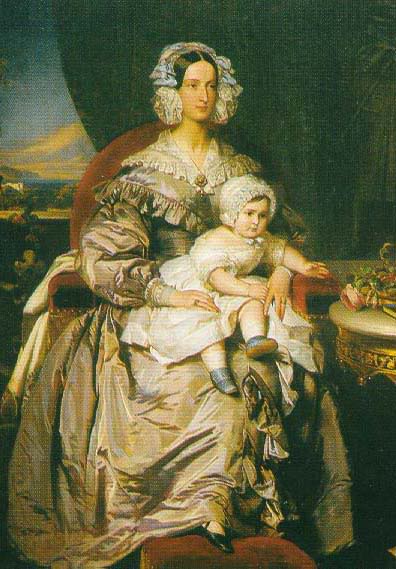
Marie d'Orléans, Sister of Queen Louise

Marie d'Orléans was the beautiful, accomplished and beloved younger sister of Queen Louise of the Belgians. Born at Palermo in 1813, she was the third child of Louis-Philippe, Duc d'Orléans, and his wife, Marie-Amélie of Naples, the future King and Queen of the French.The year after Marie's birth, her family returned to Paris, only to be forced to flee to England during the Hundred Days. In 1817, they finally returned to France, dividing their time between the Palais Royal in Paris and the country estate of Neuilly. Louis-Philippe and Marie-Amélie were known for their solid domestic virtues and Marie and her nine siblings were raised in a very affectionate and close-knit family. Marie was a lively, precocious, spontaneous, independent and mischievous girl.

Marie was very close to her eldest sister, LouiseYet, they had markedly contrasting looks and temperaments. With her blonde curls, fair skin and blue eyes, Louise was a real "golden lily of France," so to speak, while Marie was a brunette elf. From her earliest years, 'la bonne Louise' was sober, steady, disciplined, docile, gentle, retiring; Marie was vivacious, ardent, charming, witty and outgoing, but also moody, whimsical, turbulent and undisciplined. According to Louise, she had a warm, good heart, but, despite her intelligence, a "bad head," and poor judgment. Nonetheless, throughout many political and personal vicissitudes, the girls found great comfort in each other's companionship. Marie seems to have been very dependent on Louise for her emotional tranquillity, and Louise looked after Marie with almost maternal care. The sisters' relationship always reminds me of that of Elinor and Marianne Dashwood in Jane Austen's novel, Sense and Sensibility.

Along with her siblings, Marie was carefully educated. Together, Louise and Marie took lessons in history, modern languages, literature, drawing, music and horseback riding. In politics, Marie was quite liberal, influenced, in this respect, by her father and her aunt, the formidable Madame Adelaide. In religion, Marie seems to have been initially less devout than Louise, but, with time and suffering, increasingly turned to God for consolation. From a young age, Marie had a special love for art. Her favorite painter was Van Dyck, but she also admired Titian, Veronese, Michelangelo, and, among the modern artists, Gericault. She was less attracted to the Flemish primitives, finding them soulless. Marie herself eventually became a noted Romantic artist, but not before many vicissitudes. Her early attempts at drawing frustrated her teacher, Ary Scheffer, who praised her rich imagination, but criticised the quality of her lines. Rather harshly, he remarked that he was tired of "correcting broken arms and twisted legs every day." Plunged, however, into deep depression by the departure of her sister, Louise, to marry Leopold I, King of the Belgians, Marie sought comfort by throwing herself wholeheartedly into art, particularly sculpture. At seven in the morning, she would begin working in her studio, with all the windows open, dressed austerely in a cotton skirt and blouse. Under Scheffer's supervision, she developed discipline and rigor, executing a number of fine works. She drew inspiration from historical topics, and one of her favorite themes was St. Joan of Arc.

The July Revolution of 1830, which brought Marie's parents to the throne, imposed new obligations upon the young Orléans, who, like their parents, now had to fulfill the public functions of royalty. Marie hated these official duties. The revolution also meant that Marie and her siblings encountered difficulties in finding spouses. Marie's grandfather, the notorious "Philippe Egalité," who had voted for the execution of his cousin, King Louis XVI, during the first French Revolution, had already branded the Orléans with infamy. Louis-Philippe's displacement of the senior Bourbons in 1830 reinforced the family's bad reputation. European royal houses were reluctant to form alliances with people viewed as renegades. Even those who might have been willing to overlook the unfortunate events of the past were put off by the Orléans's own insecure position. After delicate negotiations, and hopes alternately raised and dashed, the 24-year-old Marie finally married Duke Alexander of Wurttemberg, a nephew of King Leopold of Belgium. A year after the wedding, in 1838, Marie gave birth to a healthy baby boy, christened Philippe.

Sadly, however, the birth shattered Marie's own health. Like Louise, Marie had always been fragile, prone to colds, coughs and dizzy spells. Her depression at the deaths of her nephew, Louise's first-born son, Louis-Philippe, in 1834, and her governess, Madame de Malet, in 1835, had further weakened her. As an additional stroke of ill-luck, a disastrous fire, erupting in the middle of the night, had forced Marie, during her pregnancy, to flee outside, scantily clad, into the snow and ice. She fell victim to tuberculosis, and, despite her travels to warmer climes and her family's hopes and prayers, she passed away in January, 1839. By then deeply religious, she bore her agony with courage, contrition, resignation, even cheerfulness. She was only 25 years old. Despite her youth, however, she declared she was dying happily, thanks to her faith. "My friends, see the power of religion," she told her loved ones,"Nemours, see it for yourself, profit by it, and tell Chartres (1)."
(1)Her second eldest brother, the Duc de Nemours, who was present, was religious, but the Duc de Chartres, the eldest, who was absent, did not share his siblings' faith.

References:

Marie-Amélie, Queen, consort of Louis-Philippe, King of the French. Journal de Marie-Amélie, Reine des Français: 1800-1866, presented by Suzanne d'Huart, 1981.
Dyson, C.C. The life of Marie Amélie last queen of the French, 1782-1866. 1910.
Kerckvoorde, Mia. Louise d'Orléans, reine oubliée. 1991. See especially Chapter XVI, "Marie, Mademoiselle de Beaujolais."
Lassère, Madeleine. Louise reine des Belges: 1812-1850. 2006.

Thursday, May 27, 2010

Le Roi Prisonnier

A few weeks ago, I provided some links to earlier posts on the tragic events of May, 1940, which spelled disaster for Belgium and King Leopold III. Here is an account of Leopold's interview with the victorious German general, shortly after the capitulation of the Belgian army. The original is in French; the translation is mine. The account, by Hubert Rumbouts, a Belgian officer who witnessed the meeting, is drawn from Col. Remy's Le 18ième Jour (1976). This is one of those scenes where you might be hard pressed to tell victor from vanquished...

On Tuesday, May 28, 1940, the day of the capitulation of his army, which had taken place that very morning, King Leopold III was at Bruges, in the hotel of the provincial government of West Flanders.

It was 15:15 when General von Reichenau, Commander of the 6th Army, presented himself at the provincial palace, surrounded by a brilliant military staff and followed by numerous reporters of the German press... The General asked to be received by the Sovereign. He was coming, on Hitler's orders, to (salute) the King of the Belgians, with the mission to express to him the Führer's friendly sentiments.

The King was waiting in the great salon on the first floor, where he had been able to observe the entry of the court of honor of General von Reichenau, and his imposing suite. He sent for Major Van den Heuvel, then commander of the royal palaces, and asked him to make known to the German general that he refused all spectacular manifestations.

Major Van den Heuvel asked me to assist him in this delicate task. It was difficult to persuade the victor of the day to bend before the formal wish of the Sovereign, but, in the end, we succeeded.

After he had sent away his staff, with the legion of journalists, General von Reichenau was introduced, alone, into the great salon.

At the back of the room, standing, behind his desk, His Majesty was fixed in the rigidity of a military attitude.

After launching a vibrant "Heil Hitler," the German general approached the King, his hand outstretched. But, impressed by the cold impassivity he encountered, he halted, right in the middle of the room, although he had ten meters or so left to cross.

Then the King spoke. "I only have one question to ask General von Reichenau," he said, "what is happening to my army?"

The General remained embarrassed for a moment, then stammered : "I have no instructions in that regard, Your Majesty. But we must recognize that a conquered army is an army taken prisoner..."

The King held his peace for a long time, before declaring, with great calm: "Under these conditions, let General von Reichenau consider me his first prisoner."

The German turned white. Disconcerted, he found nothing to reply. The King let a whole minute pass, before adding, in a firm voice: "I consider that the meeting between General von Reichenau and myself is over. Gentlemen, lead the general away."

Wednesday, May 26, 2010

Carlota's Youth

In The Life of Maximilian I, late emperor of Mexico (1868), Frederic Hall provides a touching account of the youth and education of the unfortunate Empress Carlota, born Princess Charlotte of Belgium. How sad that Queen Louise-Marie never saw her lovely daughter mature into adulthood! How sad, too, that Carlota never knew the joy of being a mother herself.

Carlota was born at the palace of Laeken, which is about fifteen miles from Brussels, on the 7th of June, 1840; and never passed over six months of her life in France, although she is called French. The French tongue is her vernacular.

Nearly eighteen years ago, the promenaders that sauntered through the public park of Brussels, frequently observed a charming and attractive little girl, the picture of beauty and loveliness, accompanied by her two little brothers, a preceptor, and governess. She was plainly dressed, wearing a broad-brim straw hat, a short dress, and white pantalettes; and under her coiffure, on each side, could be seen her neatly braided hair. That her appearance of beauty and innocence should not be lost to memory, the skill of the artist was brought into requisition, and her portrait, as she was then dressed, was taken; which may now be seen in one of the private apartments of the palace of Brussels. She was usually then seen, when promenading, with a little hoop in her hand, which she never rolled. The little bright-eyed and rosy-cheeked girl wishfully looked upon the various groups of children which she chanced to meet, anxious to join them in their innocent pleasures. But, no, that was not allowed,— the governess said, No. She then doubtless wished that she had no teacher to control her, as she saw no good reason why the freedom of others should not be allowed to her. Her little party never seemed to stop nor run, but gravely walked on with a measured tread.

The former part of the life of those children was not a gay one. At home, in the palace, during the lifetime of their mother, they were taught to pray, and all the principles of religion which their youthful minds were capable of receiving, were instilled into them. The days of reception were not play-days to those youths;—the lessons of Christianity were dispensed with, only to let those of etiquette be given in their stead. As visitors entered, they found the little princess by her mother's side; and as salutations were given and received, the bright-eyed daughter did not fail to act her part. The rank and dignity of the different personages were soon known to her, and the respective salutations due to each.

The young princess never seemed to have a playmate of her own age. She saw no one around her save the ladies of honor, whom her father had chosen for her mother. Their conversation was principally upon religious topics, or matters of importance. And yet with all the apparent severity and strictness of her mother, the princess was the object of that parent's deepest affection, who doted upon and idolized that daughter. It was the Christian virtue, the honest pride of that good mother's heart, that caused her to watch with a jealous care every act and word of that young and tender heart, that was destined to attract the world. But while that young princess was in the bud of life, the genial rays of that mother's affectionate heart ceased to shed their holy influence over her. She saw that mother on the couch of death, and heard her last affectionate farewell, which fell upon her ear like the music of a sad dream, mournfully sounding, long after that Spirit of Love had entered the heavenly portal. After that sad bereavement, the broken-hearted princess lived as it were alone in the midst of the ladies of honor.


It was quite observable, that from the age of eleven to fifteen she was less child-like in her manners and conversation than most children of that age, even including those of royalty. It must be attributed to her continual companionship with those of maturer years. She always possessed a marked gravity and dignity even in the ballroom. At the age of sixteen she was allowed to attend balls; but only four times a year, when they were given by the king in the winter season. None but those of royal blood were honored with her company in the dance; and none were permitted to embrace her in the waltz but her brothers. And while she gazed upon others that whirled in the round dances, it was apparently with indifference; and as they glided briskly in the circle, she promenaded in a dignified manner, yet with a pleasing air.

She was fine-looking—her stature tall, majestic, not haughty, graceful in her carriage; and with her air of majesty there was mingled a gentleness and mildness of disposition that won and attracted all who chanced to meet her. Her face is oval; complexion bright, and readily flushed; her nose is a little aquiline; her mouth is pretty, and beneath her rosy lips is a set of regular pearl-white teeth; her eyes are not large, but very bright, and when she becomes excited, they flash like fire. She has a heavy head of hair, of a beautiful dark auburn shade. Nature formed her for an empress, and her acquirements not less fitted her for the station. As she rose above the horizon of childhood, she appeared in all the splendor of the morning star, bright, beautiful...


She inherited the talents of her father. Her mind was deep, and exceedingly well cultivated. If her native powers were not more than ordinary, it would be remarkable, since her father and mother were both of superior intellect. At an early age she was placed in the presence of the ministers of State, while matters of importance were discussed; and therefore her opportunities for forming her judgment and training her logical powers of thought, were more than those usually allotted to princesses,—of which she gave conclusive proof in after years. She spoke and wrote, with great perfection, the French, Spanish, German, English, and Italian languages. As has been before observed, she was married in the year 1857, being then of the age of seventeen years. She never became a mother
(pp. 35-39).

Monday, May 24, 2010

A Tragic Empress

A while back, I linked to a short biography, by the Mad Monarchist, of Empress Carlota of Mexico, only daughter of King Leopold I and Queen Louise-Marie of the Belgians. Recently, I was delighted to see that he has been writing a longer series on this beautiful, brilliant, charitable, idealistic, but tragically doomed royal lady:

Sunday, May 23, 2010

Pentecost


Today the Church celebrates the Feast of Pentecost, commemorating the Descent of the Holy Ghost upon the Apostles, fifty days after the Resurrection of Christ.

And when the days of the Pentecost were accomplished, they were all together in one place. And suddenly there came a sound from heaven, as of a mighty wind coming, and it filled the whole house where they were sitting. And there appeared to them parted tongues as it were of fire, and it sat upon every one of them. And they were all filled with the Holy Ghost, and began to speak with divers tongues, according as the Holy Ghost game them to speak. Now there were dwelling at Jerusalem, Jews, devout men, out of every nation under heaven. 

And when this was noised abroad, the multitude came together, and were confounded in mind, because every man heard them speak in his own tongue. And they were all amazed, and wondered, saying: Behold, are not all these, that speak, Galileans? And how have we heard, every man our own tongue wherein we were born? ...

...And they were all astonished, and wondered, saying to one another: What meaneth this? But others mocking, said: These men are full of new wine. But Peter standing up with the eleven, lifted up his voice, and spoke to them: Ye men of Judea, and all you that dwell in Jerusalem, be this known to you, and with your ears receive my words. For these are not drunk, as you suppose, seeing it is but the third hour of the day.

But this is that which was spoken of by the prophet Joel: And it shall come to pass, in the last days (saith the Lord), I will pour out my spirit upon all flesh, and your sons and your daughters shall prophesy, and your young men shall see visions, and your old men shall dream dreams. And upon my servants indeed, and upon my handmaids will I pour out in those days of my spirit, and they shall prophesy. And I will shew wonders in the heaven above, and signs on the earth beneath: blood and fire, and vapor of smoke. The sun shall be turned into darkness, and the moon into blood, before the great and manifest day of the Lord shall come. 

And it shall come to pass, that whosoever shall call upon the name of the Lord, shall be saved. Ye men of Israel, hear these words: Jesus of Nazareth, a man approved of God among you, by miracles, and wonders, and signs, which God didst in the midst of you, as you also know: This same being delivered up, by the determinate counsel and foreknowledge of God, you by the hands of wicked men have crucified and slain. Whom God hath raised up, having loosed the sorrows of hell, as it was impossible that he should be holden by it. For David saith concerning him: I foresaw the Lord before my face, because he is at my right hand, that I may not be moved.

For this my heart hath been glad, and my tongue hath rejoiced, moreover my flesh also shall rest in hope. Because thou wilt not leave my soul in hell, nor suffer thy Holy One to see corruption. Thou hast made known to me the ways of life: thou shalt make me full of joy with thy countenance. Ye men, brethren, let me freely speak to you of the patriarch David; that he died, and was buried; and his sepulchre is with us to the present day. Whereas therefore he was a prophet, and knew that God had sworn to him an oath, that of the fruit of his loins one should sit upon his throne.

Foreseeing this, he spoke of the resurrection of Christ. For neither was he left in hell, neither did his flesh see corruption. This Jesus hath God raised again, whereof all we are witnesses. Being exalted therefore by the right hand of God, and having received of the Father the promise of the Holy Ghost, he hath poured forth this which you see and hear...

Therefore let all the house of Israel know most certainly, that God hath made both Lord and Christ, this same Jesus, whom you have crucified. Now when they had heard these things, they had compunction in their heart, and said to Peter, and to the rest of the apostles: What shall we do, men and brethren? But Peter said to them: Do penance, and be baptized every one of you in the name of Jesus Christ, for the remission of your sins, and you shall receive the gift of the Holy Ghost...

They therefore that received his word, were baptized; and there were added in that day about three thousand souls. And they were persevering in the doctrine of the apostles, and in the communication of the breaking of bread, and in prayers. And fear came upon every soul, and many wonders and signs were done by the apostles in Jerusalem, and there was great fear in all...

And continuing daily with one accord...and breaking bread from house to house, they took their meat in gladness and simplicity of heart; praising God, and having favor with all the people. And the Lord increased daily together such as should be saved. 

(The Acts of the Apostles, ch. 2, Douay-Rheims Bible)

The Tragedy of Albert and Astrid

I knew the story all too well, of course, but still loved reading this very moving and beautifully written account of the tragic deaths of King Albert I and Queen Astrid. (Yes, how is it that one can enjoy something so sad?). The article, dating from 1939, is also interesting in illustrating the good reputation Leopold III enjoyed before World War II. The author dwells with sympathy on Leopold's sufferings and the nobility with which he bore the devastating double loss of his father and his wife: "History will keep a sad yet gallant page for Leopold III, King of the Belgians." How ironic to think that, only a year later, this same Leopold would be calumniated and reviled throughout the world as a coward, traitor and felon. Sic gloria transit mundi. RIP King Albert I, Queen Astrid, King Leopold III.

Friday, May 21, 2010

The Belgian Queens

A tribute to the six women who have served as Belgium's queen consorts:
  • Louise-Marie of Orléans (1812-1850)
  • Marie-Henriette of Austria (1836-1902)
  • Elisabeth of Bavaria (1876-1965)
  • Astrid of Sweden (1905-1935)
  • Fabiola de Mora y Aragón (1928-present)
  • Paola Ruffo di Calabria (1937-present)

Wednesday, May 19, 2010

Delphine Boël, Art and Scandal

Belgian Pearls, the blog of interior decorator Greet Lefèvre, is displaying some of the work of Belgian papier maché artist Delphine Boël. Delphine herself is a very pretty lady, but, despite the many rave reviews, I regret to say that I find her work hideously garish. I am sure that part of the reason for all the attention she receives is not her artistic merits but the sensation surrounding her claim to be the illegitimate daughter of Belgium's reigning king, Albert II.

I find it extremely unfortunate that Delphine not only made these public claims, but poured fuel on the flames of scandal by bitterly denouncing the King, asserting that he simply wanted to wash his hands of her and bury the embarrassing issue. If she really is his daughter, I can understand her desire for recognition, and feelings of rejection, but, at the risk of sounding harsh, there are more important things than hurt feelings. I believe that the dignity and prestige of the monarchy ought to take precedence. Even when royals have acted less than admirably, their position is deserving of respect. Not that they should be immune to criticism, but lurid scandal-mongering and vitriolic public attacks are out of place. This is all the more so in a place like Belgium, where the monarchy is so vital to the country's fragile national unity.

As for Delphine's paternity allegation in itself, I cannot say whether it is true or false. There would be nothing impossible or improbable about Albert II having a child out of wedlock. Although they were thankfully reconciled at the beginning of the 1980's, it is certainly true that the royal couple's marriage has known painful times. The King himself admitted it in his Christmas Speech, in 1999. Whether Delphine is his daughter, however, is another matter altogether, and I would like to note that her claim has never been formally verified. Therefore, the Belgian press' continued references to her as the "King's love child," as if it were a confirmed fact, are out of place. I also find it unnecessary that many chose to make such a cause celebre out of Delphine's case in particular. Leopold I, Leopold II, and Prince Charles of Belgium all had natural children, and it is hardly an extraordinary phenomenon among royalty in general.

(Image: Delphine Boël at a book-signing, by Luc van Braekel. Some rights reserved.)

Comments

The comment feature on this blog seems to be behaving erratically- someone's comment unfortunately disappeared altogether when I tried to click on the dashboard link for comment review. This was happening the other day at The Sword & The Sea, too. I hope the issue is resolved soon. My apologies for the inconvenience.

(Update: alas, this happened again. I checked on the "Known Issues" page of Blogger Help and apparently it is a general issue. I hope the comments people have tried to leave are not lost, so that I will be able to moderate them after the problem is fixed).

"She Walks in Beauty"

In a stirring article, quite poetic in itself, on the sorrows of Leopold III, Michael Geelan, to describe Queen Astrid, cites the opening lines of Lord Byron's "She Walks in Beauty" (1814). Intrigued, I looked up the quote and decided the whole poem suited Astrid perfectly:

She walks in beauty, like the night
Of cloudless climes and starry skies;
And all that's best of dark and bright
Meet in her aspect and her eyes :
Thus mellow'd to that tender light
Which heaven to gaudy day denies.

One shade the more, one ray the less,
Had half impaired the nameless grace
Which waves in every raven tress,
Or softly lightens o'er her face;
Where thoughts serenely sweet express
How pure, how dear their dwelling-place.

And on that cheek, and o'er that brow,
So soft, so calm, yet eloquent,
The smiles that win, the tints that glow,
But tell of days in goodness spent,
A mind at peace with all below,
A heart whose love is innocent!